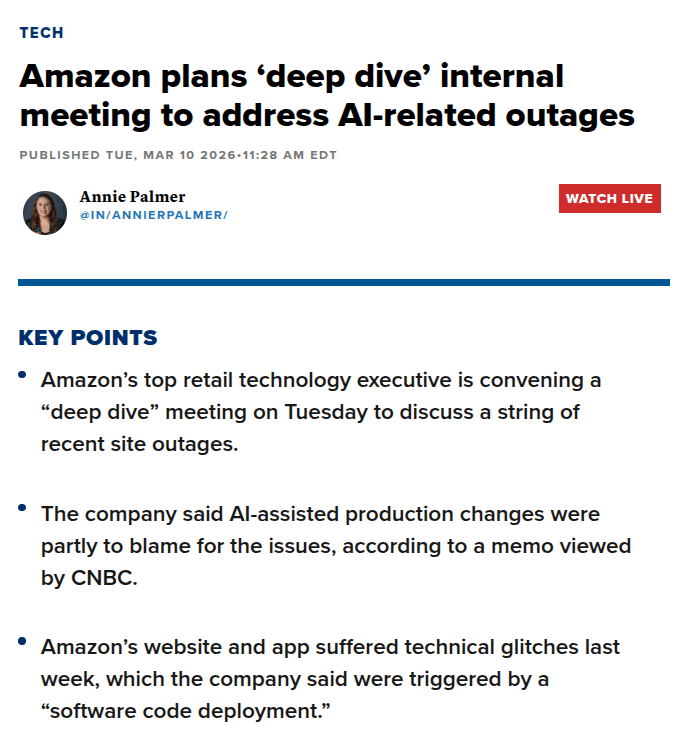
Amazon is holding an emergency meeting on March 26 to address a series of website crashes caused by errors introduced through AI-assisted coding tools, according to reports from CNBC and industry analysts. The e-commerce giant experienced four major outages in a single week after generative AI tools suggested unsafe software changes that compromised critical systems.
The Outage Crisis
The incidents reached "Sev 1" status—the highest level of technical emergency at Amazon—meaning critical customer-facing features like the checkout button completely failed. These outages represent one of the most significant public failures of AI-assisted development in a major technology company, highlighting the risks when artificial intelligence tools are integrated into core engineering workflows without adequate safeguards.
According to the reports, the trouble began when Amazon engineers used generative AI tools to accelerate their coding processes. While these tools promised increased productivity and faster development cycles, they apparently introduced errors that weren't caught by existing quality assurance processes, leading to system-wide failures.
Amazon's Response Strategy
In response to the crisis, Amazon is implementing immediate measures to prevent future incidents. The company is now requiring senior engineers to manually review any code changes made by AI assistants—a significant shift from the automated workflows that initially caused the problems. This represents a partial retreat from fully automated AI coding assistance toward a more supervised hybrid approach.
Additionally, Amazon is investing in what it calls "agentic safeguards"—AI systems designed to act as "digital hall monitors" that can catch errors before they cause operational problems. These secondary AI systems would presumably analyze code suggestions from primary AI coding assistants and flag potential issues before implementation.
The emergency meeting scheduled for March 26 will bring together engineering leadership, AI researchers, and operational teams to establish clearer guidelines for how these powerful AI tools should be safely integrated into daily work. Amazon has acknowledged that they are still determining the optimal rules and protocols for generative AI usage in their development pipelines.
Broader Industry Implications
This incident at Amazon represents a watershed moment for the AI-assisted development industry. As companies increasingly adopt tools like GitHub Copilot, Amazon CodeWhisperer (Amazon's own AI coding assistant), and various other generative coding solutions, the Amazon outages demonstrate that productivity gains come with substantial operational risks.
The situation highlights several critical challenges in enterprise AI adoption:
- Quality Assurance Gaps: Traditional testing and review processes may be inadequate for catching subtle errors introduced by AI systems
- Responsibility Attribution: Determining accountability when AI-generated code causes failures
- Speed vs. Safety Tradeoffs: Balancing the desire for rapid development against system stability requirements
- Human Oversight Requirements: Determining the appropriate level of human review for AI-generated content
The Future of AI-Assisted Development
Amazon's experience suggests that the industry may need to develop new frameworks for AI-assisted coding that prioritize safety alongside productivity. This could include:
- More sophisticated validation systems specifically designed for AI-generated code
- Staged rollout protocols for AI-assisted changes
- Enhanced training for engineers working with AI coding tools
- Industry standards for AI coding safety and reliability
The company's investment in "agentic safeguards" points toward a future where multiple AI systems work in concert—with some focused on creation and others on validation—creating a checks-and-balances approach to AI-assisted development.
Conclusion
Amazon's emergency response to AI-induced outages serves as a cautionary tale for the entire technology industry. As generative AI tools become increasingly integrated into software development workflows, companies must develop robust safety protocols alongside their productivity enhancements. The March 26 meeting represents not just a crisis response for Amazon, but potentially a turning point in how major technology companies approach AI-assisted engineering.
The incident underscores that while AI tools can dramatically accelerate development, they also introduce new failure modes that require novel solutions. How Amazon and other companies address these challenges will shape the future of software development in the AI era.
Source: CNBC report on Amazon's planned internal meeting to address AI-related outages, along with analysis from industry experts.