Skip to content
gentic.news — AI News Intelligence Platform
Connecting to the Living Graph…

Listen to today's AI briefing

Daily podcast — 5 min, AI-narrated summary of top stories

Andrew Ng holding a printed 12-page playbook, with diagrams of interconnected nodes and arrows representing…
AI ResearchScore: 87

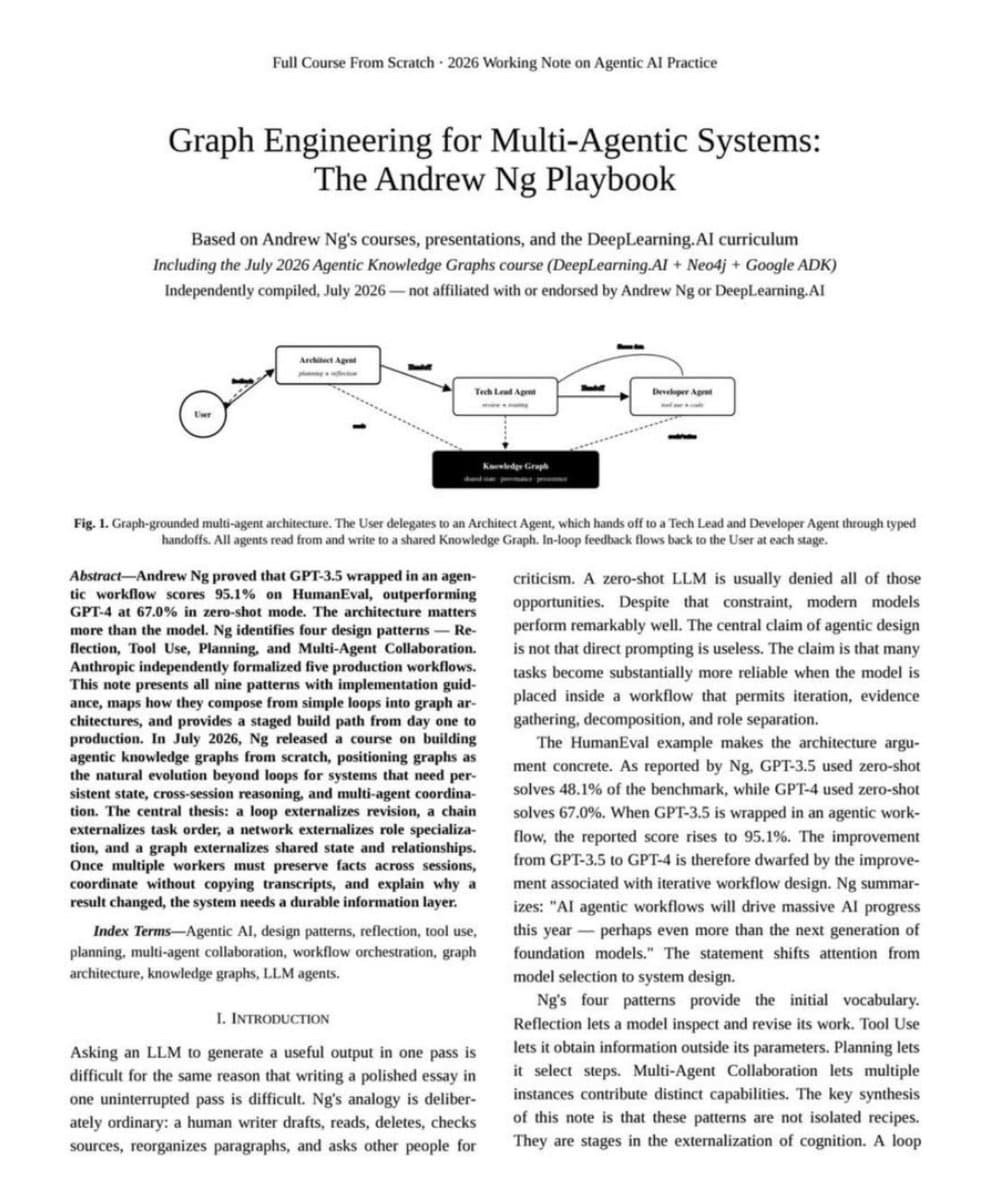
Andrew Ng Publishes 12-Page Graph Engineering Playbook for Multi-Agent AI

Andrew Ng published a 12-page playbook on graph engineering for multi-agent systems. The document shifts focus to interaction topology as a key design parameter.

·1d ago·3 min read··40 views·AI-Generated·Report error
Share:
What is in Andrew Ng's new playbook on Graph Engineering for Multi-Agent Systems?

Andrew Ng published a 12-page playbook titled 'Graph Engineering for Multi-Agent Systems' via his X account. The document provides practical guidance on designing interaction topologies between AI agents, covering orchestration patterns, communication protocols, and scalability considerations for production multi-agent deployments.

TL;DR

Andrew Ng released a 12-page playbook on graph engineering · Focuses on multi-agent system design and coordination · Practical guidance for structuring agent communication topologies

Andrew Ng released a 12-page playbook on Graph Engineering for Multi-Agent Systems, announced via X. The document shifts focus from individual agent quality to the interaction topology that binds them.

Key facts

  • 12-page playbook on Graph Engineering for Multi-Agent Systems
  • Published by Andrew Ng via X on an unspecified date
  • Source post contains no excerpts or benchmark data
  • Focuses on interaction topology as a design parameter
  • Targets production multi-agent system builders

Andrew Ng published a 12-page playbook titled 'Graph Engineering for Multi-Agent Systems' via his X account. The announcement came as a single post with a link, offering no accompanying commentary on the content or intended audience According to @_vmlops.

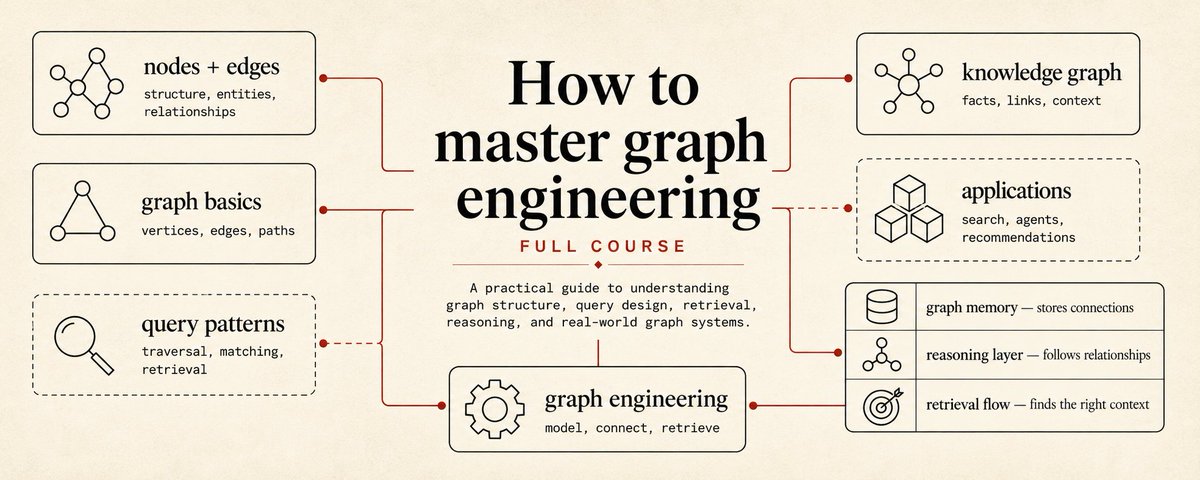
The document addresses the structural challenge of how agents communicate, delegate, and share state. Graph engineering treats the interaction topology as a first-class design parameter, moving beyond the common practice of treating multi-agent systems as an undifferentiated swarm. The playbook reportedly covers patterns for defining node roles, edge types, and information flow between specialized agents.

Key Takeaways

  • Andrew Ng published a 12-page playbook on graph engineering for multi-agent systems.
  • The document shifts focus to interaction topology as a key design parameter.

Why topology matters more than agent count

The timing is notable. As multi-agent frameworks mature, teams are discovering that naive approaches—broadcasting every message to every agent—collapse under context-window pressure and token costs. Ng's playbook appears to respond to that operational reality, offering guidance on structuring graphs to minimize redundant communication and preserve coherence across long-running tasks.

The playbook emphasizes that agent count alone does not determine system capability. The shape of the graph—whether star, mesh, or hierarchical—directly influences latency, error propagation, and debuggability. Ng's guidance targets engineers building production systems, not just research prototypes.

Practical implications for system design
Andrew Ng: “AI agents are doing almost 100% of my tasks now ...

For engineers, the immediate takeaway is that graph design deserves the same rigor as model selection or prompt engineering. The playbook likely includes concrete heuristics for when to use centralized orchestrators versus peer-to-peer delegation, and how to partition state across agents to avoid bottlenecks.

The source post provides no technical excerpts, benchmark data, or code samples. The 12-page length suggests depth, but the absence of released figures means the specific recommendations remain unverified until the full document circulates.

What to watch

Watch for the full playbook document to circulate across AI engineering channels. If Ng follows his pattern from previous publications, expect a companion blog post or video breakdown within two weeks. Track whether the guidance includes specific graph topology benchmarks or remains qualitative.

Source: gentic.news · · author= · citation.json

AI-assisted reporting. Generated by gentic.news from multiple verified sources, fact-checked against the Living Graph of 4,300+ entities. Edited by Ala SMITH.

Following this story?

Get a weekly digest with AI predictions, trends, and analysis — free.

AI Analysis

The significance here is less about the content—which remains unverified—and more about the signal. Andrew Ng's publication cadence on AI engineering topics has historically preceded broader industry adoption of specific practices. His earlier work on prompt engineering and agent design patterns became de facto standards in production teams. A dedicated playbook on graph engineering suggests the community has hit a wall with naive multi-agent architectures. The shift toward topology-aware design mirrors what distributed systems engineers learned decades ago: the communication pattern between nodes often matters more than the nodes themselves. For AI engineers, this means the next wave of optimization will come from restructuring how agents interact, not just from better models. The lack of benchmark data in the announcement is telling—this feels like a principles document rather than an empirical study. The contrarian read: Ng may be codifying patterns that are already emerging organically in production systems. Teams at scale have been forced to build hierarchical agent structures to control costs. The playbook's value may be in standardizing vocabulary and providing a mental model, rather than introducing genuinely novel techniques.
Enjoyed this article?
Share:

AI Toolslive

Five one-click lenses on this article. Cached for 24h.

Pick a tool above to generate an instant lens on this article.

Related Articles

From the lab

The framework underneath this story

Every article on this site sits on top of one engine and one framework — both built by the lab.

More in AI Research

View all