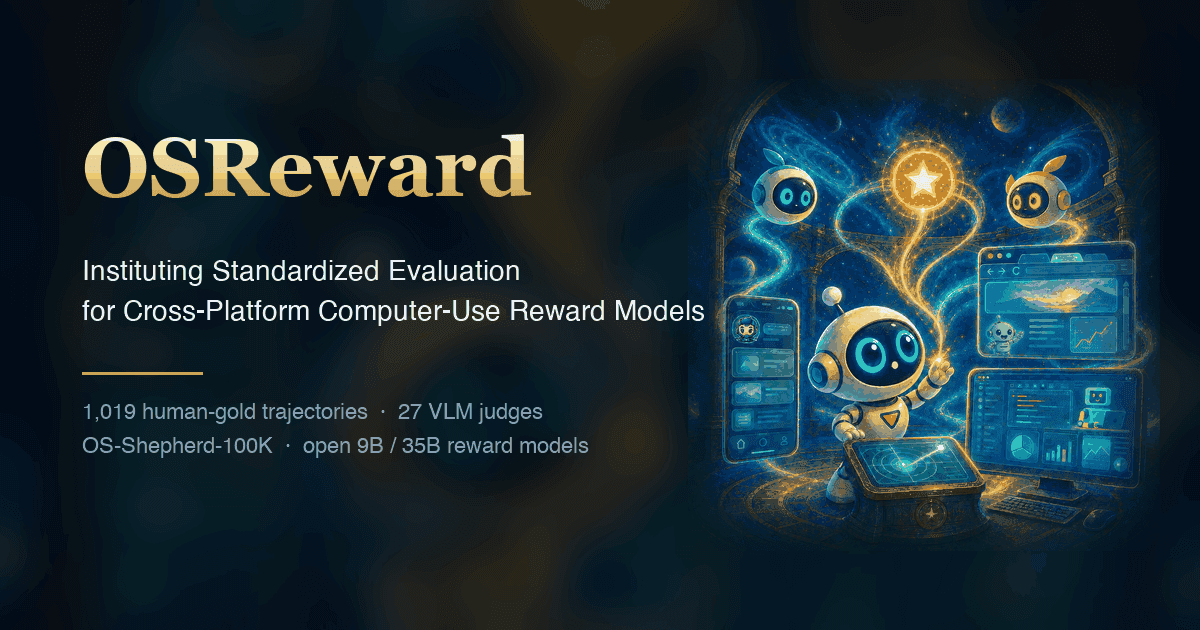
OSReward, announced by @HuggingPapers, is a human-gold benchmark for VLM judges scoring computer-use agents. It ships open OS-Shepherd reward models matching commercial judges at 30-60x lower cost.
Key facts
- OSReward: human-gold benchmark for VLM judges
- OS-Shepherd models: open reward models
- 30-60x lower cost vs commercial judges
- Targets computer-use agent trajectory scoring
- Announced via @HuggingPapers on X
OSReward, announced via @HuggingPapers, targets a specific reliability gap in agent evaluation: the trustworthiness of VLM judges that score computer-use trajectories. The project provides a human-gold benchmark to measure how well these judges align with human preferences, and it ships open OS-Shepherd reward models that reportedly match commercial judge performance at 30-60x lower inference cost. According to @HuggingPapers
The cost delta is the headline. Commercial VLM judges typically run on frontier models, which carry per-token pricing that scales linearly with trajectory length. A single computer-use trajectory can span dozens of steps, each requiring a full judge pass. At 30-60x lower cost, OS-Shepherd makes exhaustive evaluation of large agent rollouts economically feasible for research labs that would otherwise subsample or skip judge-based scoring entirely.
The human-gold design is the structural differentiator. Most judge benchmarks measure agreement against another model, which risks rewarding models that simply mimic the reference judge's biases. OSReward anchors to human annotation, providing a more direct read on whether a judge is actually scoring what humans would score.
What the benchmark measures
The benchmark evaluates judge reliability across computer-use agent trajectories, which are notoriously noisy to score. A trajectory can include partial successes, tool misuses, and multi-step recoveries that a coarse rubric would misclassify. Human-gold labels capture those nuances, and the benchmark reports how closely each VLM judge tracks them.
The open OS-Shepherd models are the practical output. The project does not disclose the exact model sizes, training data, or the specific commercial judges used in the cost comparison, per the announcement. Those details, plus the full benchmark results, are expected in the linked paper.
The 30-60x figure is a cost multiplier, not a quality claim. The announcement states OS-Shepherd models "match" commercial judges, but the matching is presumably on the human-gold benchmark itself. The paper will need to show the agreement rates, the trajectory distribution, and whether the cost advantage holds at higher agent complexity.
Why judge reliability matters now
Computer-use agents are moving from research demos to production deployments, and every deployment needs a scoring loop. If the judge is unreliable, the agent's reported success rate is fiction. OSReward's human-gold benchmark gives teams a way to validate their judge before trusting its output.
The 30-60x cost reduction also changes the economics of evaluation. Teams can now run judge-based scoring on every rollout rather than a subsample, which tightens the feedback loop for RL training on agent tasks. That is the practical value proposition: more evaluation per dollar, with a reliability check attached.
Key Takeaways
- OSReward is a human-gold benchmark for VLM judges scoring computer-use agents.
- Open OS-Shepherd models reportedly match commercial judges at 30-60x lower cost.
What to watch
Watch for the OSReward paper release with full benchmark tables, including OS-Shepherd agreement rates against human gold and the specific commercial judges used in the cost comparison. The key metric is whether the 30-60x cost advantage holds without a significant reliability drop on harder, multi-step trajectories.