Anthropic has begun a phased preview of a new safety feature for its command-line coding tool, Claude Code. Dubbed "auto mode," the system introduces a classifier designed to let the AI agent autonomously execute actions deemed safe while blocking or redirecting potentially risky operations like mass file deletions, data extraction, or malicious code execution.
The feature, announced on March 26, 2026, represents a middle ground between Claude Code's default interactive mode—which requires user approval for every file write and bash command—and the dangerously-skip-permissions command some advanced users employ for full autonomy.
What's New: A Guardrail for Autonomous Coding
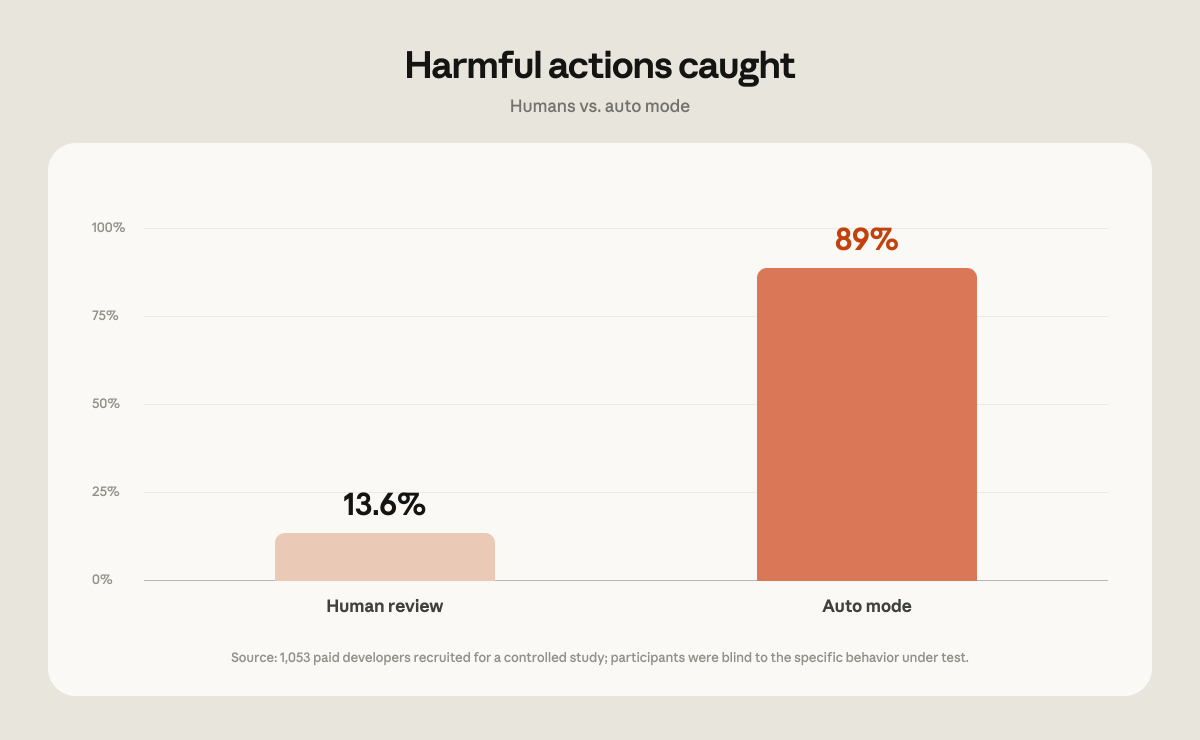
Auto mode is not a simple on/off switch for autonomy. It is a decision layer—a classifier—that sits between Claude's planned actions and their execution. When enabled, this system evaluates each proposed action in real-time.
- For Safe Actions: The classifier grants permission, allowing Claude Code to proceed without interrupting the user. This could include writing a single new file, running a
git statuscommand, or installing a common package. - For Risky Actions: The classifier intervenes, either blocking the action outright or prompting Claude to take a different, safer approach. The primary design goals are to prevent mass file deletions, the extraction of sensitive data, and the execution of malicious code.
Anthropic explicitly states the system is not perfect. In a blog post, the company warns: "The classifier may still allow some risky actions: for example, if user intent is ambiguous, or if Claude doesn't have enough context about your environment to know an action might create additional risk."
Technical Details and Rollout
The release is a direct response to the growing pains of AI coding agents operating in real-world environments. While Anthropic did not cite a specific incident, the timing is conspicuous. It follows a recent 13-hour AWS outage that was reportedly triggered by an Amazon AI tool deleting a critical hosting environment—an incident Amazon attributed to a human operator with "broader permissions than expected."

Availability is rolling out in stages:
- Team Plan Users: Can access the auto mode preview starting March 26, 2026.
- Enterprise & API Users: Will gain access "in the coming days."
The feature is part of a significant wave of activity for Claude Code, which has been mentioned in 137 articles in the past week alone and recently surpassed 100,000 stars on GitHub, signaling massive developer adoption.
How It Compares: The Spectrum of AI Agent Safety
Auto mode positions Claude Code in a nuanced space within the competitive landscape of AI coding assistants.
Default (Interactive) High - approves every action Slow Very High Precise, supervised tasks; learning environments Auto Mode Medium - sets guardrails, reviews logs Fast High (Anthropic's claim) General development; trusted automationdangerously-skip-permissions
Low - full autonomy
Very Fast
Low
Expert users in sandboxed/controlled environments
This move is a strategic differentiation from competitors like GitHub Copilot, which primarily focuses on code completion within an IDE, rather than autonomous terminal operations. It aligns Anthropic more closely with the "AI agent" paradigm, where safety and reliability are paramount for adoption.
What to Watch: The Limits of Automated Guardrails
The success of auto mode hinges on the classifier's accuracy. False positives (blocking safe actions) will frustrate users and slow workflows. False negatives (allowing risky actions) could lead to the very incidents the feature aims to prevent.

Developers should treat this initial release as a research preview. Anthropic will likely rely heavily on user feedback from Team and Enterprise clients—who often work in more complex and sensitive codebases—to refine the classifier's logic before a wider release.
The feature also raises questions about accountability. If a risky action slips through the classifier and causes damage, where does responsibility lie? Anthropic's clear warnings suggest they are establishing a framework where the user, by enabling auto mode, accepts a degree of residual risk.
gentic.news Analysis
This release is a calculated and necessary step in the maturation of Claude Code from a novel tool to a professional-grade platform. The 137 articles mentioning Claude Code this week highlight its explosive growth, but with scale comes increased risk. Auto mode is Anthropic's institutional response, an attempt to codify safety best practices before a major incident tarnishes the product's reputation. It follows the recent AWS outage not as a reaction, but as a validation of a critical need in the market.
The move deepens Anthropic's investment in the Model Context Protocol (MCP) ecosystem, which Claude Code uses heavily. By building a safety layer directly into the agent's execution flow, Anthropic is effectively hardening the entire MCP-based toolchain, making it more viable for enterprise adoption. This aligns with trends we've covered, such as developers using claude-flow MCP and building multi-agent systems, where automated safety is non-negotiable.
Furthermore, this positions Claude Code not just against GitHub Copilot, but as a foundational tool for the emerging multi-agent development landscape. As seen in our coverage of one developer's 40-commit field report, complex systems involve multiple Claude instances collaborating. Auto mode provides a consistent, configurable safety policy across all agents, which is essential for managing such systems. It's a feature that serves the cutting edge of AI-augmented development while protecting the mainstream user, a difficult but crucial balance to strike.
Frequently Asked Questions
What is Claude Code Auto Mode?
Claude Code Auto Mode is a new safety feature preview from Anthropic that uses a classifier to allow its AI coding agent to autonomously execute actions deemed safe (like creating a single file) while blocking or redirecting actions deemed risky (like mass file deletions or running unknown scripts). It is designed as a middle-ground option between full manual approval and full autonomy.
How do I get access to Claude Code Auto Mode?
Access is being rolled out in phases. As of March 26, 2026, users on Anthropic's Team plan can preview the feature. It is scheduled to become available for Enterprise and API users in the days following the initial announcement. Users on individual plans were not mentioned in the initial rollout.
Is Claude Code Auto Mode completely safe?
No. Anthropic explicitly states the classifier is not perfect. It may allow risky actions if the user's intent is ambiguous or if Claude lacks sufficient environmental context to assess the risk. Users enable auto mode with the understanding that it reduces, but does not eliminate, the risk of harmful automated actions.
Why did Anthropic release this feature now?
While not directly stated, the release follows a high-profile incident where an AI tool was implicated in a major AWS outage. The broader context is the rapid scaling of Claude Code, which now has over 100,000 GitHub stars. As developer adoption soars, providing scalable safety mechanisms becomes critical to prevent user error and AI missteps from causing significant damage.