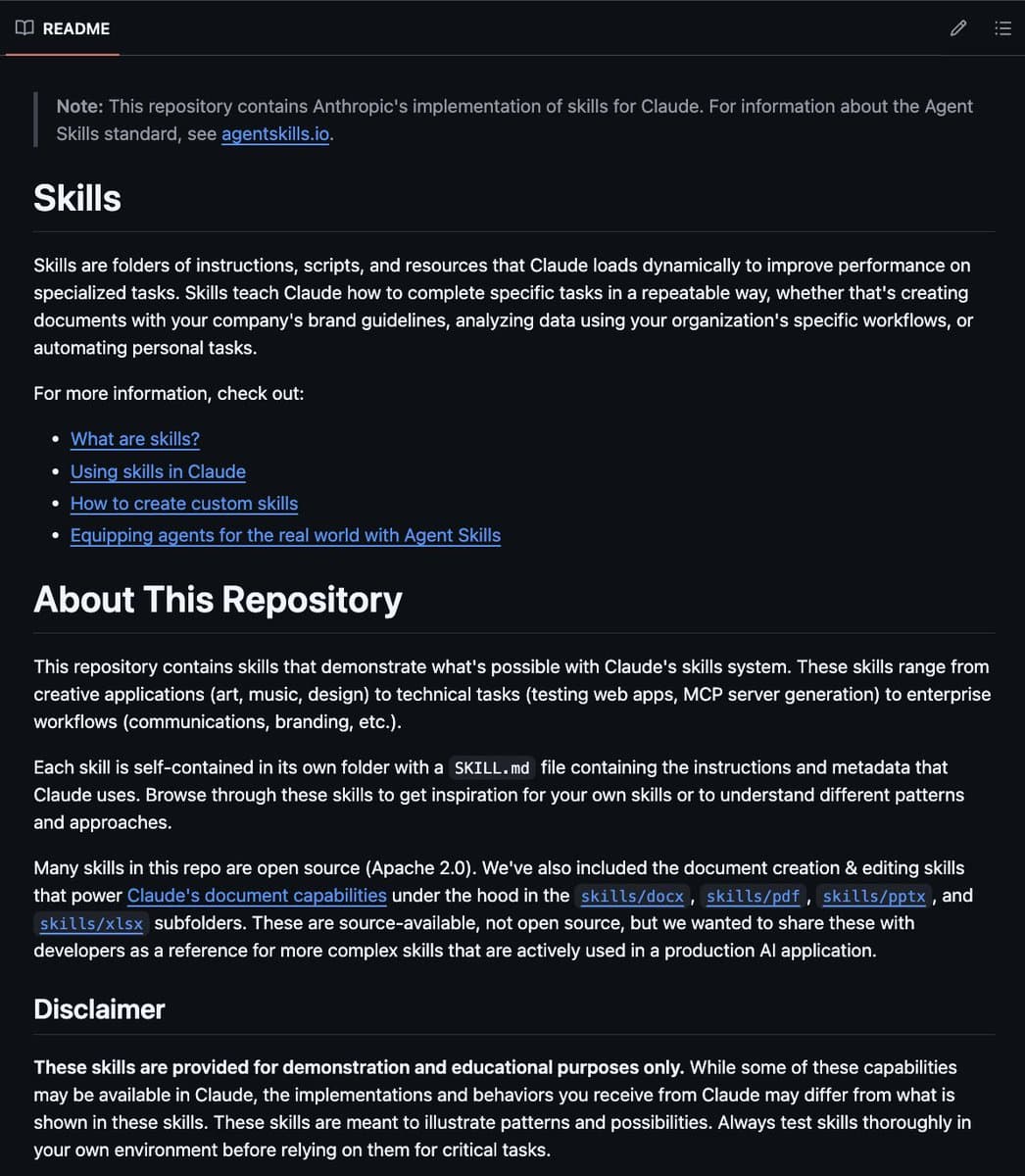
In a significant move that could reshape how developers interact with AI systems, Anthropic has open-sourced its internal Skills library—the exact toolkit powering Claude's document processing and workflow capabilities. This release represents more than just another GitHub repository; it's a window into how one of the world's most sophisticated AI companies structures intelligence at scale.
What Are Skills?
Skills are essentially modular instruction sets that Claude loads dynamically to perform specific tasks. Think of them as specialized toolkits or workflows that teach Claude how to handle particular types of documents, processes, or analyses. Each Skill is contained within a folder structure that includes instructions, examples, and configuration parameters that Claude can understand and execute.
According to the announcement, these Skills represent the same internal tools Anthropic engineers use to power Claude's document features. This means developers now have access to production-grade AI workflows that have been tested and refined within one of the leading AI research organizations.
Technical Architecture and Implementation
The Skills framework operates on a dynamic loading system where Claude can access and apply different Skills based on context and user needs. This modular approach allows for:
- Specialization without retraining: Instead of fine-tuning the entire model for each new task, Skills provide targeted instructions that Claude can apply situationally
- Rapid iteration: New Skills can be developed and deployed without modifying the core model architecture
- Enterprise scalability: Organizations can build proprietary Skills for their specific workflows while maintaining consistency with Claude's core capabilities
This architecture reflects a growing trend in AI development toward composable intelligence—systems that can assemble different capabilities on demand rather than relying on monolithic models that attempt to do everything.
Implications for Developers and Enterprises
For developers, this open-sourcing represents unprecedented access to Anthropic's internal tooling. Previously, building sophisticated document processing workflows with Claude required significant engineering effort to replicate what Anthropic had already perfected internally. Now, developers can:
- Accelerate development by starting with proven Skills rather than building from scratch
- Understand best practices for structuring AI workflows by examining Anthropic's implementation
- Customize and extend existing Skills for specific use cases
- Contribute back to the ecosystem by developing new Skills that benefit the broader community
For enterprises, this release lowers the barrier to implementing sophisticated AI document processing. Skills can be adapted for:
- Legal document analysis and summarization
- Financial report processing and extraction
- Medical record parsing and organization
- Technical documentation management
- Research paper analysis and synthesis
The Strategic Context
Anthropic's move comes at a pivotal moment in the AI landscape. While OpenAI has focused on expanding ChatGPT's capabilities through plugins and custom instructions, and Google has emphasized integration across its ecosystem, Anthropic appears to be taking a different approach: empowering developers with the actual tools they use internally.
This strategy aligns with Anthropic's stated commitment to AI safety and transparency. By open-sourcing their Skills framework, they're providing visibility into how Claude operates at a practical level, which could help address concerns about "black box" AI systems.
Competitive Landscape Implications
The Skills library release positions Anthropic uniquely in the enterprise AI market. While other companies offer API access to their models, few provide the actual workflow tooling they use internally. This could give Anthropic an edge in:
- Enterprise adoption: Companies looking to implement AI at scale often need more than just model access—they need proven workflows and best practices
- Developer mindshare: By giving developers powerful tools, Anthropic builds loyalty and ecosystem growth
- Vertical specialization: The Skills framework makes it easier to develop industry-specific solutions
Challenges and Considerations
Despite the promise, several challenges remain:
- Skill maintenance: As Claude evolves, Skills may need updating to remain compatible
- Security considerations: Organizations must carefully vet Skills before deploying them with sensitive documents
- Performance optimization: While Skills provide functionality, optimizing them for specific use cases will still require expertise
- Integration complexity: Incorporating Skills into existing systems may present technical hurdles
The Future of AI Workflows
This release points toward a future where AI capabilities become increasingly modular and composable. Rather than relying on single, massive models to handle all tasks, we may see ecosystems of specialized Skills that can be combined in various ways.
This approach could lead to:
- More efficient AI systems that only use the capabilities needed for a given task
- Greater transparency as Skills make AI decision-making more interpretable
- Faster innovation as developers build on each other's work
- More personalized AI experiences tailored to specific domains or workflows
Getting Started with Skills
Developers interested in exploring the Skills library can access it through Anthropic's GitHub repository. The initial release includes documentation and examples to help users understand how to:
- Install and configure the Skills framework
- Use existing Skills for common document processing tasks
- Create custom Skills for specialized workflows
- Integrate Skills with existing applications and systems
Conclusion
Anthropic's decision to open-source its Skills library represents a significant shift in how AI companies engage with the developer community. By sharing their internal tooling, they're not just providing code—they're providing insight into how sophisticated AI systems are built and operated at scale.
This move could accelerate AI adoption in enterprises, foster innovation through community contributions, and set a new standard for transparency in AI development. As the Skills ecosystem grows, it may fundamentally change how we think about structuring intelligence in artificial systems.
Source: @hasantoxr on Twitter