In a development that could fundamentally reshape how artificial intelligence systems are developed and evaluated, Anthropic has released what they're calling a "nontechnical Cowork Skill" that enables their Claude AI to build, interview, and benchmark other AI skills. This advancement, highlighted by AI researcher Ethan Mollick, represents one of the most consequential developments in AI tooling since the emergence of large language models themselves.
What Are AI Skills and Why Do They Matter?
AI skills represent a paradigm shift in how we interact with and utilize artificial intelligence. Rather than treating AI systems as monolithic entities with fixed capabilities, the skills framework allows for modular, specialized functions that can be combined and customized for specific tasks. Think of them as apps for AI—discrete capabilities that can be added, removed, or combined to create tailored solutions.
This modular approach offers several advantages. First, it allows for more efficient development, as specialized skills can be created independently and integrated as needed. Second, it enables better performance tracking, as individual skills can be benchmarked and optimized separately. Third, it creates a more transparent system where users can understand exactly which capabilities are being employed for any given task.
The Breakthrough: AI That Builds AI Skills
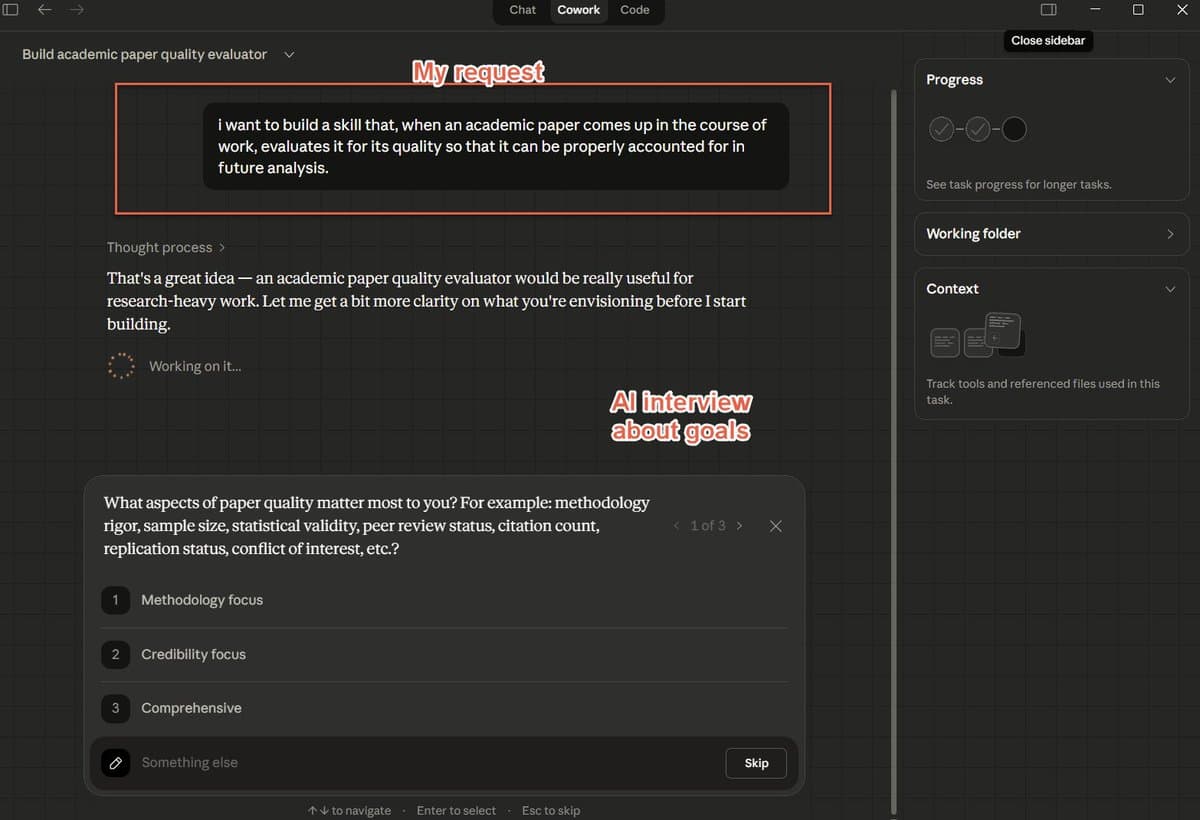
What makes Anthropic's Cowork Skill particularly remarkable is its recursive nature. This isn't just another AI tool—it's an AI tool that creates other AI tools. According to available information, the Cowork Skill enables Claude to:
- Create new skills through natural language descriptions of desired capabilities
- Interview potential skills to evaluate their suitability for specific tasks
- Provide benchmarks to measure skill performance against established standards
This represents a significant step toward autonomous AI development. While human oversight remains essential (as Mollick notes, "you still need to add the human touch"), the ability for AI to participate in its own capability expansion could dramatically accelerate progress in the field.
Technical Implications and Architecture
While specific technical details remain limited, the Cowork Skill appears to leverage several advanced AI techniques. The skill-building capability likely involves sophisticated prompt engineering, few-shot learning, and potentially retrieval-augmented generation to create effective skill definitions. The interviewing function suggests the implementation of evaluation frameworks that can assess skill coherence, reliability, and applicability.
Most intriguing is the benchmarking capability, which implies the development of standardized testing protocols that AI can both administer and interpret. This could lead to more objective, consistent evaluation of AI capabilities across different domains and applications.
Practical Applications and Industry Impact
The implications of self-improving AI skills extend across multiple sectors:
For developers and businesses: The ability to rapidly prototype and test AI capabilities could dramatically reduce development timelines and costs. Companies could create custom skill sets tailored to their specific needs without requiring extensive AI expertise.
For research and evaluation: Automated benchmarking could provide more consistent, comprehensive testing of AI systems, addressing current challenges in AI evaluation where different testing methodologies often yield conflicting results.
For end-users: Modular skills could lead to more transparent, customizable AI assistants. Users might eventually be able to select and combine skills like building blocks, creating personalized AI tools that match their specific requirements.
The Human Touch: Why Oversight Remains Critical
Despite the impressive capabilities demonstrated by Anthropic's Cowork Skill, Mollick's caution about maintaining human oversight is well-founded. Autonomous skill creation raises important questions about:
- Quality control: How do we ensure that AI-created skills meet appropriate standards for accuracy and reliability?
- Safety considerations: What safeguards prevent the creation of harmful or unethical skills?
- Interpretability: How do we maintain understanding of increasingly complex skill ecosystems?
These concerns highlight that while the technology represents a significant advancement, it should be viewed as augmenting human capabilities rather than replacing human judgment.
The Competitive Landscape and Future Trajectory
Anthropic's development places them at the forefront of what is likely to become a major area of competition in AI. Other major players, including OpenAI, Google, and Meta, have been exploring similar directions with their approaches to AI tooling and customization.
The emergence of skill-building AI suggests several future developments:
- Skill marketplaces: Platforms where users can share, rate, and purchase AI skills
- Cross-platform compatibility: Standards allowing skills to work across different AI systems
- Specialized skill ecosystems: Industry-specific collections of AI capabilities
- Automated skill optimization: AI systems that not only create but continuously improve skills based on performance data
Ethical Considerations and Responsible Development
As with any significant AI advancement, the development of self-improving skill systems raises important ethical questions. These include:
- Accountability: Who is responsible when an AI-created skill causes harm or produces incorrect results?
- Transparency: How do we ensure users understand which skills are being employed and how they were created?
- Access and equity: Will skill-building capabilities be widely available or concentrated among technical elites?
- Control and alignment: How do we maintain alignment with human values as AI systems gain more autonomy in their own development?
Addressing these concerns will require collaboration between developers, policymakers, and ethicists to establish appropriate frameworks for responsible development.
Conclusion: A New Chapter in AI Evolution
Anthropic's Cowork Skill represents more than just another technical achievement—it signals a fundamental shift in how AI systems are developed and expanded. By enabling AI to participate in its own capability enhancement, we're moving toward more adaptive, customizable, and potentially more capable systems.
However, as Mollick appropriately notes, the human element remains irreplaceable. The most promising path forward likely involves synergistic collaboration between human intelligence and artificial intelligence, where each augments the other's capabilities.
As this technology matures, we can expect to see increasingly sophisticated ecosystems of AI skills, potentially transforming everything from software development to scientific research. The challenge will be ensuring these developments proceed safely, ethically, and beneficially for society as a whole.
Source: Ethan Mollick (@emollick) on X/Twitter, highlighting Anthropic's release of a nontechnical Cowork Skill that builds AI skills.