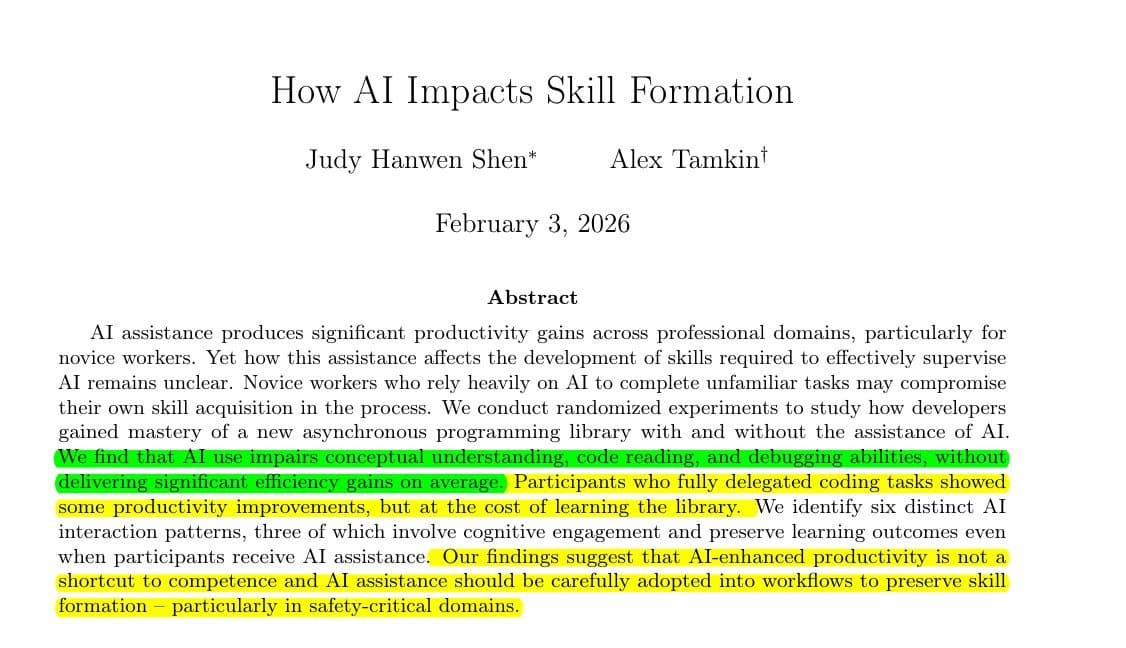
A recent internal study from Anthropic, titled "How AI Impacts Skill Formation" (arXiv:2601.20245), presents a critical examination of AI coding assistants' effects on developer skill building. The research directly challenges the prevailing narrative of AI as an unalloyed productivity booster, instead finding that AI use can impair conceptual understanding, code reading, and debugging abilities without delivering significant average efficiency gains.
What the Study Found
The core experiment involved developers learning a new Python library. Participants were split into groups: one using an AI coding assistant and a control group working without AI. The results were stark:
17% Lower Conceptual Scores: Developers using AI scored 17% lower on subsequent tests assessing their understanding of the library's concepts and functionality.
No Statistical Speed Advantage: Contrary to common claims, using AI did not make programmers statistically faster at completing the assigned coding tasks on average.
Prompting Over Coding: A significant observed behavior was that participants wasted time writing and refining prompts instead of engaging directly with the codebase.
The Delegation Penalty: Performance degraded severely when developers fully delegated code generation. Scores crashed below 40% when developers "let AI write everything." In contrast, developers who used AI only for simple concept clarification scored above 65%.
Key Implications from the Paper
The study's authors draw a direct line between tool use and skill atrophy. The act of delegating code generation to an AI assistant appears to short-circuit the cognitive processes required for deep understanding. This leads to a specific deficit in debugging and code reading abilities, as the developer lacks the foundational mental model of the system.
The paper concludes with a pointed warning for engineering managers: pressuring engineers to use AI for maximal perceived productivity may backfire. It argues that forcing a focus on top-line speed can result in a workforce that loses the capacity to understand, maintain, and debug the very systems they are building, creating long-term technical debt and operational risk.
The "Vibe-Coding" Phenomenon
The tweet referencing the study popularizes the term "vibe-coding," which describes a development style where the programmer curates prompts and integrates AI-generated blocks without fully comprehending the underlying logic or structure. This study provides empirical evidence that this practice, while potentially yielding a superficially functional output, actively harms the developer's skill formation.
The takeaway is not that AI assistants are useless, but that their application requires careful strategy. Using them as a crutch for core learning and implementation is detrimental. Their value may lie in later-stage optimization, boilerplate generation, or clarifying discrete concepts—not in replacing the fundamental act of problem-solving and system comprehension.