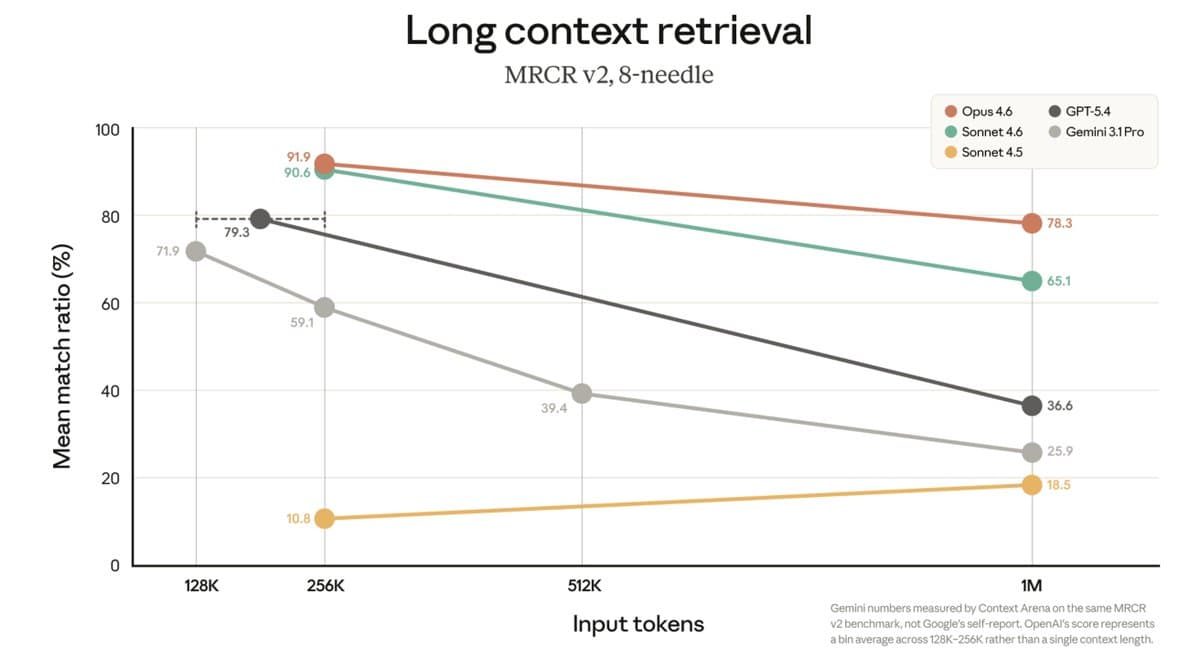
In a development that signals shifting dynamics within the AI industry, Anthropic has reportedly achieved superior performance over Google in maintaining attention and reasoning across extended contexts. According to analysis shared by AI researcher @kimmonismus, Anthropic "consistently manages to impress, particularly with its ability to maintain attention and reasoning across extended contexts" and is "even outperforming ex-context-king Google, by a lot."
The Context Length Arms Race
Extended context capability has emerged as one of the most significant competitive frontiers in artificial intelligence. The ability to process and reason across lengthy documents, conversations, or datasets represents a fundamental advancement in how AI systems understand and interact with complex information. For years, Google has been considered a leader in this domain, pioneering techniques that allowed models to maintain coherence across thousands of tokens.
Anthropic's apparent breakthrough suggests a notable shift in this landscape. The company's Claude models have demonstrated remarkable consistency in attention mechanisms—the technical processes that determine which parts of input data an AI focuses on during processing. This consistency appears to translate directly to improved reasoning capabilities when dealing with extended material, whether that involves analyzing lengthy legal documents, maintaining coherent multi-turn conversations, or synthesizing information from extensive research papers.
Technical Implications of Superior Attention
The technical achievement here extends beyond simply increasing the number of tokens a model can process. True extended context capability requires maintaining what researchers call "attention fidelity"—the model's ability to properly weight and relate information throughout lengthy sequences. When attention mechanisms degrade over long contexts, models begin to "forget" earlier information or make inconsistent connections between distant parts of the text.
Anthropic's reported success suggests they may have developed more efficient attention algorithms or novel architectural approaches that reduce the computational overhead typically associated with processing long sequences. This could involve innovations in how attention is distributed, how positional information is encoded, or how the model manages its "working memory" throughout extended reasoning tasks.
Practical Applications and Industry Impact
The practical implications of superior extended context AI are substantial across multiple domains:
Legal and Research Applications: Legal professionals could leverage these capabilities to analyze case law spanning thousands of pages while maintaining consistent reasoning about precedent and argument structure. Researchers could process entire scientific literatures while keeping track of methodological details and findings across dozens of papers.
Enterprise Solutions: Businesses could implement AI systems that maintain context across entire business processes, from lengthy contract negotiations to complex project management timelines, without losing track of critical details mentioned hours or days earlier in the interaction.
Creative and Educational Tools: Writers and educators could benefit from AI assistants that remember character development across entire novels or maintain pedagogical consistency throughout extended learning modules.
The Competitive Landscape
This development represents more than just a technical achievement—it signals a potential shift in the competitive dynamics between AI labs. Google's historical dominance in context length gave them significant advantages in applications requiring deep, sustained engagement with complex material. Anthropic's reported advancement challenges that position and suggests that smaller, more focused AI companies can compete effectively with tech giants in specific technical domains.
The timing is particularly significant as enterprises increasingly prioritize AI solutions that can handle their complete documentation sets, maintain context across extended customer interactions, and process lengthy internal communications. Companies making purchasing decisions about AI integration will likely weigh extended context capabilities heavily, potentially giving Anthropic an edge in certain market segments.
Future Directions and Challenges
While the reported performance is impressive, several challenges remain in the extended context domain. Even with improved attention mechanisms, there are fundamental limitations to how much information any model can effectively utilize, particularly when that information is spread across tens or hundreds of thousands of tokens. Researchers continue to explore techniques like hierarchical attention, memory-augmented architectures, and dynamic context window sizing to push these boundaries further.
Additionally, there are important questions about evaluation methodologies. How exactly are these extended context capabilities being measured, and what specific tasks demonstrate the superiority? Different benchmarks might reveal different strengths and weaknesses, and the field would benefit from standardized evaluation protocols for extended context reasoning.
Conclusion
Anthropic's reported outperformance of Google in extended context capabilities represents a significant milestone in AI development. It demonstrates that focused innovation in specific technical areas can yield competitive advantages even against well-resourced industry giants. As AI systems increasingly move from simple question-answering to complex reasoning across extensive information spaces, capabilities like those demonstrated by Anthropic will become increasingly valuable—and increasingly expected by users.
The broader implication is that the AI landscape continues to evolve rapidly, with leadership positions in specific capabilities shifting as different organizations make breakthroughs in their areas of focus. For developers, researchers, and enterprises, this means paying close attention not just to which company has the largest model, but which has made the most meaningful advances in the specific capabilities that matter most for their applications.
Source: Analysis shared by @kimmonismus on X/Twitter, referencing Anthropic's extended context performance relative to Google.