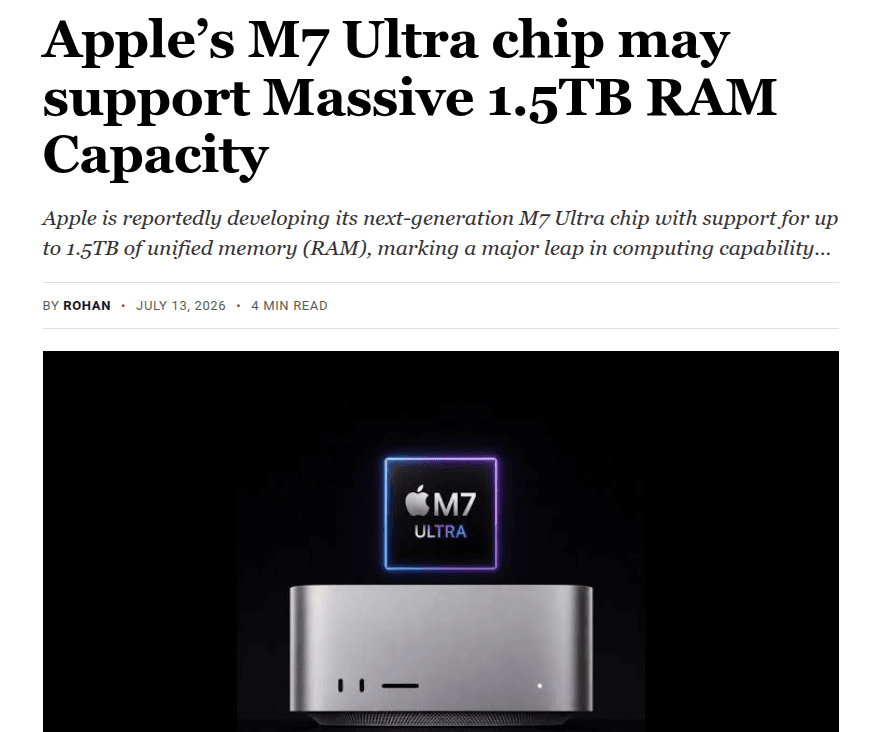
Apple's M7 Ultra chip reportedly supports up to 1.5TB of unified memory. That would more than double the M3 Ultra's ceiling and match the aggregate capacity of eight Nvidia B200 GPUs.
Key facts
- M7 Ultra reportedly supports 1.5TB unified memory.
- That's double the M3 Ultra's 512GB ceiling.
- Eight B200 GPUs provide 1.44TB aggregate memory.
- M3 Ultra reaches 819GB/s memory bandwidth.
- Apple pulled 128GB Mac Studio amid DRAM shortages.
Apple is reportedly building an M7 Ultra chip that supports up to 1.5TB of unified memory, according to a post by @rohanpaul_ai on X. That would more than double the memory ceiling on today's M3 Ultra Macs, which top out at 512GB. The push comes from local AI inference, where large language models with hundreds of billions of parameters need vast memory to run without offloading to disk or cloud.
The big deal is that M7 Ultra's GPU could access the entire 1.5TB pool directly. Unlike desktop DIMMs, Apple's unified memory is package-integrated and fixed when owners purchase it. That shared pool reduces copying between processors and gives the GPU far more capacity than dedicated VRAM solutions.
Server-Scale Comparison
An Nvidia Blackwell B200 server GPU carries 180GB HBM3e and reaches roughly 8TB/s bandwidth. Eight B200 GPUs together provide 1.44TB, so if M7 Ultra really happens then it will make it genuinely server-scale. Unified memory lets the CPU, GPU, and Neural Engine share one fast pool, so data moves with lower latency and less power than split PC memory. Apple's memory would serve CPU and GPU together, unlike NVIDIA's dedicated GPU-only HBM.
Apple's M3 Ultra already reaches 819GB/s of memory bandwidth by fusing two Max dies. For comparison, an Nvidia RTX 5090 carries 32GB VRAM but delivers 1.792TB/s bandwidth for graphics workloads. Apple currently offers more capacity but less bandwidth than consumer GPUs.
The Supply Constraint
The catch is supply, because DRAM prices are climbing and parts stay scarce. Apple already pulled its 128GB Mac Studio this year amid those shortages [according to previous reports]. An M7 Ultra with 1.5TB would need far more of that same costly memory. Apple has not confirmed the M7 Ultra, so its final specs could change. Memory supply, not chip design, decides whether this ships at a sane price. If DRAM stays scarce, only film studios and labs could afford a 1.5TB Mac.
What to watch
Watch for Apple's next Mac Pro or Mac Studio announcement cycle—likely late 2026 or early 2027—and whether DRAM spot prices ease enough to make a 1.5TB configuration economically viable beyond niche pro workflows.