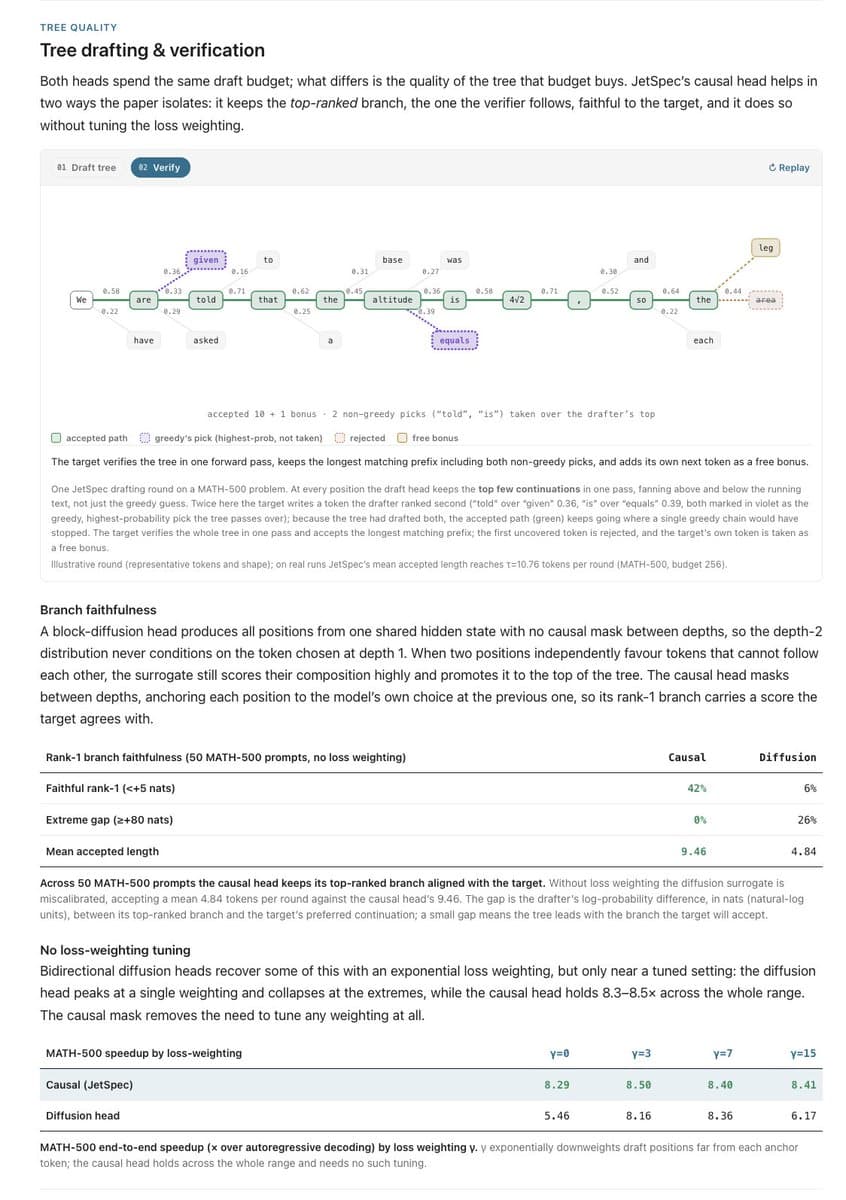
JetSpec achieves 1,000 tokens per second on Qwen-8B running on a single B200 GPU. The speculative decoding method claims to outperform prior block diffusion and speculative decoding approaches.
Key facts
- 1,000 tokens per second on Qwen-8B.
- Runs on a single Nvidia B200 GPU.
- Claims to outperform prior speculative decoding.
- Enables better compute utilization at any batch size.
- Targets single-stream inference throughput.
JetSpec, a new speculative decoding method, achieves 1,000 tokens per second on Qwen-8B running on a single B200 GPU, according to @teortaxestex on X. The claim positions JetSpec as "strictly smarter and stronger than previous speculative decoding and block diffusion approaches." The method reportedly enables better utilization of compute at any batch size, suggesting efficiency gains across deployment scenarios.
How JetSpec improves throughput
Speculative decoding accelerates inference by having a draft model generate multiple tokens in parallel, which are then verified by the target model. JetSpec appears to refine this process, though the specific algorithmic innovations remain undisclosed in the tweet. The 1,000 t/s figure on Qwen-8B—an 8-billion-parameter model—is notably high; typical inference speeds for such models are in the range of 50–200 t/s depending on hardware and quantization. The B200 GPU, based on Nvidia's Blackwell architecture, offers significant memory bandwidth and compute, but the 5–20x speedup over naive decoding suggests substantial algorithmic gains.
Context and comparison
Prior work in speculative decoding includes Medusa (Cai et al. 2024), Eagle (Li et al. 2024), and block diffusion methods like Lookahead Decoding (Fu et al. 2024). JetSpec claims superiority over these, but the tweet provides no benchmark comparisons or ablation studies. The single-stream metric (batch size 1) is relevant for latency-sensitive applications like chatbots, while the mention of "any batch size" hints at broader applicability. The method's practical implications include reduced inference cost and improved user experience for deployed LLMs.
Limitations and unknowns
The source is a single tweet with a link to further details, which were not examined in this article. No open-source code, paper, or reproducibility instructions are provided. The claim of 1,000 t/s on Qwen-8B requires independent verification. The specific hardware configuration (e.g., memory bandwidth, precision) is not specified. The comparison to "block diffusion approaches" is vague; block diffusion is a less common technique that generates blocks of tokens via diffusion models, and JetSpec's relationship to it is unclear.
What to watch
Watch for a formal paper or code release from the JetSpec authors, which would enable independent verification of the 1,000 t/s claim and comparison to baselines like Medusa and Eagle. Also monitor Nvidia's B200 inference benchmarks to see if JetSpec is adopted in production inference stacks.