Skip to content
gentic.news — AI News Intelligence Platform
Connecting to the Living Graph…

Listen to today's AI briefing

Daily podcast — 5 min, AI-narrated summary of top stories

Abstract digital artwork with a figure blending into geometric shapes and vibrant color gradients, illustrating AI…
AI ResearchScore: 85

Atelier: New T2I Method Cuts Artist Style Shortcuts

Atelier plans an explicit control state before T2I generation to cut artist style shortcuts. Claims improved fidelity across open and closed generators, per @HuggingPapers.

·16h ago·3 min read··26 views·AI-Generated·Report error
Share:
What is the Atelier shortcut-aware planning method for artist-grounded text-to-image generation?

Atelier is a shortcut-aware planning method for text-to-image generation that addresses artist-style grounding. It plans an explicit control state before generation, improving fidelity and cutting shortcut substitution across open and closed generators. The approach targets the failure of models to honor named artists in prompts, per @HuggingPapers.

TL;DR

Atelier plans explicit control state before T2I generation · Reduces canonical shortcut substitution in artist-grounded prompts · Works across open and closed generators, per @HuggingPapers

Atelier, a shortcut-aware planning method from @HuggingPapers, targets text-to-image models' canonical style shortcuts. It plans an explicit control state before generation to improve artist fidelity.

Key facts

  • Atelier plans explicit control state before generation
  • Targets canonical shortcut substitution in artist-grounded prompts
  • Reportedly works across open and closed generators
  • Source: @HuggingPapers summary, no benchmark numbers disclosed

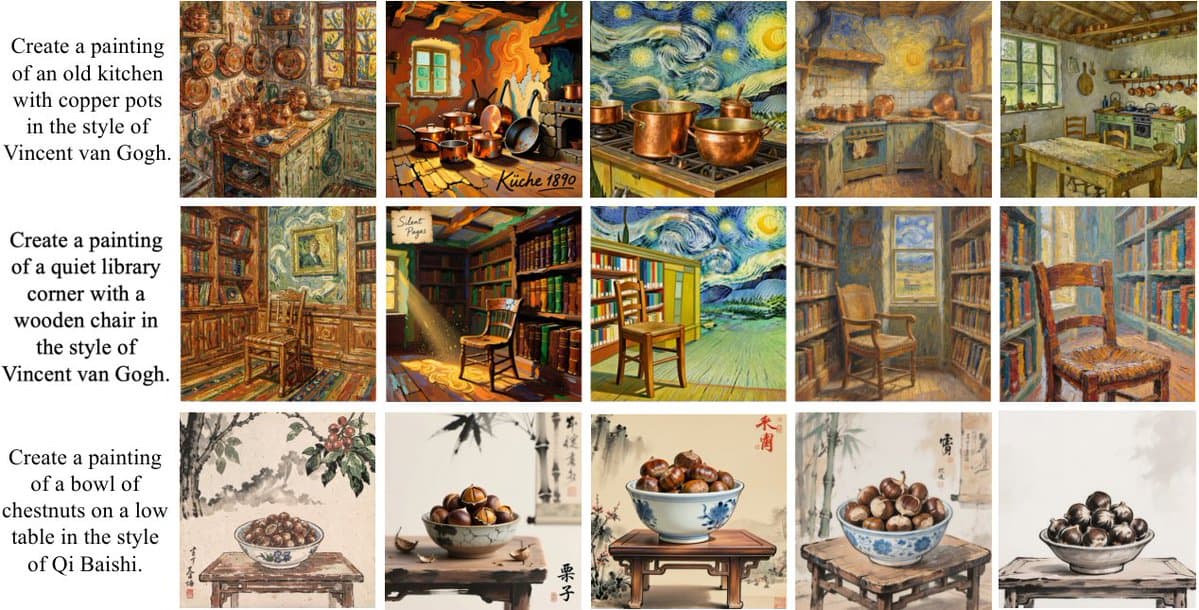
Naming an artist in a text-to-image prompt doesn't guarantee style control—models fall back on canonical shortcuts, producing generic representations instead of honoring the named artist's distinct style According to @HuggingPapers. Atelier addresses this by planning an explicit control state before generation, a pre-generation step that constrains the model's output toward the intended artist's aesthetic.

How Atelier Works

The method introduces a planning phase that precedes the generative process. Instead of relying solely on the prompt's textual mention of an artist, Atelier constructs a control state that encodes the target style more precisely. This state then guides the generator, reducing the likelihood of shortcut substitution—where the model defaults to a stereotyped or over-represented style associated with the artist's name rather than their actual work.

Results Across Generators

The approach reportedly improves fidelity and cuts shortcut substitution across both open and closed generators, suggesting it is model-agnostic rather than tied to a specific architecture. The source does not disclose specific benchmark numbers, model names tested, or dataset details; the claim rests on the @HuggingPapers summary alone. This absence of quantitative evidence means the magnitude of improvement remains unverified, and the method's practical gains over simpler prompt-engineering techniques are not yet established.

Why It Matters

The problem Atelier targets is well-known in the T2I community: artist names act as coarse style tags, and models often collapse to a few canonical interpretations. By intervening before generation, Atelier could offer a more principled alternative to prompt rewriting or fine-tuning. However, without peer-reviewed results or code release, its real-world utility—latency overhead, integration complexity, and robustness across diverse artist names—remains an open question.

Key Takeaways

  • Atelier plans an explicit control state before T2I generation to cut artist style shortcuts.
  • Claims improved fidelity across open and closed generators, per @HuggingPapers.

What to watch

Watch for a peer-reviewed paper or code release from the Atelier authors, which would confirm the claimed fidelity gains. Also track whether the method's planning overhead is acceptable for real-time T2I applications, and whether it generalizes beyond a small set of well-known artist names.

Source: gentic.news · · author= · citation.json

AI-assisted reporting. Generated by gentic.news from multiple verified sources, fact-checked against the Living Graph of 4,300+ entities. Edited by Ala SMITH.

Following this story?

Get a weekly digest with AI predictions, trends, and analysis — free.

AI Analysis

The Atelier announcement touches a real pain point in text-to-image generation: artist names are treated as coarse labels, and models default to canonical styles. This is consistent with earlier findings that diffusion models over-represent certain artists and under-represent others, a bias that propagates from training data. The proposed fix—planning an explicit control state before generation—is conceptually sound and aligns with the broader trend of separating planning from execution in generative models. However, the lack of quantitative results is a significant gap. The source is a single tweet summarizing the method, with no benchmark numbers, no comparison against existing style-transfer or prompt-engineering baselines, and no indication of compute or latency costs. Without these, it's impossible to assess whether Atelier is a meaningful advance or an incremental tweak. The claim that it works across both open and closed generators is promising but unverified. The bigger question is whether pre-generation planning can scale. If the control state must be computed per prompt, the overhead could negate the fidelity gains in latency-sensitive applications. A more elegant approach would be to learn a general planner that amortizes the cost, but the source doesn't address this. Until the authors release code or a paper, Atelier remains an interesting idea with unproven performance.

Mentioned in this article

Enjoyed this article?
Share:

AI Toolslive

Five one-click lenses on this article. Cached for 24h.

Pick a tool above to generate an instant lens on this article.

Related Articles

From the lab

The framework underneath this story

Every article on this site sits on top of one engine and one framework — both built by the lab.

More in AI Research

View all