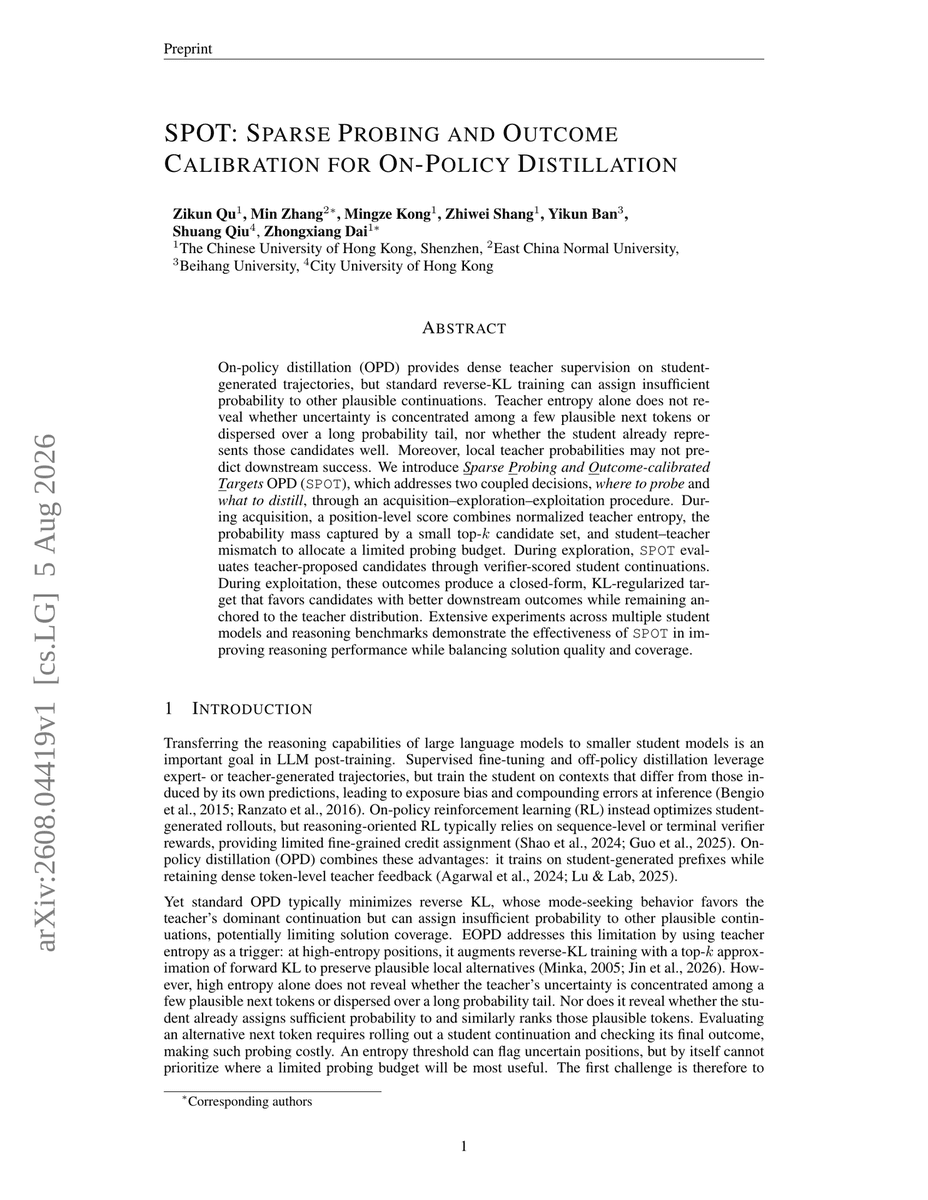
SPOT, a new on-policy distillation method, outperforms OPD and EOPD across student scales on reasoning benchmarks. The method sparsely probes key positions and uses outcome-calibrated targets from verifier-scored continuations, according to @HuggingPapers.
Key facts
- SPOT beats OPD and EOPD on reasoning benchmarks
- Uses sparse probing of key positions
- Outcome-calibrated targets from verifier-scored continuations
- Improvements hold across multiple student scales
Standard on-policy distillation (OPD) has a blind spot: it can miss plausible solutions during training. SPOT (Smarter On-Policy Distillation) addresses this by sparsely probing key positions in the sequence and using outcome-calibrated targets derived from verifier-scored continuations. According to @HuggingPapers, this approach yields better reasoning performance than both OPD and EOPD across multiple student scales.
The core insight is that not all token positions deserve equal attention during distillation. Standard OPD treats every position uniformly, which can dilute the learning signal. SPOT's sparse probing focuses the student's capacity on the positions that matter most, while the outcome-calibrated targets ensure the student learns from completions that a verifier actually scores as correct. This combination appears to close the gap between teacher and student more effectively than prior methods.
The paper reports consistent gains across student scales, suggesting the method is robust rather than tuned to a single model size. For practitioners doing distillation for reasoning tasks, this is a meaningful improvement over the default OPD baseline.
Key Takeaways
- SPOT distillation beats OPD and EOPD on reasoning benchmarks by sparsely probing key positions and using outcome-calibrated targets.
- Reported by @HuggingPapers.
Why Sparse Probing Matters
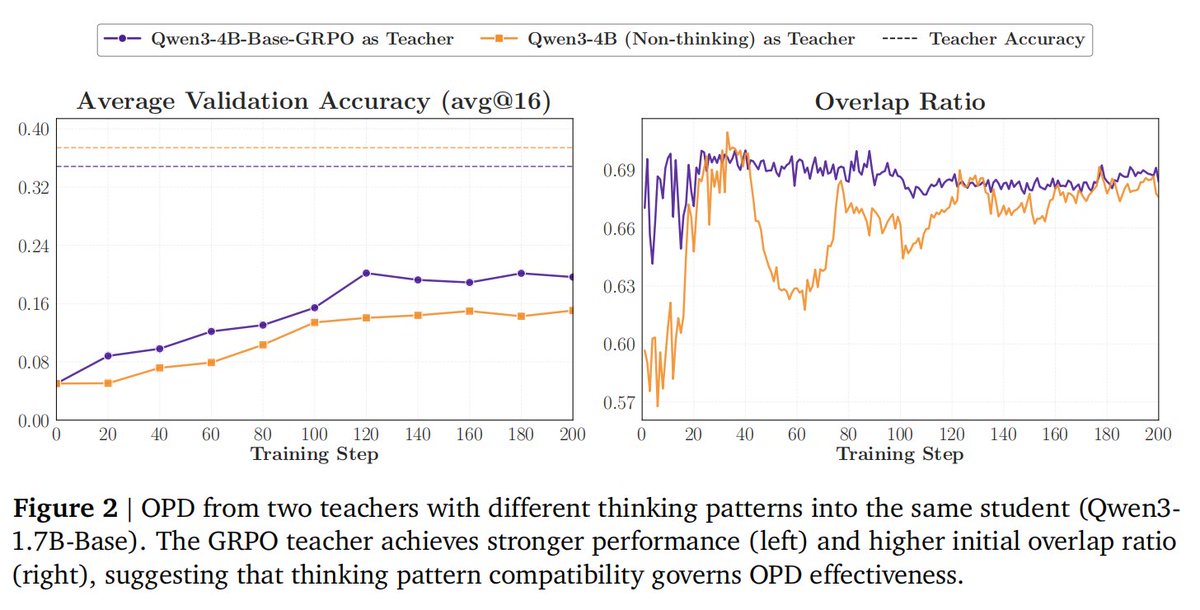
The efficiency angle is as important as the accuracy gain. By sparsely probing key positions, SPOT reduces the number of forward passes needed during distillation. This is a practical win for teams that are compute-constrained when training student models, since distillation already doubles the training cost by running both teacher and student.
The outcome-calibrated target is the other half of the story. Instead of trusting every teacher token equally, SPOT weights targets by whether the continuation actually solves the problem. This is a form of reward-weighted learning that aligns the student's objective with verifiable correctness, not just teacher mimicry.
What to watch
Watch for the full paper release with ablation studies. The key question is whether SPOT's gains persist on non-reasoning tasks like coding or instruction following, and whether the sparse probing schedule requires tuning per dataset. If the method generalizes, expect it to become the default distillation recipe in open-source LLM training pipelines.