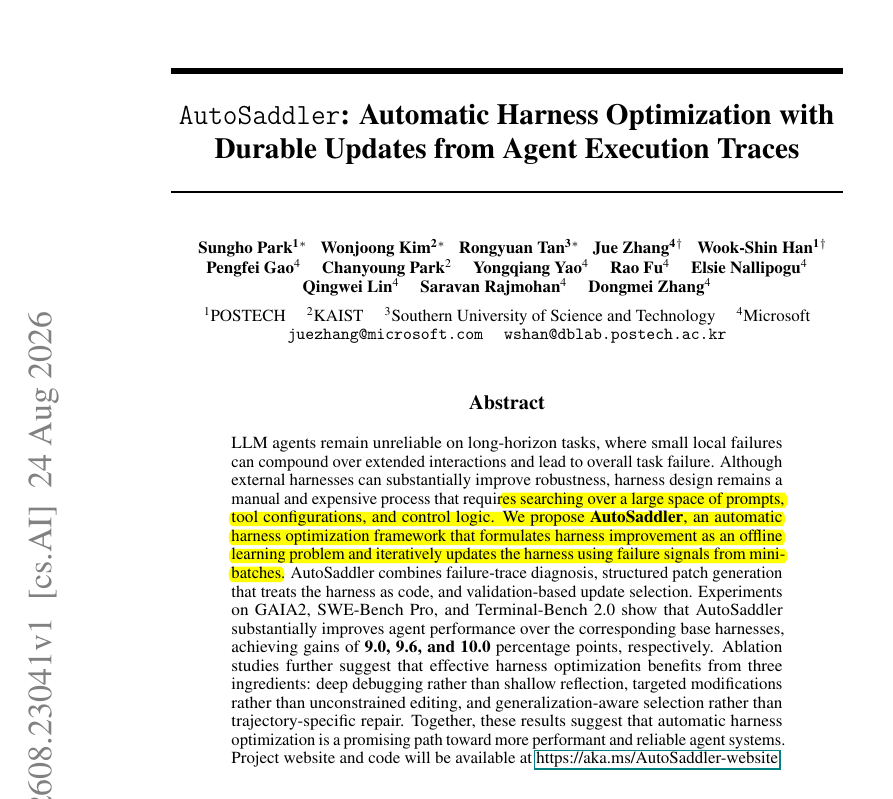
AutoSaddler, an arXiv paper (2608.23041), shows automatic harness patching needs held-out validation. Without it, optimized harnesses underperform hand-written baselines.
Key facts
- arXiv ID: 2608.23041
- Method: patches prompts, tools, middleware from failure traces
- Key criterion: keep updates improving held-out development set
- Without held-out check: result below hand-written harness
- Source: @rohanpaul_ai on X
AutoSaddler, an arXiv preprint (2608.23041) from the agent-systems research community, tackles a problem that surfaces the moment you let an LLM rewrite its own operating instructions: automatic patch generation is easy, but keeping the patches that actually help is not. According to @rohanpaul_ai, the paper's core finding is that harness optimization does work, but only when updates are validated against a held-out development set. Without that check, the result lands below the hand-written harness it started from.
The method: AutoSaddler diagnoses failed traces from a mini-batch, treats the harness as code, and patches prompts, tools, and middleware. The critical step is a filtering mechanism that keeps only updates which also improve performance on a held-out development set—tasks the patch was not written for. This is a regression-aware selection criterion, scoring fixes minus regressions rather than fixes alone.
The practical implication for anyone tuning agents—whether by hand or with an LLM in the loop—is direct: hold out a set of tasks that the patch was not written for, and score fixes minus regressions. This prevents the common failure mode where a patch overfits to the exact traces that triggered it, improving those cases while silently degrading others.
The paper does not disclose full benchmark numbers or compute budgets in the tweet summary; the arXiv abstract is the primary source for details. But the structural insight is clear: harness optimization is a search problem, and without a generalization check, the search collapses to local overfitting.
The unique angle here is that this mirrors a known tension in RLHF and preference optimization: reward hacking on the training distribution. AutoSaddler's held-out filter is essentially a regularization term for harness updates, a lesson that applies beyond this specific method to any self-modifying agent pipeline.
What to watch
Watch for the full AutoSaddler paper release with benchmark details—specifically SWE-Bench or similar agentic coding scores, and whether the held-out filter shows consistent gains across task distributions. Also track whether agent frameworks like LangChain or OpenAI's Agents SDK adopt regression-aware patch selection in their auto-tuning tools.