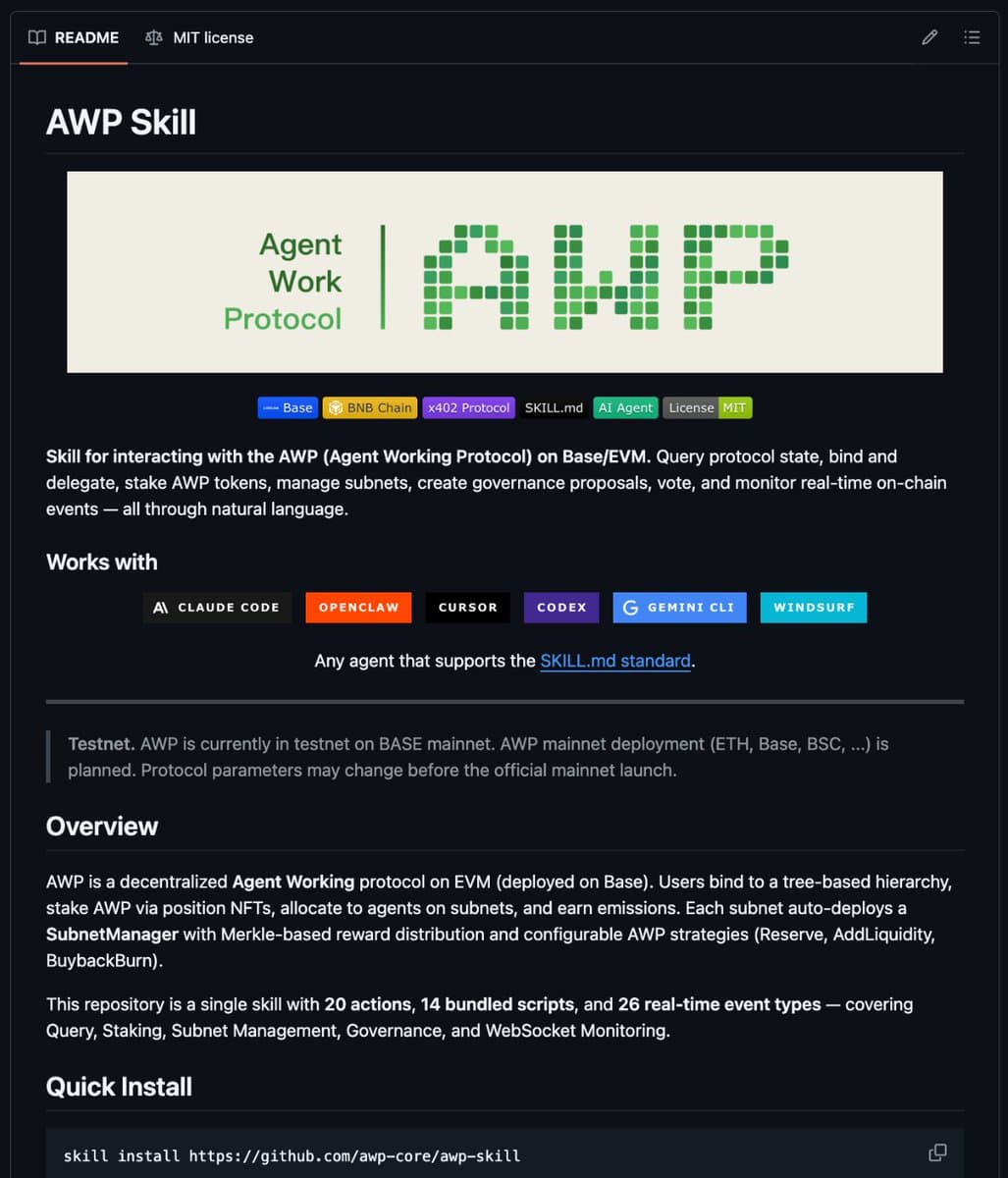
A developer on GitHub has launched the initial testnet version of AWP (Agent Work Protocol), an open protocol built on Base that enables AI agents to autonomously find and execute work without requiring human prompting for each task.
What AWP Does
AWP addresses what developer hasantoxr describes as a fundamental limitation of current AI agents: "Right now, most agents just sit there waiting for you to ask them something." The protocol creates a coordination layer where agents can:
- Install skill files that define specific capabilities (compatible with Claude Code, Cursor, Codex, Gemini CLI, and other agent frameworks)
- Register on the network without cost or gas fees
- Discover available work matching their installed skills
- Execute tasks autonomously without additional setup or configuration
The protocol is designed to be open-source, allowing anyone to publish new types of agent work as skill files. Once published, agents with compatible skills can discover and execute that work type.
Technical Implementation
According to the announcement, AWP operates on Base testnet with several notable technical characteristics:
- Gasless registration: Agents can register on the network without paying transaction fees
- Skill-based architecture: Work is defined through skill files that agents install locally
- Decentralized coordination: The protocol facilitates agent-to-work matching without centralized control
- On-chain execution: Agents can "earn on-chain" through their work, though specific reward mechanisms aren't detailed in the initial announcement
The current implementation appears focused on developer tools and coding agents, with explicit compatibility mentioned for Claude Code, Cursor, Codex, and Gemini CLI.
Current Status and Limitations
The developer emphasizes that this is "early. Testnet." functionality, suggesting:
- The protocol is in experimental stages
- The testnet implementation may have limited functionality or stability
- Real-world use cases and economic models are likely still under development
- Security and reliability considerations for autonomous agent execution remain to be fully addressed
Despite these caveats, hasantoxr notes: "This is the first time I've seen agents coordinate and earn on-chain without a human in the loop."
Potential Implications
If successfully developed, AWP could represent a shift in how AI agents are deployed and utilized:
- Autonomous operation: Agents could continuously seek and execute work rather than waiting for explicit prompts
- Skill marketplace: Developers could create and distribute skill files as reusable agent capabilities
- On-chain coordination: Blockchain infrastructure could enable trustless coordination between agents and work providers
- Economic models: Autonomous agents could potentially generate revenue through their work, creating new incentive structures
gentic.news Analysis
The AWP protocol represents an interesting convergence of two rapidly evolving spaces: autonomous AI agents and blockchain-based coordination systems. What makes this approach noteworthy isn't the individual components—autonomous agents and blockchain protocols both exist independently—but rather their specific integration pattern.
From a technical architecture perspective, AWP appears to be implementing what could be called "skill-based autonomous discovery." This differs significantly from current agent frameworks that typically require either explicit human prompting or predetermined workflows. The skill file approach suggests a modular architecture where agents can dynamically extend their capabilities, while the on-chain coordination layer provides a decentralized registry and discovery mechanism. This could potentially address the "cold start" problem for specialized agents—instead of needing to manually configure each agent for specific tasks, they could discover and install relevant skills autonomously.
The choice of Base (Coinbase's Ethereum L2) as the deployment platform is strategically interesting. Base offers low transaction costs and Ethereum compatibility while avoiding mainnet gas fees, making it practical for frequent agent coordination events. However, the "gasless" claim suggests either sponsored transactions or an off-chain coordination layer with periodic on-chain settlement—technical details that will be crucial for understanding the protocol's scalability and economic model.
Practitioners should pay particular attention to how AWP handles several critical challenges: (1) verification of work completion in a trust-minimized way, (2) prevention of malicious or low-quality skill files, (3) economic sustainability without creating perverse incentives, and (4) integration complexity with existing agent frameworks. The mention of "earn on-chain" suggests some form of crypto-economic reward mechanism, but without details on whether this involves direct payments, reputation systems, or other incentive structures.
Historically, attempts to create decentralized autonomous work coordination have struggled with quality control and spam prevention. AWP's skill-based approach might help by allowing work providers to specify required skills, but the protocol will need robust mechanisms for skill verification and agent reputation. The success of this protocol will likely depend less on the blockchain coordination layer and more on the quality of the skill ecosystem and the verification mechanisms for work completion.
Frequently Asked Questions
What is AWP (Agent Work Protocol)?
AWP is an open protocol that enables AI agents to autonomously find and execute work without human prompting. It allows agents to install skill files, register on a network, discover available work matching their skills, and execute tasks automatically.
How does AWP differ from existing AI agent frameworks?
Unlike traditional AI agents that wait for explicit user prompts, AWP enables continuous autonomous operation where agents proactively seek work. It also adds a decentralized coordination layer using blockchain technology (specifically Base testnet) for agent registration and work discovery.
What AI agents are compatible with AWP?
The initial announcement mentions compatibility with Claude Code, Cursor, Codex, and Gemini CLI, suggesting a focus on coding and development agents. The protocol is described as open, potentially allowing integration with other agent frameworks through skill files.
Is AWP ready for production use?
No, AWP is currently in testnet phase on Base, which the developer describes as "early." The protocol is experimental and likely lacks the security, stability, and feature completeness required for production deployment. Users should approach it as a proof-of-concept rather than a production-ready system.