As AI agents increasingly handle critical tasks—from autonomous driving to medical diagnosis and financial trading—a troubling disconnect has emerged between their performance on standardized benchmarks and their real-world reliability. A groundbreaking new research paper titled "Towards a Science of AI Agent Reliability" (arXiv:2602.16666) exposes this fundamental limitation and proposes a comprehensive framework to address it.
The Problem with Single-Metric Evaluation
Current AI evaluation predominantly focuses on compressing complex agent behavior into a single success metric, typically accuracy or completion rate. While convenient for tracking progress, this approach obscures critical operational flaws that become apparent in real-world deployment.
"While rising accuracy scores on standard benchmarks suggest rapid progress, many agents still continue to fail in practice," the researchers note in their abstract. This discrepancy isn't merely academic—it has real consequences for safety-critical applications where failure can mean physical harm, financial loss, or security breaches.
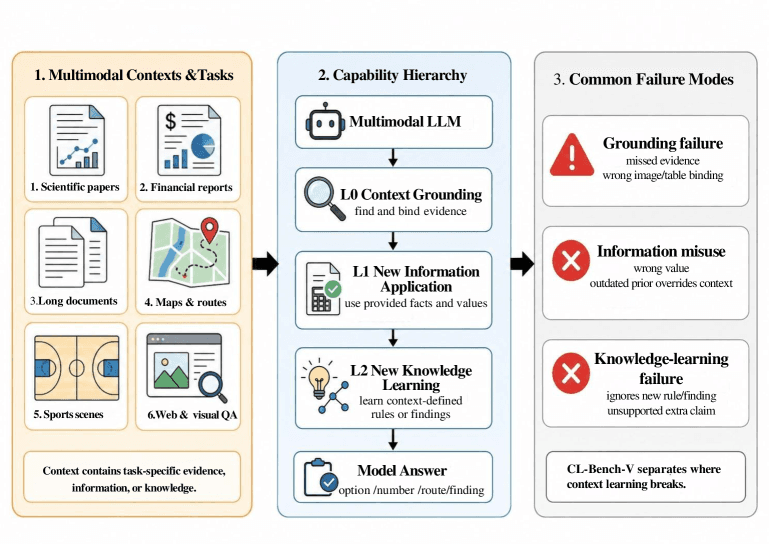
The paper arrives amid a flurry of recent benchmark developments, including SkillsBench (published February 16, 2026 as the first comprehensive benchmark for AI agent skills), GT-HarmBench (testing AI safety through game theory), and BrowseComp-V³ (evaluating multimodal AI's ability to perform deep web searches). Despite this proliferation of testing frameworks, the fundamental question of reliability has remained inadequately addressed.
A Four-Dimensional Framework for Reliability
Grounded in safety-critical engineering principles, the researchers propose evaluating AI agents across four key dimensions:
1. Consistency: Does the agent produce the same output given the same input across multiple runs? Inconsistent behavior indicates fundamental instability in the agent's decision-making process.
2. Robustness: How well does the agent withstand perturbations, noise, or variations in input? Real-world environments are messy, and agents must perform reliably despite imperfect conditions.
3. Predictability: When the agent fails, does it do so in predictable ways? Unpredictable failure modes are particularly dangerous because they prevent effective safeguards and recovery mechanisms.
4. Safety: Are the agent's errors bounded in severity? Some failures are merely inconvenient, while others are catastrophic. Understanding error severity is crucial for risk assessment.
For each dimension, the researchers propose three concrete metrics, resulting in a comprehensive 12-metric reliability profile that moves beyond simplistic pass/fail evaluations.
Revealing Findings from Agent Evaluation
The research team evaluated 14 state-of-the-art agentic models across two complementary benchmarks, revealing several critical insights:
First, despite significant capability gains in recent years—as measured by traditional accuracy metrics—reliability improvements have been minimal. Agents that score highly on standard benchmarks continue to exhibit fundamental reliability flaws.
Second, reliability varies dramatically across different dimensions. An agent might be highly consistent but fragile to minor input perturbations, or robust but unpredictable in its failure modes.
Third, the researchers identified specific patterns of degradation—ways in which agent performance breaks down under stress or unusual conditions. Understanding these patterns is essential for designing effective safeguards and fallback mechanisms.
Implications for AI Development and Deployment
This research arrives at a critical juncture in AI development. As noted in recent coverage, "Research reveals fundamental identity problems in AI agents that undermine security and accountability" (February 18, 2026). The reliability framework addresses precisely these concerns by providing tools to systematically assess and improve agent dependability.
For developers, the metrics offer actionable guidance for improving agent design. Rather than simply chasing higher accuracy scores, teams can now target specific reliability dimensions—strengthening robustness against adversarial inputs, improving consistency across runs, or bounding error severity.
For regulators and organizations deploying AI systems, the framework provides a more nuanced risk assessment tool. A medical diagnosis agent with high accuracy but unpredictable failure modes presents different risks than one with slightly lower accuracy but bounded, predictable errors.
The Path Forward: Toward a Science of Reliability
The paper's title—"Towards a Science of AI Agent Reliability"—signals its ambitious scope. Reliability shouldn't be an afterthought or incidental property; it should be a foundational concern with its own principles, methodologies, and metrics.
This approach aligns with broader trends in AI safety research but extends them specifically to agentic systems. While GT-HarmBench focuses on safety through game theory and SkillsBench evaluates agent capabilities, this reliability framework provides the connective tissue—understanding how those capabilities translate (or fail to translate) into dependable performance.
As AI agents take on increasingly important roles in society, developing rigorous methods for assessing and ensuring their reliability becomes not just an engineering challenge but an ethical imperative. This research represents a significant step toward meeting that challenge.
Source: "Towards a Science of AI Agent Reliability" (arXiv:2602.16666, submitted February 18, 2026)