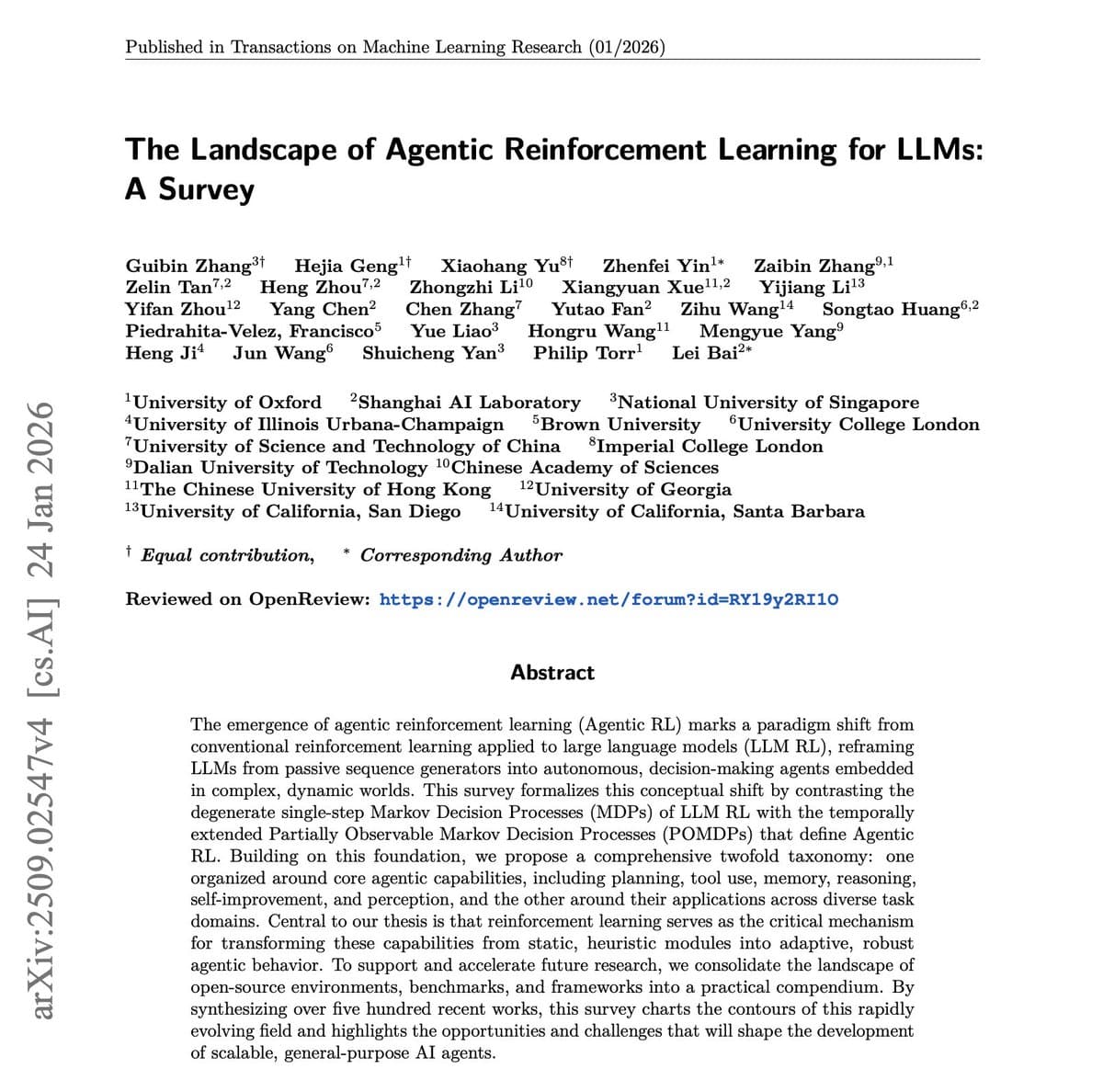
A groundbreaking new survey paper is challenging how researchers approach reinforcement learning for large language models, arguing that current methods treat LLMs as mere sequence generators rather than true autonomous agents. The paper, highlighted by AI researcher Omar Sar, contends that while traditional LLM RL operates in relatively narrow, controlled settings, real-world agents must function in open-ended, partially observable environments where multiple capabilities interact dynamically.
The Limitations of Current LLM Reinforcement Learning
Most existing reinforcement learning approaches for LLMs focus on optimizing text generation against specific reward functions in constrained environments. This paradigm treats language models as sophisticated sequence generators rather than entities capable of autonomous action in complex worlds. The paper argues this approach fails to capture the multifaceted nature of true agency, where planning, memory, tool use, reasoning, self-improvement, and perception must work in concert.
Traditional RL for LLMs typically involves fine-tuning models to maximize rewards on specific tasks like question-answering accuracy or dialogue coherence. While effective for narrow applications, this methodology doesn't prepare models for the unpredictable, open-ended environments where real agents operate. The disconnect between laboratory-optimized sequence generation and real-world agency represents a fundamental challenge in AI development.
Defining the Agentic RL Landscape
The survey paper introduces agentic reinforcement learning as its own distinct research landscape, separate from conventional LLM RL. This emerging field focuses on developing AI systems that can perceive their environment, make decisions, take actions, and learn from experience in ways that go far beyond text generation.
At the core of this new paradigm is the recognition that true agents require integrated capabilities that traditional LLM RL treats separately. An agentic system must simultaneously handle:
- Planning: Formulating sequences of actions to achieve goals
- Memory: Maintaining and utilizing information over time
- Tool use: Interacting with external systems and APIs
- Reasoning: Making logical inferences and decisions
- Self-improvement: Learning from experience to enhance performance
- Perception: Interpreting environmental inputs beyond text
A Comprehensive Taxonomy for Agentic RL
The paper's most significant contribution is a broad taxonomy that organizes the agentic RL field across two dimensions: core agent capabilities and application domains. This framework provides researchers with a structured way to understand the landscape and identify gaps in current approaches.
Core Capabilities Taxonomy categorizes research based on which agentic functions are emphasized, from basic action selection to sophisticated meta-reasoning. Application Domains Taxonomy maps how these capabilities apply across different environments, from simulated worlds to real-world robotics and everything in between.
This dual-axis approach allows for precise characterization of different agentic RL systems and facilitates comparison between approaches that might otherwise seem unrelated. The taxonomy reveals patterns in how capabilities cluster in certain domains and highlights opportunities for cross-pollination between research areas.
Mapping the Agentic RL Ecosystem
Beyond theoretical frameworks, the survey provides practical value by mapping the open-source environments, benchmarks, and frameworks currently shaping agentic RL development. This resource guide helps researchers and developers navigate the rapidly expanding ecosystem of tools for building and testing agentic systems.
The paper catalogs:
- Environments: From text-based worlds like NetHack and ScienceWorld to multimodal environments combining vision and language
- Benchmarks: Standardized tests for evaluating agentic capabilities across different dimensions
- Frameworks: Development tools and platforms for creating and training agentic systems
This mapping reveals both the richness of current resources and significant gaps where new environments and benchmarks are needed to advance the field.
Implications for AI Development
The shift toward agentic RL represents more than just a technical refinement—it signals a fundamental rethinking of what LLMs can become. As models evolve from passive text generators to active agents, they'll need new architectures, training methodologies, and evaluation frameworks.
This evolution has implications across multiple domains:
Research Priorities: Agentic RL requires moving beyond pure language modeling to integrate perception, action, and memory systems. This may lead to new hybrid architectures that combine LLMs with other AI approaches.
Evaluation Challenges: Traditional metrics like perplexity or BLEU scores become inadequate for assessing agentic capabilities. New evaluation frameworks must measure how well agents achieve goals in complex environments.
Safety Considerations: Autonomous agents introduce new risks that sequence generators don't face. Researchers must develop safety frameworks for systems that can take actions in the real world.
Practical Applications: Agentic LLMs could power more sophisticated virtual assistants, autonomous research systems, creative collaborators, and problem-solving tools that interact dynamically with their environments.
The Path Forward for Agentic RL
The survey paper concludes by outlining key research directions for advancing agentic RL. These include developing more realistic and diverse environments, creating better benchmarks for evaluating agentic capabilities, designing architectures that seamlessly integrate multiple capabilities, and addressing the unique safety challenges of autonomous AI systems.
Perhaps most importantly, the paper advocates for treating agentic RL as a unified field rather than a collection of disparate research threads. By establishing common frameworks, taxonomies, and benchmarks, the AI community can accelerate progress toward truly capable autonomous agents.
As Omar Sar notes in his commentary on the paper, "If you are building agents, this is a strong paper worth checking out." For anyone working at the intersection of LLMs and autonomous systems, this survey provides both a comprehensive overview of the current landscape and a roadmap for future development.
Source: Survey on agentic reinforcement learning for LLMs highlighted by Omar Sar (@omarsar0)