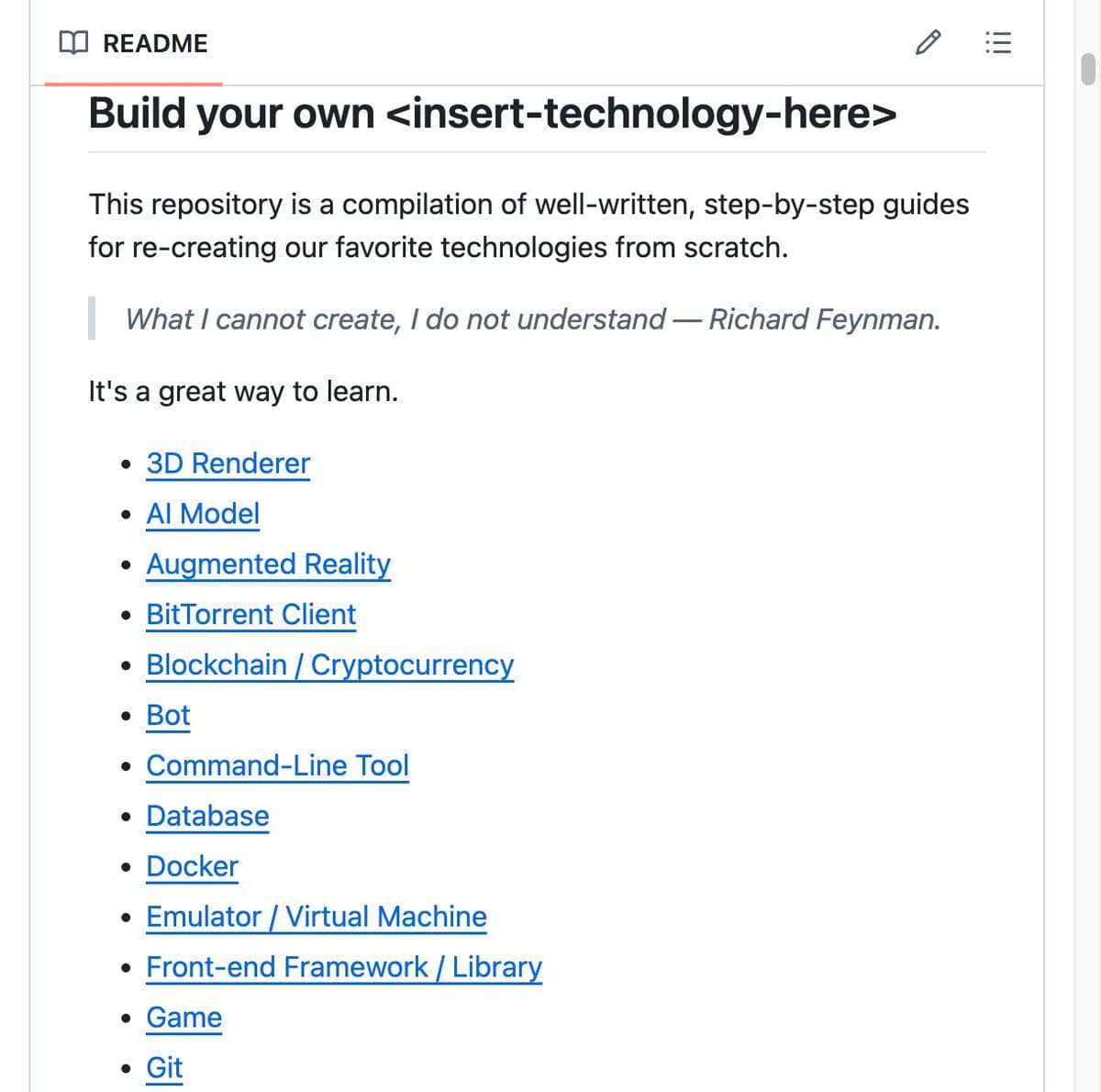
In a remarkable development that speaks volumes about the current state of software engineering education, a GitHub repository called build-your-own-x has quietly become the most-starred project in the platform's history, surpassing industry giants like React and TensorFlow with an astonishing 466,000 stars and 43,700 forks. This isn't another framework or library—it's a meticulously curated collection of tutorials that teach developers how to rebuild foundational technologies from the ground up, without relying on pre-existing libraries or abstractions.
What Makes This Repository Different
The build-your-own-x repository represents a radical departure from typical programming tutorials that focus on tool usage and library implementation. Instead, it follows the philosophy famously articulated by physicist Richard Feynman: "What I cannot create, I do not understand." Each tutorial guides developers through the process of recreating complex systems using only fundamental programming concepts and algorithms.
The collection spans virtually every domain of computing:
- Databases: From B+ Trees to full Redis clones
- Infrastructure: Docker containers in 500 lines of C
- Version Control: Building Git to understand what commits actually are
- AI/ML: Neural networks with real backpropagation (no TensorFlow imports)
- Systems Programming: Operating system kernels written in C
- Language Design: Interpreters, compilers, and garbage collectors
- Graphics: 3D renderers with ray tracing implemented pixel by pixel
Additional categories include web servers, browsers, search engines, shells, regex engines, games, blockchains, BitTorrent clients, and physics engines. Each category features multiple implementations across programming languages including C, C++, Python, Go, Rust, JavaScript, Java, Ruby, Haskell, and TypeScript.
The Counterintuitive Nature of Advanced Learning
Perhaps the most surprising aspect of this repository's popularity is that it's explicitly not beginner material. As noted in the source material, "This is the most advanced learning material that exists for software engineers." The difficulty lies not in complex syntax or obscure features, but in the fundamental requirement to confront every design decision made by the original creators of these technologies.
When building a database from scratch, you can't skip understanding how data structures interact with storage systems. When creating a neural network without libraries, you must implement every mathematical operation manually. This process reveals the hidden complexities that abstraction layers typically conceal, forcing developers to develop a deeper, more intuitive understanding of how systems actually work.
Why This Matters in the Age of AI-Generated Code
The timing of this repository's explosive growth is particularly significant. As AI coding assistants become increasingly capable of generating functional code by importing libraries and following patterns, the value proposition of software engineering is shifting. AI can import libraries, but AI cannot replace an engineer who understands WHY systems work the way they do.
The build-your-own-x approach represents precisely the kind of knowledge that becomes more valuable, not less, as AI automates routine coding tasks. Developers who understand systems at this fundamental level will be better equipped to:
- Debug complex, emergent behaviors in distributed systems
- Design novel architectures rather than just implementing existing patterns
- Make informed decisions about when to build versus when to use existing solutions
- Understand the performance implications of architectural choices
The Open Source Learning Revolution
Equally remarkable is the repository's commitment to accessibility. Every tutorial is 100% free, with no paywalls, sign-ups, or hidden costs. This aligns with the broader open source philosophy while addressing a critical gap in software education: the availability of high-quality, practical learning materials that bridge the gap between theoretical computer science and production engineering.
The repository's structure encourages exploration and comparison. With multiple implementations of the same concept in different languages, developers can see how programming paradigms influence implementation choices. A database built in Rust will necessarily differ from one built in Python, not just in syntax but in fundamental architectural decisions about memory management, concurrency, and error handling.
Implications for Software Engineering Education
This repository's popularity suggests a growing recognition within the developer community that tool proficiency is not equivalent to systems understanding. As the software ecosystem grows increasingly complex with layers of abstraction, there's a countervailing movement toward rediscovering fundamentals.
Educational institutions and bootcamps might take note: while teaching React or TensorFlow gets students productive quickly, teaching them to build these systems from scratch creates engineers capable of innovation rather than just implementation. The 466,000 developers who have starred this repository are voting with their GitHub accounts for a deeper, more fundamental approach to technical education.
Looking Forward: The Future of Developer Expertise
As AI continues to transform the coding landscape, the distinction between syntax-level programming (which AI excels at) and systems-level understanding (which requires human insight) will become increasingly important. The build-your-own-x repository represents a grassroots response to this shift—a community-driven effort to preserve and disseminate the kind of deep technical knowledge that cannot be automated.
The repository's continued growth and maintenance will be worth watching. As new technologies emerge, will the community create "build your own large language model" or "build your own diffusion model" tutorials? The pattern suggests yes, and these additions will only increase the repository's value as a living document of computing fundamentals.
Source: Based on reporting from @hasantoxr on X/Twitter about the build-your-own-x GitHub repository.