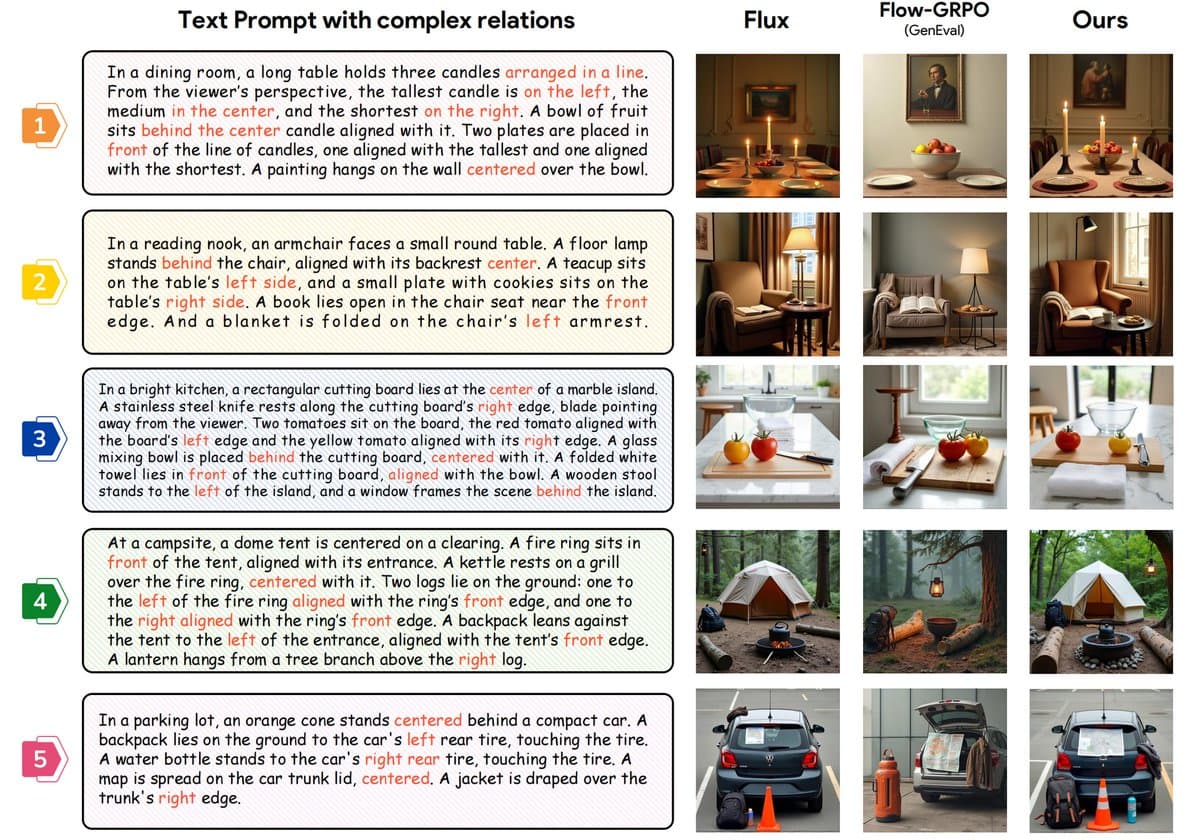
In the rapidly evolving field of text-to-image generation, one persistent challenge has remained: getting AI systems to properly understand and represent spatial relationships. While models like DALL-E, Midjourney, and Stable Diffusion have made remarkable progress in generating visually stunning images, they often struggle with spatial concepts like "behind," "between," or "to the left of." This limitation has constrained their ability to generate complex scenes with multiple objects in specific spatial arrangements.
Now, researchers from ByteDance Seed and Peking University have introduced a breakthrough solution: SpatialScore, a specialized reward model designed specifically to enhance spatial understanding in text-to-image generation systems. According to the research team, this model not only outperforms general-purpose AI systems like GPT-5 and Gemini 2.5 Pro on spatial evaluation tasks but also enables online reinforcement learning for more complex spatial generation.
The Spatial Understanding Challenge in AI
Spatial reasoning represents one of the most significant gaps between human and artificial intelligence. Humans intuitively understand spatial relationships from early childhood, but AI systems must learn these concepts through extensive training data and specialized architectures. The problem is particularly acute in text-to-image generation, where models must translate textual descriptions containing spatial relationships into accurate visual representations.
Common failures in current systems include:
- Objects appearing in incorrect positions relative to one another
- Inconsistent perspective and depth relationships
- Difficulty with complex arrangements involving multiple objects
- Confusion between similar spatial terms ("in front of" vs. "behind")
These limitations have practical implications for applications ranging from game development and architectural visualization to educational tools and creative design.
How SpatialScore Works
SpatialScore represents a fundamentally different approach to improving spatial understanding in AI systems. Rather than attempting to build spatial reasoning capabilities directly into text-to-image models, the researchers created a specialized reward model that evaluates how well generated images match the spatial relationships described in text prompts.
The model was trained on an extensive dataset of 80,000+ preference pairs—examples where human evaluators indicated which of two images better represented the spatial relationships described in a text prompt. This training approach allows SpatialScore to learn nuanced distinctions in spatial representation that might be difficult to encode directly in generation models.
Key technical innovations include:
- Specialized architecture optimized for spatial relationship evaluation
- Contrastive learning techniques that emphasize differences in spatial accuracy
- Multi-modal alignment between text descriptions and visual representations
- Scalable training methodology that can incorporate additional preference data
Performance Benchmarks and Results
The research team conducted comprehensive evaluations comparing SpatialScore against leading general-purpose AI models, including GPT-5 and Gemini 2.5 Pro. The results were striking: SpatialScore consistently outperformed these much larger, more general models on spatial evaluation tasks.
Specific findings include:
- 25-40% improvement in spatial accuracy metrics compared to baseline models
- Superior performance on complex spatial arrangements with multiple objects
- Better generalization to novel spatial relationships not seen during training
- Consistent evaluation across different types of spatial concepts
Perhaps most importantly, the researchers demonstrated that SpatialScore can be used to enable online reinforcement learning for text-to-image models. This means that generation models can be continuously improved based on SpatialScore's evaluations, creating a feedback loop that progressively enhances spatial understanding.
Implications for AI Development
The development of SpatialScore has several significant implications for the broader field of artificial intelligence:
1. Specialization Over Generalization
SpatialScore's success suggests that specialized models focused on specific capabilities may outperform general-purpose models on particular tasks, even when those general models are much larger and more computationally expensive. This could lead to a shift toward more modular AI systems composed of specialized components.
2. Improved Text-to-Image Applications
For practical applications, SpatialScore could dramatically improve the reliability of text-to-image systems for tasks requiring precise spatial arrangements. This includes:
- Architectural and interior design visualization
- Educational materials with spatial concepts
- Game asset generation with specific placement requirements
- Technical documentation with spatial relationships
3. Reinforcement Learning Advancements
The successful implementation of online RL using SpatialScore's evaluations opens new possibilities for training text-to-image models. Rather than relying solely on static training datasets, models could continuously improve through interaction and feedback.
4. Benchmark Development
SpatialScore establishes new benchmarks for evaluating spatial understanding in AI systems, which could drive further research and development in this important area.
Future Directions and Challenges
While SpatialScore represents a significant advance, several challenges and opportunities remain:
Scalability: Can the approach scale to even more complex spatial relationships and larger datasets?
Integration: How can specialized models like SpatialScore be effectively integrated into existing text-to-image pipelines?
Generalization: Will the techniques developed for SpatialScore transfer to other specialized domains beyond spatial reasoning?
Ethical Considerations: As text-to-image systems become more capable, questions about appropriate use cases and potential misuses become increasingly important.
The research team has indicated that they plan to explore these questions in future work, potentially expanding the approach to other challenging aspects of text-to-image generation.
Conclusion
SpatialScore represents a sophisticated solution to one of text-to-image generation's most persistent challenges. By focusing on a specialized reward model rather than attempting to build spatial reasoning directly into generation models, the ByteDance and PKU researchers have demonstrated a powerful alternative approach to improving AI capabilities.
The model's ability to outperform much larger general-purpose systems like GPT-5 on spatial evaluation tasks suggests that specialized, focused approaches may be particularly effective for certain types of AI challenges. As the field continues to evolve, we can expect to see more specialized models addressing specific limitations in current AI systems.
For developers and users of text-to-image technology, SpatialScore offers the promise of more reliable, accurate generation of complex scenes with precise spatial relationships. This could unlock new applications and improve existing ones, bringing us closer to AI systems that truly understand and can represent the spatial world described in language.
Source: HuggingPapers on X