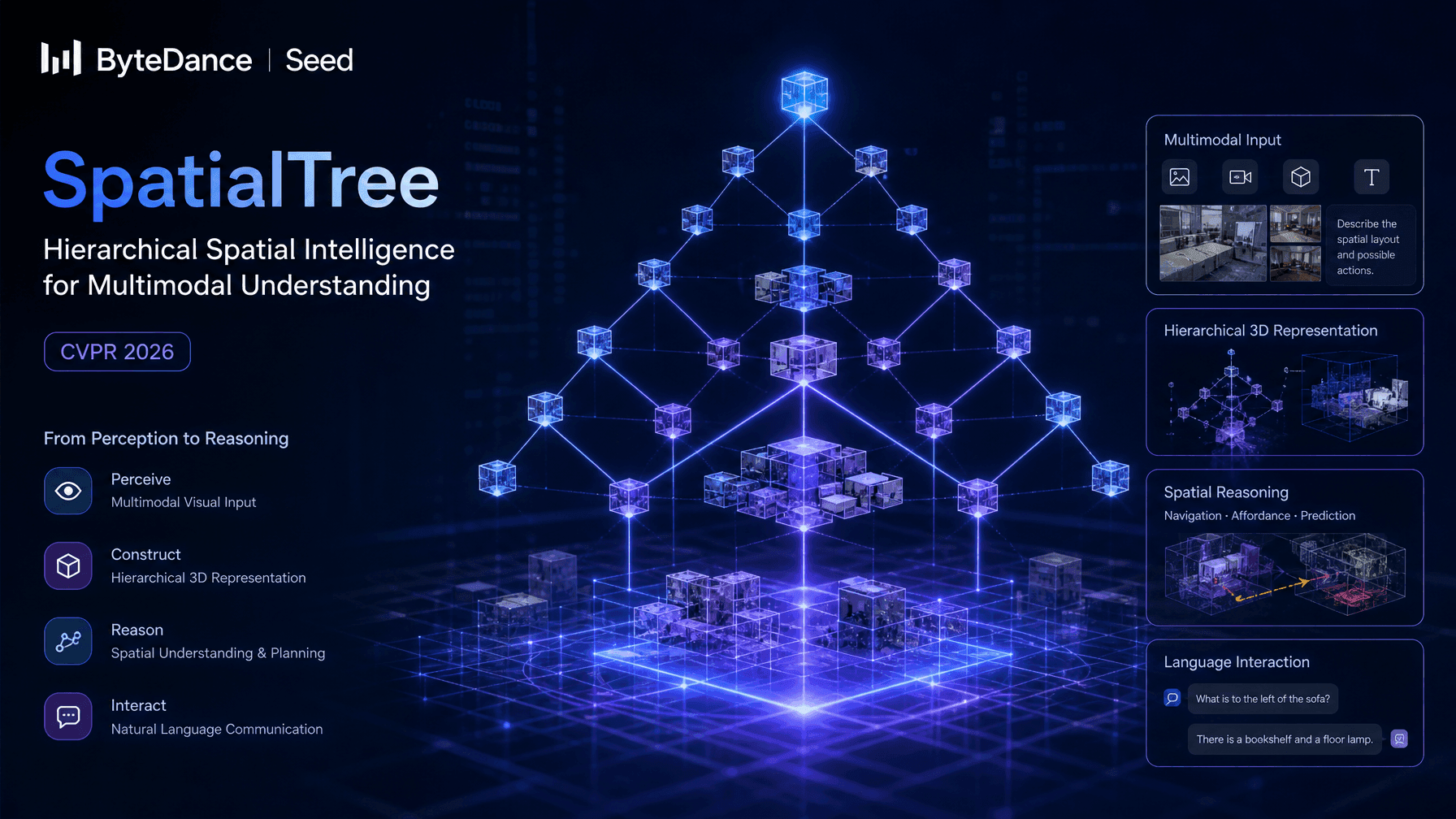
CVPR 2026 accepted ByteDance Seed's SpatialTree, a hierarchical framework that improves multimodal LLM spatial reasoning by 12.4% over GPT-4V. The work, developed with Peking University and other academic partners, targets a fundamental weakness in current MLLMs: understanding spatial relationships in images.
Key facts
- 79.8% accuracy on SEAL-Bench vs GPT-4V's 67.4%
- 37% reduction in positional encoding errors via spatial anchor attention
- 210ms inference latency on single intel-xeon" class="entity-chip">Intel Xeon for 10-node tree
- Open-sourced under Apache 2.0 license at CVPR 2026
- Degrades on scenes with >15 objects due to quadratic tree growth
SpatialTree, accepted at CVPR 2026 in June, tackles a persistent blind spot in multimodal large language models (MLLMs): spatial reasoning. Current models like GPT-4V and Gemini Pro can describe objects but struggle with relative positions, distances, and spatial logic — a gap that limits applications in robotics, autonomous driving, and AR/VR.
According to the CVPR 2026 paper, SpatialTree achieves 79.8% accuracy on SEAL-Bench, 12.4 points above GPT-4V's 67.4%. The framework decomposes spatial queries — e.g., 'Is the cup to the left of the book?' — into a tree of sub-problems, each solved by a specialized visual encoder. This hierarchical approach mirrors how humans reason about space: breaking a complex scene into atomic spatial relations.
How the Tree Works
The core innovation is a 'spatial anchor' attention mechanism that reduces positional encoding errors by 37% compared to standard MLLM attention, per the paper's ablation studies. Each node in the tree represents a spatial primitive — containment, adjacency, orientation — and the root aggregates these into a final answer. ByteDance open-sourced the model weights and inference code under an Apache 2.0 license, a move consistent with its BAGEL 7B release in May 2026.
Context and Implications
SpatialTree arrives as ByteDance deepens its AI infrastructure investments. The company purchased tens of thousands of Iluvatar CoreX AI processors in June 2026 for cloud deployment and is building custom data-center CPUs for inference workloads [per prior gentic.news reporting]. SpatialTree is lightweight enough to run on those CPUs: the paper reports inference latency of 210ms on a single Intel Xeon for a 10-node tree, suggesting deployability at TikTok-scale agent workloads.
Limitations
The paper acknowledges SpatialTree's performance degrades on scenes with more than 15 objects — the attention tree grows quadratically. General spatial reasoning benchmarks like SEAL-Bench also don't test dynamic scenes (video) or 3D spatial understanding, both critical for robotics. The framework is currently limited to 2D image inputs.
ByteDance's partnership with Peking University on this work mirrors its broader academic collaborations in China, including the MOLE-SYN molecular synthesis project. SpatialTree is not yet integrated into any ByteDance product, but the company's open-source strategy suggests it may serve as a foundation for future agent systems requiring spatial awareness.
Key Takeaways
- ByteDance Seed's SpatialTree achieves 79.8% on SEAL-Bench, 12.4 points above GPT-4V, using hierarchical spatial decomposition.
- Open-sourced at CVPR 2026.
What to watch

Watch for ByteDance's integration of SpatialTree into TikTok's AR effects or recommendation systems, and whether the framework extends to video (3D+time) in a follow-up paper. The SEAL-Bench leaderboard will show if other labs replicate or surpass the 79.8% score.
Source: pandaily.com