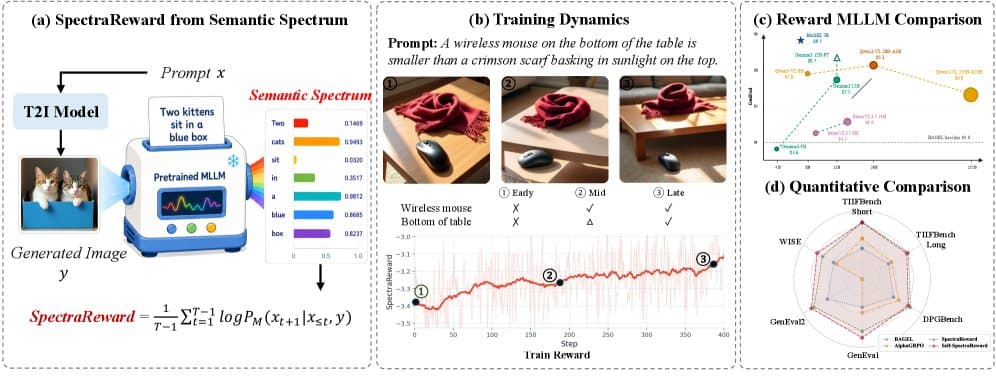
ByteDance Seed's SpectraReward reads a text prompt back from a generated image without any training. It uses image-conditioned prompt log-likelihood as a reward signal, bypassing preference labels and fine-tuning entirely.
Key facts
- SpectraReward uses image-conditioned prompt log-likelihood as reward.
- No training, no preference labels, no question decomposition needed.
- Zero-shot applicable to any text-to-image model.
- First training-free reward for text-to-image generation.
- Code and model weights released by ByteDance Seed.
ByteDance Seed, the AI research arm of ByteDance, has released SpectraReward, a training-free reward model for text-to-image generation. According to @HuggingPapers, SpectraReward uses image-conditioned prompt log-likelihood as a reward signal—no training, no preference labels, and no question decomposition needed.
Unlike existing reward models that require fine-tuning on human preference datasets or complex multi-step reasoning, SpectraReward directly measures how well the generated image encodes the original prompt. It computes the log-likelihood of the text prompt given the image, effectively asking "how likely is this prompt if we only see this image?" The higher the log-likelihood, the better the image aligns with the prompt.
This approach sidesteps a key bottleneck in reward model development: the need for large, curated preference datasets. By eliminating training, SpectraReward can be applied zero-shot to any text-to-image model without additional data collection or compute. The method is particularly attractive for iterative refinement during inference, where a reward signal can guide diffusion or autoregressive generation steps without modifying the base model.
SpectraReward joins a growing trend of training-free alignment methods in generative AI. Earlier this year, researchers at Meta and Google explored similar log-likelihood-based rewards for language models, but this is among the first applications to image generation. The technique's simplicity—no question decomposition, no auxiliary models—makes it easy to integrate into existing pipelines.
The release includes code and model weights, though ByteDance Seed has not disclosed specific benchmark results or comparisons against trained reward models like ImageReward or HPS v2. The community will need to validate whether prompt log-likelihood alone captures nuanced aspects of image quality, such as aesthetic appeal or compositional accuracy, which trained reward models explicitly target.
Key Takeaways
- ByteDance Seed releases SpectraReward, a training-free reward that reads a prompt back from a generated image using prompt log-likelihood.
- No training or preference labels needed.
What to watch

Watch for community benchmarks comparing SpectraReward against ImageReward and HPS v2 on standard datasets like DrawBench or PartiPrompts. If prompt log-likelihood matches trained reward models on alignment metrics, it could accelerate RL-free alignment for image generation.