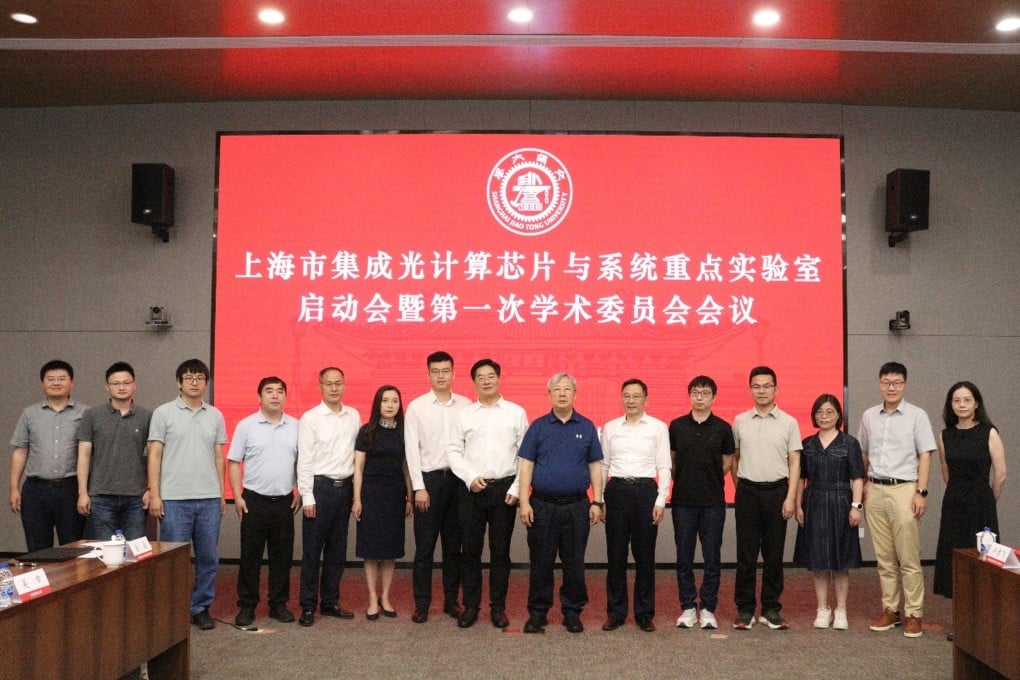
Shanghai launched the Key Laboratory of Integrated Photonic Computing Chips and Systems on Wednesday. It is China's first industry-academia platform dedicated to photonic computing, aiming to bypass US chip export curbs.
Key facts
- Lab launched Wednesday, December 2026.
- First industry-academia platform for photonic computing in China.
- Director Zou Weiwen is a photonics professor at Shanghai Jiao Tong University.
- Photons travel faster and generate less heat than electrons.
- Lab targets silicon-photonics integration and optical components.
The Shanghai Key Laboratory of Integrated Photonic Computing Chips and Systems, launched on Wednesday, was China's first industry-academia platform dedicated to the field, according to the SCMP. Zou Weiwen, director of the new laboratory and a photonics professor at Shanghai Jiao Tong University, said photonic – or optical – computing was “an important pathway for achieving breakthroughs in computing power, offering advantages in bandwidth, latency, and energy efficiency.”
The lab aims to develop chips that use photons instead of electrons for data transmission and computation. Because photons travel much faster than electrons and generate less heat, photonic chips could deliver higher performance while consuming just a fraction of the power – making them a potential alternative to the conventional semiconductors used in power-hungry data centres supporting the AI boom. The Shanghai lab would focus on research into photonic chip architectures, silicon-photonics integration, optical components and the algorithms and commercial applications needed to make them viable.
Why photonics now
The launch comes as tech companies around the world race to secure the massive computing power required to train and run increasingly sophisticated AI models. The surging energy consumption and performance demands of the models are pushing conventional silicon semiconductors to their physical limits. For China, the urgency is compounded by US export controls that restrict access to advanced chips from Nvidia and others, making domestic alternatives like photonic computing a strategic priority.
The lab's focus on silicon-photonics integration is notable: it aims to combine optical components with existing silicon manufacturing processes, potentially enabling faster commercial deployment. However, Zou acknowledged that fundamental scientific challenges remain before photonic chips can match theoretical performance. The lab is based at Shanghai Jiao Tong University, leveraging existing research infrastructure.
A long road ahead
Photonics has been a research topic for decades, but commercial photonic AI accelerators remain rare. Companies like Lightmatter and Celestial AI have raised venture funding for optical interconnects and compute, but no photonic chip has yet demonstrated competitive performance against Nvidia's H100 or B200 on standard AI benchmarks like MLPerf. The Shanghai lab's work will need to overcome issues with optical component integration, signal loss, and algorithm mapping to become viable for large-scale AI training.
What to watch
Watch for any published benchmark results from the Shanghai lab within 12 months, particularly comparisons against Nvidia's latest GPUs on standard AI inference tasks. Also monitor US export control updates that may expand or contract restrictions on photonic components.
Source: scmp.com