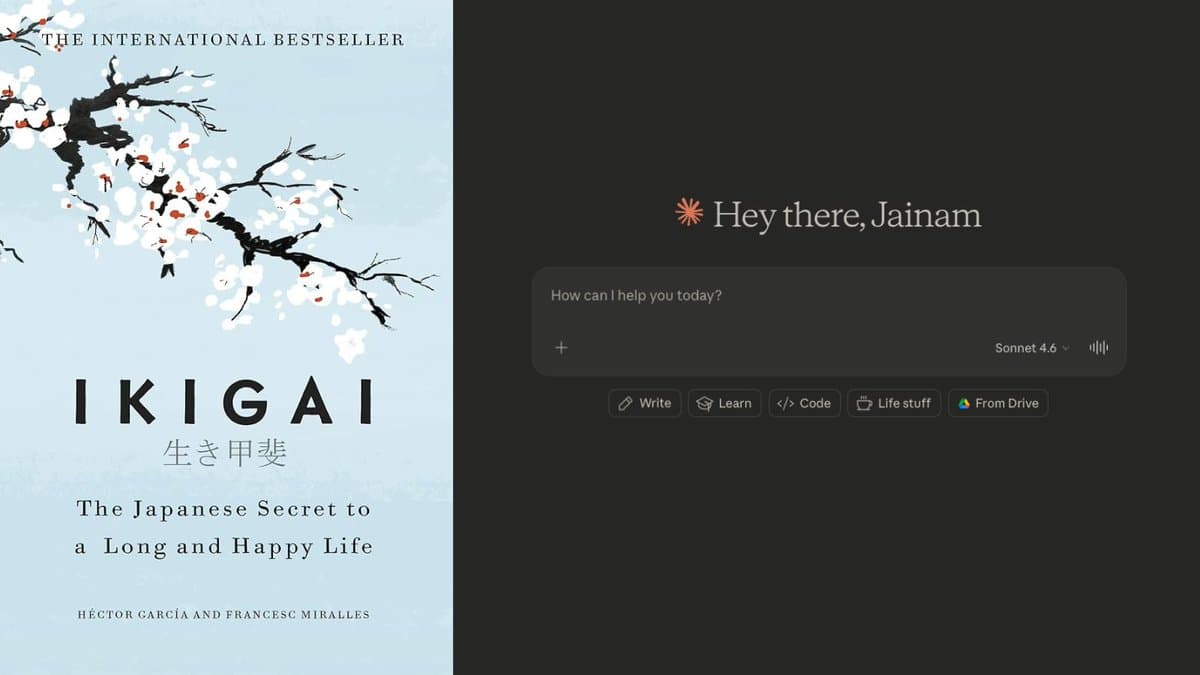
A viral social media post from AI creator Jairam R. (@aiwithjainam) has sparked interest in a so-called "secret mode" for Anthropic's Claude AI assistant called the "Ikigai Career Mapper." The post claims this mode helps users find the intersection of their skills, passions, and income needs to identify fulfilling careers.
However, the linked resource reveals this is not a hidden feature built into Claude's interface, but rather a sophisticated, pre-written prompt template designed to guide users through a structured career coaching session using the Ikigai framework.
What Is the 'Ikigai Career Mapper'?
The "Ikigai Career Mapper" is a detailed text prompt. When pasted into a new chat with Claude (Claude 3.5 Sonnet is recommended), it instructs the AI to act as a career coach. It guides the user through a multi-step process based on the Japanese concept of Ikigai, which seeks the intersection of four elements:
- What you love (your passion)
- What you are good at (your vocation)
- What the world needs (your mission)
- What you can be paid for (your profession)
The prompt template structures a conversation where Claude asks a series of reflective questions across these four domains. Based on the user's responses, it then synthesizes the information to suggest potential career paths, roles, or industries that align with the user's stated inputs.
How to 'Activate' It
Activation is straightforward:
- Navigate to the shared resource (a site like GitHub Gist or similar).
- Copy the entire block of prompt text.
- Start a new chat with Claude, preferably Claude 3.5 Sonnet.
- Paste the prompt and send it.
- Claude will acknowledge the instructions and begin the coaching session.
This method is an example of prompt engineering—crafting detailed instructions to unlock specific, high-quality behaviors from a general-purpose AI model. It leverages Claude's strengths in long-context understanding and conversational depth.
Context: The Rise of AI-Powered Career Coaching
The emergence of such prompts is part of a broader trend where users and creators are building specialized "modes" or "agents" on top of foundational models like Claude and GPT-4. These are not official features but shared community knowledge. Similar prompt libraries and "system prompt" collections exist for tasks like brainstorming, editing, strategic planning, and technical tutoring.
This specific application taps into a growing use case for large language models (LLMs) in personal and professional development. The Ikigai framework provides a familiar and structured philosophy that an LLM can operationalize through dialogue, making abstract self-reflection more concrete and actionable.
Limitations and Considerations
- Dependent on User Input: The quality of the output is entirely dependent on the depth, honesty, and self-awareness of the user's responses. The AI can only work with the information provided.
- Not a Certified Career Advisor: The suggestions are generative outputs based on pattern recognition in the model's training data. They should be treated as brainstorming aids, not professional, certified career advice.
- No Official Endorsement: This is a community-shared prompt, not an official tool released or verified by Anthropic. Its effectiveness may vary across different Claude model versions.
gentic.news Analysis
This viral moment is less about a technical breakthrough and more about the evolving prompt-as-software paradigm. The "Ikigai Career Mapper" is a user-created application that runs on the Claude platform, demonstrating how the most valuable features of modern AI are increasingly co-created by the community. This aligns with trends we've covered, such as the proliferation of Claude 3.5 Sonnet's "Artifacts" feature for project-based work, which creates a natural environment for these structured prompt interactions.
The framing of a "secret mode" is savvy marketing but highlights a real user desire: for AI interfaces to feel more like tools with dedicated functions, rather than blank text boxes. Anthropic's main competitor, OpenAI, has addressed this with GPTs and a dedicated GPT Store, allowing users to build and share tailored versions of ChatGPT. Anthropic has taken a different, more open approach by empowering users to achieve similar specialization through advanced prompting within a single, powerful model—Claude 3.5 Sonnet. This incident shows that community is effectively building its own "store" of prompts, distributed through social networks.
From a technical perspective, the effectiveness of this prompt is a testament to the instruction-following and role-playing capabilities of Claude 3.5 Sonnet. Successfully guiding a user through a multi-stage, reflective framework without breaking character requires strong context management and reasoning, areas where this model family has excelled in benchmarks. The viral spread of this prompt will serve as another real-world, stress-test case study for Anthropic's engineers.
Frequently Asked Questions
Is the Ikigai Career Mapper a real hidden feature in Claude?
No. It is not a hidden setting or official feature built into the Claude.ai interface or API. It is a sophisticated prompt template created by a member of the AI community. When you paste this prompt into a chat, you are giving Claude a specific set of instructions to follow, not activating a dormant mode.
Which Claude model works best with the Ikigai Career Mapper prompt?
The prompt creator recommends using Claude 3.5 Sonnet. This is currently Anthropic's most capable model for complex reasoning and long-context tasks, making it ideally suited for the nuanced, multi-turn conversation the prompt requires. Older models like Claude 3 Haiku or Opus may not follow the instructions as precisely or may have shorter effective context windows.
Is it safe to share my personal career details with Claude for this?
You should apply the same discretion as with any online tool. Do not share highly sensitive personal data (e.g., social security numbers, exact financial details). The conversation is subject to Anthropic's privacy policy. For generic discussions about skills, interests, and industry trends, the risk is generally considered low, but you should never input information you wouldn't want potentially stored or reviewed.
Can I modify the Ikigai prompt for other types of coaching?
Absolutely. This is a core strength of prompt engineering. You can use the structure of this prompt as a template. By changing the domain (e.g., from "career" to "fitness planning," "learning roadmap," or "business idea validation") and adjusting the framework questions, you can instruct Claude to act as a specialized coach for almost any goal-oriented, reflective process.