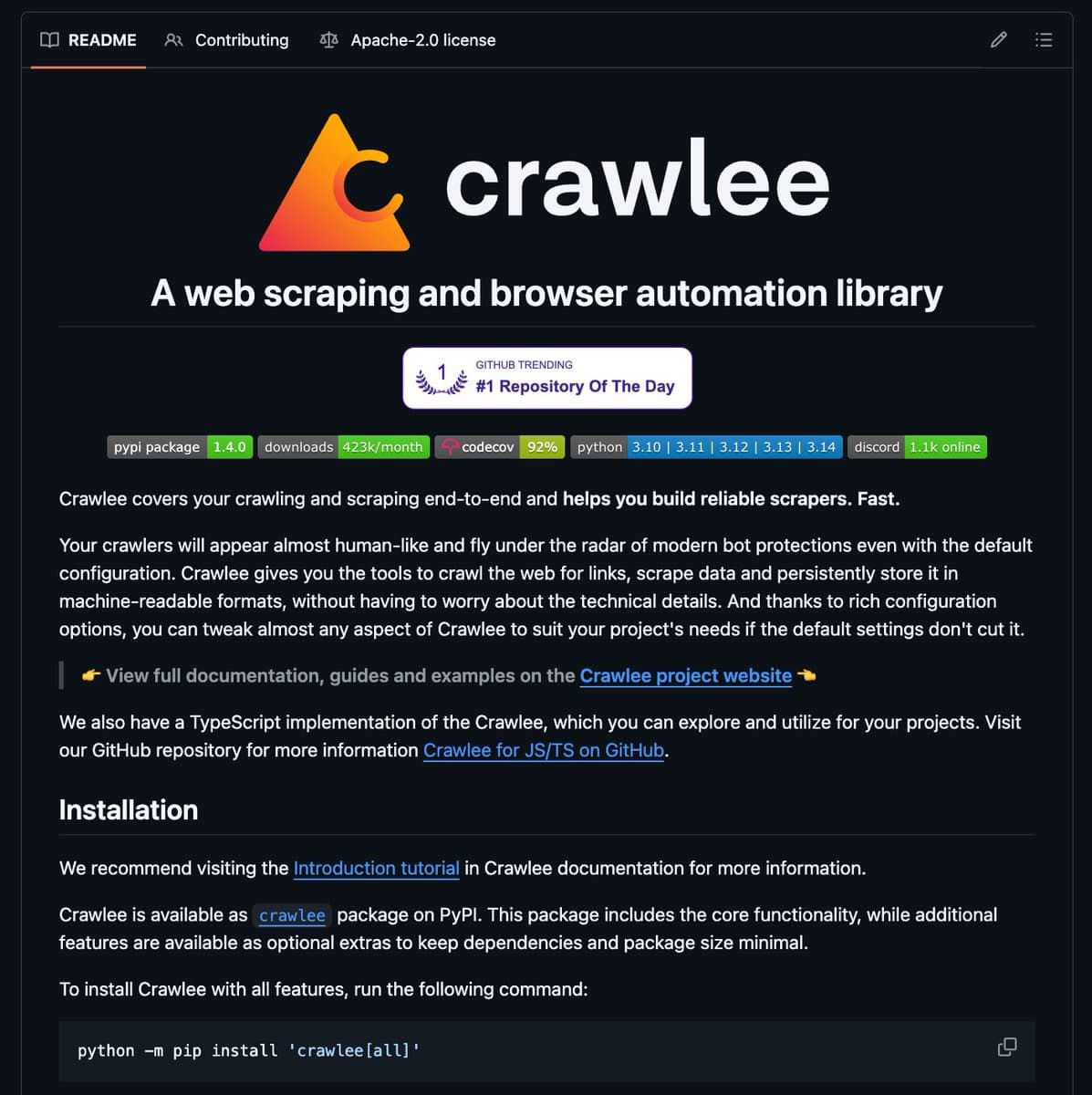
In the ever-evolving cat-and-mouse game between web scrapers and anti-bot systems, a new contender has emerged that promises to tilt the balance. Crawlee, a 100% open-source Python library, is gaining attention for its ability to create web scrapers that "fly under the radar of every modern anti-bot system," according to developer Hasantoxr who recently highlighted the tool on social media.
With 8.1K GitHub stars and growing, Crawlee represents a significant development in the web scraping ecosystem, offering enterprise-grade capabilities in an accessible, open-source package under the permissive Apache 2.0 license.
What Makes Crawlee Different?
Traditional web scraping tools often struggle against increasingly sophisticated bot detection systems that analyze everything from request patterns to browser fingerprints. Crawlee addresses these challenges through a multi-layered approach:
Flexible Scraping Options: Developers can choose between BeautifulSoup for simple HTML parsing, Playwright for JavaScript-heavy sites, or raw HTTP requests depending on their needs. This flexibility allows scrapers to adapt to different website architectures without changing tools.
Advanced Evasion Techniques: The library automatically rotates proxies and manages sessions to prevent IP-based blocking. More importantly, it simulates human-like browsing patterns that are difficult for anti-bot systems to distinguish from legitimate traffic.
Headless Browser Support: For modern websites that rely heavily on JavaScript for content rendering, Crawlee provides full headless browser capabilities. This means it can execute JavaScript just like a regular browser, accessing content that traditional HTTP-based scrapers would miss.
Technical Capabilities and Features
Crawlee's architecture is designed for both reliability and stealth. The library includes several key features that set it apart:
Parallel Crawling with Automatic Scaling: The system automatically scales with available system resources, allowing efficient data collection without manual configuration. This is particularly valuable for large-scale scraping projects where performance optimization can be complex.
Persistent Storage and Crash Recovery: Unlike many scraping tools that lose progress on failure, Crawlee saves data to persistent storage. If a scraper crashes or encounters network issues, it can resume from where it left off rather than starting over.
Automatic Retry Logic: Failed requests are automatically retried with configurable backoff strategies. This reduces the need for manual intervention when dealing with temporary network issues or rate limiting.
Multi-Format Support: Beyond HTML, Crawlee can handle PDFs, images (JPG, PNG), and other file formats, making it suitable for diverse data collection needs.
The Open-Source Advantage
Being 100% open-source under the Apache 2.0 license gives Crawlee several advantages over proprietary alternatives. Developers can examine the code to understand exactly how evasion techniques work, contribute improvements, and customize the tool for specific needs without licensing restrictions.
This transparency is particularly valuable in the web scraping domain, where understanding detection mechanisms is crucial for developing effective countermeasures. The open-source model also fosters community development, with contributors adding features and fixing issues that benefit all users.
Ethical and Legal Considerations
While Crawlee's capabilities are impressive, they raise important questions about web scraping ethics and legality. The library's ability to evade detection doesn't override website terms of service or legal restrictions on data collection.
Responsible Use Guidelines:
- Always check robots.txt files and website terms of service
- Implement rate limiting to avoid overwhelming servers
- Respect data privacy regulations like GDPR and CCPA
- Consider the purpose of scraping and potential impact on website owners
Many legitimate use cases exist for advanced scraping tools, including academic research, price monitoring, market analysis, and data journalism. The key is using these capabilities responsibly and legally.
Industry Implications
Crawlee's emergence reflects broader trends in the web scraping industry. As websites implement more sophisticated anti-bot measures, scraping tools must evolve accordingly. This arms race has led to:
Increased Technical Sophistication: Both scraping tools and detection systems are becoming more advanced, incorporating machine learning and behavioral analysis.
Democratization of Advanced Capabilities: Tools like Crawlee make enterprise-grade scraping accessible to individual developers and small organizations that previously couldn't afford proprietary solutions.
Standardization of Best Practices: Open-source libraries often establish de facto standards for how certain technical challenges should be addressed.
Getting Started with Crawlee
Installation is straightforward with a single pip command, making Crawlee accessible to Python developers of varying experience levels. The library's documentation and active GitHub community provide resources for both beginners and advanced users.
For those new to web scraping, Crawlee offers a gentler learning curve than building evasion techniques from scratch. For experienced developers, it provides a robust foundation that can be extended and customized for specific projects.
The Future of Web Scraping
Tools like Crawlee represent the next generation of web scraping technology—smarter, more adaptive, and better integrated with modern web technologies. As artificial intelligence and machine learning continue to advance, we can expect both scraping tools and detection systems to incorporate these technologies more extensively.
The open-source nature of Crawlee suggests that future developments will be driven by community needs rather than corporate priorities. This could lead to more innovative solutions to technical challenges and broader accessibility of advanced web scraping capabilities.
Source: Hasantoxr on X/Twitter (https://x.com/hasantoxr/status/2030331610302988358)