A groundbreaking computer vision framework presented at CVPR 2026 is revolutionizing how artificial intelligence systems understand objects across different perspectives. The research, which received an exceptional review score of 554, introduces a novel approach to cross-view object correspondence that eliminates the need for labor-intensive manual annotations while achieving remarkable robustness.
The Cross-View Challenge in Computer Vision
For years, computer vision researchers have struggled with a fundamental problem: how can AI systems reliably recognize that an object seen from a first-person (egocentric) perspective is the same object when viewed from a third-person (exocentric) perspective? This challenge has significant implications for applications ranging from augmented reality and robotics to surveillance and human-computer interaction.
Traditional approaches have relied heavily on supervised learning with extensive labeled datasets, requiring human annotators to painstakingly identify corresponding objects across different viewpoints. This process is not only time-consuming and expensive but also inherently limited by the quality and diversity of the annotations. The new framework circumvents these limitations entirely through an innovative self-supervised approach.
How the Framework Works: Cycle-Consistent Mask Prediction
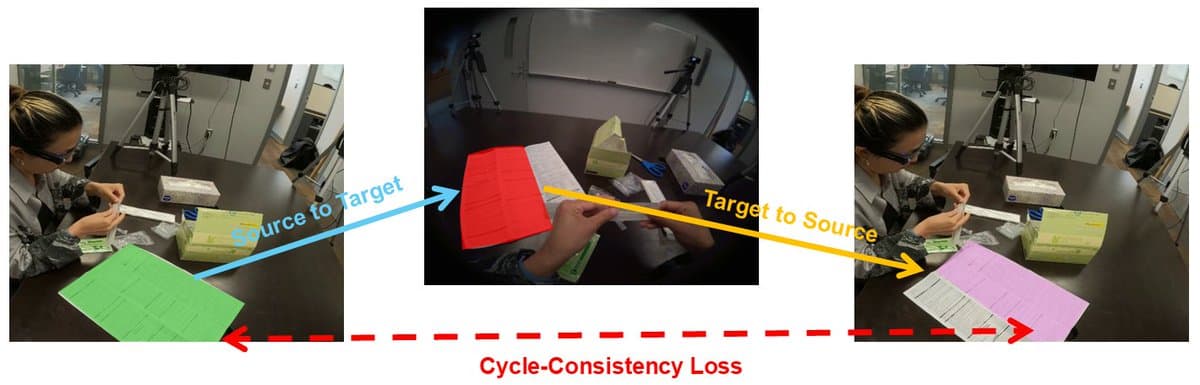
At the heart of this breakthrough is a technique called cycle-consistent mask prediction. The system learns to predict segmentation masks for objects in one view based on their appearance in another view, then cycles back to verify consistency. This creates a self-supervised learning loop where the AI teaches itself to identify corresponding objects without any human-provided ground truth.
The architecture operates through three key components:
View-Invariant Feature Extraction: The system learns to extract object representations that remain consistent regardless of viewing perspective
Cross-View Mask Prediction: Given an object in one view, the model predicts how it would appear segmented in the other view
Cycle Consistency Verification: The system validates its predictions by cycling back to the original view, creating a self-correcting feedback loop
This approach mirrors how humans develop object permanence—the understanding that objects continue to exist even when we can't see them directly. By forcing the AI to maintain consistent object representations across dramatic viewpoint changes, the system develops a more robust understanding of object identity and properties.
Technical Innovations and Architecture
The framework's architecture represents several significant advances in self-supervised learning. Unlike previous methods that might rely on simple feature matching or geometric transformations, this system employs a sophisticated attention mechanism that learns which object features are most relevant for cross-view correspondence.
One particularly innovative aspect is how the system handles occlusion and partial visibility—common challenges in real-world scenarios. When an object is partially obscured in one view but fully visible in another, the framework learns to infer the complete object representation from available information, then uses this to verify correspondence when cycling between views.
Applications and Real-World Impact
The implications of this research extend across numerous domains:
Robotics and Autonomous Systems: Robots could better understand their environment from both onboard and external camera perspectives, improving navigation and manipulation tasks.
Augmented and Virtual Reality: AR systems could more seamlessly integrate virtual objects with real-world scenes from different viewpoints.
Surveillance and Security: Systems could track objects and individuals across multiple camera angles without manual calibration.
Human-Robot Collaboration: Robots could better understand human actions and intentions by correlating first-person human perspectives with external views.
Autonomous Vehicles: Self-driving cars could improve their understanding of objects seen from vehicle-mounted cameras versus infrastructure cameras.
Performance and Validation
The exceptional review score of 554 at CVPR 2026—one of the most prestigious computer vision conferences—indicates strong validation from the research community. While specific benchmark numbers aren't provided in the initial announcement, such high scores typically reflect both technical innovation and empirical results that significantly advance the state of the art.
The framework's ability to learn without ground-truth annotations represents a paradigm shift in how computer vision systems are trained. By reducing dependency on labeled data, this approach could accelerate development cycles and make advanced computer vision capabilities more accessible to organizations without massive annotation budgets.
Future Directions and Research Implications
This work opens several promising research directions. Future iterations might incorporate temporal consistency for tracking objects across time as well as viewpoints, or extend the approach to handle more extreme viewpoint changes. The fundamental insight—that cycle consistency can replace manual annotations for certain correspondence tasks—could inspire similar approaches in other areas of computer vision and machine learning.
Researchers might also explore how this framework could be combined with large vision-language models to enable more sophisticated reasoning about objects across views, potentially leading to AI systems with more human-like understanding of spatial relationships and object permanence.
Conclusion
The cross-view object correspondence framework represents a significant step toward more robust, flexible, and efficient computer vision systems. By eliminating the need for costly manual annotations while achieving strong performance, this research addresses one of the fundamental bottlenecks in AI development. As the field continues to move toward more self-supervised and unsupervised learning approaches, techniques like cycle-consistent mask prediction will likely become increasingly important for developing AI systems that can understand and interact with the world as humans do—from multiple perspectives simultaneously.
Source: HuggingPapers on X/Twitter, referencing CVPR 2026 research on cross-view object correspondence.