Cursor AI has unveiled a new methodology for evaluating AI models on agentic coding tasks, providing developers and organizations with more nuanced insights into how different AI assistants perform in real-world development scenarios. The company shared its findings on how various models compare in terms of both intelligence and efficiency, marking a significant advancement in how we measure AI coding capabilities.
What Are Agentic Coding Tasks?
Agentic coding tasks refer to complex development workflows where AI assistants operate with significant autonomy to complete multi-step programming challenges. Unlike simple code completion or single-function generation, these tasks involve understanding broader context, making decisions about implementation approaches, and executing sequences of actions to achieve development goals.
Traditional benchmarks have often focused on narrow metrics like code completion accuracy or specific algorithm implementation. Cursor AI's new approach evaluates how models perform across entire development workflows, providing a more comprehensive view of their practical utility.
The Two-Dimensional Evaluation Framework
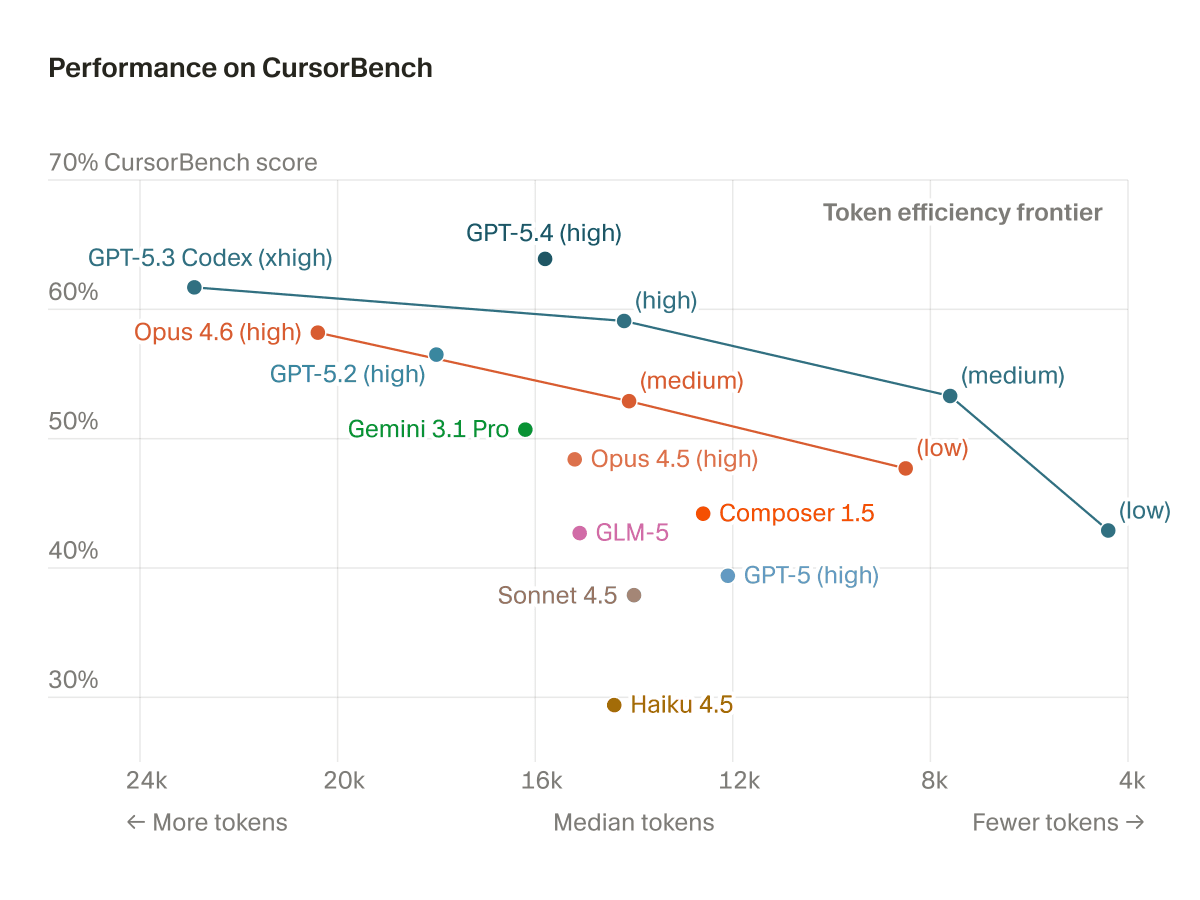
Cursor AI's methodology assesses models along two primary dimensions: intelligence and efficiency. This dual-axis approach recognizes that raw capability alone doesn't determine a model's practical value in development workflows.
Intelligence measures a model's ability to understand complex requirements, reason about implementation approaches, and produce correct, well-structured code. This dimension evaluates the cognitive capabilities that enable AI assistants to tackle challenging programming problems.
Efficiency assesses how quickly and resource-effectively models can complete tasks. This includes factors like token usage, response time, and the number of interactions required to reach satisfactory solutions. Efficiency metrics are particularly important for practical deployment where computational costs and developer time are significant considerations.
Comparative Performance Insights
While the specific numerical results are detailed in Cursor AI's full report (available through their shared link), the comparative analysis reveals interesting patterns about how different models balance intelligence and efficiency.
Some models demonstrate exceptional raw intelligence but require more computational resources and interaction cycles to achieve results. Others show remarkable efficiency but may struggle with the most complex reasoning tasks. The optimal balance depends on specific use cases and organizational priorities.
Implications for Development Teams
This new benchmarking approach has several important implications for software development teams:
Informed Tool Selection: Development teams can now make more data-driven decisions about which AI coding assistants to adopt based on their specific needs and constraints.
Workflow Optimization: Understanding the intelligence-efficiency tradeoffs helps teams design better development workflows that leverage AI strengths while mitigating limitations.
Cost-Benefit Analysis: Organizations can perform more accurate ROI calculations by considering both capability and resource requirements.
The Evolving Landscape of AI-Assisted Development
Cursor AI's benchmarking initiative reflects the maturation of AI-assisted development tools. As these tools move from novelty to necessity in many development environments, standardized evaluation methodologies become increasingly important.
This development also highlights the growing recognition that AI coding assistants need to be evaluated in context—not just on isolated technical capabilities, but on how they perform in realistic development scenarios that developers actually encounter.
Future Directions and Industry Impact
The introduction of this benchmarking methodology may spur several industry developments:
Standardization Efforts: Other organizations may adopt or adapt Cursor AI's approach, potentially leading to industry-standard evaluation frameworks.
Model Improvement: AI developers can use these insights to optimize their models for better balance between intelligence and efficiency.
Specialized Solutions: We may see more specialized AI coding assistants optimized for specific types of development work or organizational needs.
Accessing the Full Analysis
Developers and organizations interested in the detailed comparative analysis can access Cursor AI's full report through the link shared in their announcement. The comprehensive evaluation provides specific data on how various models perform across different types of coding tasks and development scenarios.
Source: Cursor AI announcement on X (formerly Twitter) - https://x.com/cursor_ai/status/2032148125448610145