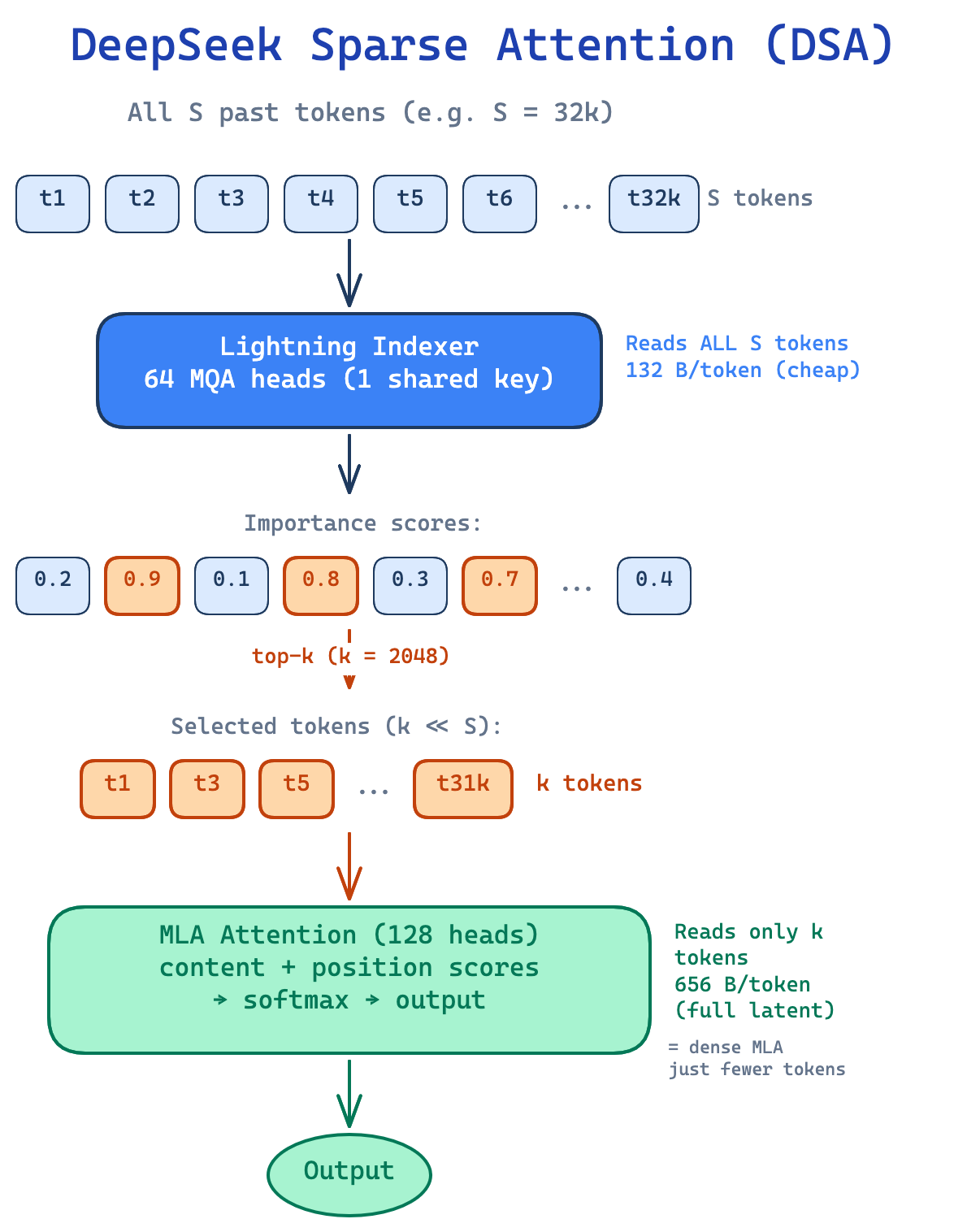
SemiAnalysis posted that DeepSeek Sparse Attention (DSA) challenges the dominant paradigm, favoring selective redistribution of finite resources. Under finite resources, DSA directs compute where it matters most while cutting waste.
Key facts
- SemiAnalysis posted DSA challenges dominant paradigm
- DSA favors selective redistribution of finite resources
- No benchmark numbers or architecture details disclosed
- Follows lab findings on redundant attention heads (up to 40%)
- Could reduce training/inference costs by concentrating compute
SemiAnalysis, the influential AI infrastructure research firm, published a short post on X declaring that DeepSeek Sparse Attention (DSA) "challenges the dominant paradigm." According to @SemiAnalysis_, under finite resources, DSA favors selective redistribution, directing resources where they matter most while reducing waste. The post is thin on technical specifics—no architecture diagram, no benchmark numbers, no ablation results—but the signal is clear: DeepSeek's attention mechanism is being positioned as a structural counter to the field's default assumption that dense attention is the only viable path to scale.
What DSA implies
Sparse attention is not new—Longformer (Beltagy et al. 2020) and BigBird (Zaheer et al. 2020) introduced fixed sparse patterns years ago. What makes DSA potentially different is the word "selective." Instead of a static mask, DSA appears to redistribute attention dynamically, concentrating compute on tokens that carry the most information. If true, that would mean DeepSeek has moved from hand-crafted sparsity to learned, input-dependent sparsity. The payoff is tangible: lower FLOPs per forward pass, reduced memory bandwidth pressure, and the ability to push context windows further without linear cost growth.
Why it matters now
This comes at a moment when the industry is hitting the wall of dense attention scaling. Training runs like GPT-4-class models cost hundreds of millions of dollars, and inference at scale is a growing operational burden. Recent lab findings have shown that attention heads in dense transformers are often redundant, with up to 40% of heads contributing little to final performance. DSA aligns with that evidence: if you can identify and skip low-value computations, you save real dollars. SemiAnalysis, which has deep ties to the hardware and data-center world, is signaling that this is not just an academic curiosity but a cost curve inflection point.
The contrarian read
The hype is ahead of the evidence. The source post contains zero numbers—no accuracy delta, no speedup ratio, no cost comparison. Sparse attention has a history of promising efficiency gains that vanish when you measure end-to-end throughput on real hardware, especially with modern tensor-core optimizations that favor dense, regular operations. If DSA requires custom kernels or dynamic routing, the overhead could eat the theoretical savings. The real test is whether DeepSeek ships a model using DSA and publishes a benchmark that shows a win on both quality and cost. Until then, treat this as a directional signal, not a proven breakthrough.
Key Takeaways
- SemiAnalysis touts DeepSeek Sparse Attention as a paradigm shift, but lacks data.
- Sparse attention could cut costs, yet no benchmarks yet.
What to watch
Watch for DeepSeek's next model release—if it uses DSA and includes a technical report with FLOPs, memory, and quality metrics versus dense baselines, that will confirm the claim. Also monitor SemiAnalysis for a follow-up analysis with actual measured speedups.