A pointed critique of the prevailing AI-as-a-service business model has emerged from developer George Pu, who claims the core technology behind subscription-based AI search services like Perplexity can be self-hosted on consumer hardware for a one-time cost.
What Happened
In a post on X, Pu directly targeted Perplexity AI, a company known for its conversational, citation-backed search engine. Perplexity operates on a subscription model, with its Pro plan costing $20 per month and an Enterprise tier reaching up to $200 per month.
Pu's argument is straightforward: the technological components required to build a similar system are now available in the open-source ecosystem. He specifies three core elements:
- Open-source LLM: A large language model like Llama 3.1, Mistral, or Qwen, which can be downloaded and run locally.
- Open-source Crawler: Software to scrape and index web content, such as Apache Nutch, Scrapy, or bespoke tools.
- Open-source RAG: A retrieval-augmented generation framework—like LlamaIndex, LangChain, or Chroma—to ground the LLM's responses in the crawled data.
Pu's central claim is that these components, integrated and running on a single Apple Mac Mini (which he prices at $2,500), can provide a functional equivalent to a commercial AI search product. The key distinction is ownership: a one-time hardware investment versus an ongoing monthly subscription.
The Technical and Economic Argument
The post frames the current AI boom as the construction of a "rental economy," where users perpetually pay for access to models and infrastructure they do not control. Pu's proposition is a call for technological sovereignty, suggesting developers and technically-inclined users can "own" their AI search capability outright.
While the post does not provide a detailed tutorial or performance benchmarks, it points to a tangible trend: the increasing viability of running sophisticated AI workloads on local, edge devices. Apple's M-series chips in the Mac Mini are particularly noted for their memory bandwidth and unified architecture, which are beneficial for running large models.
The implication is that the premium charged by services like Perplexity is not solely for the raw AI inference, but for the curated experience, continuous web crawling and indexing, user interface, reliability, and legal/compliance overhead of serving commercial search results.
gentic.news Analysis
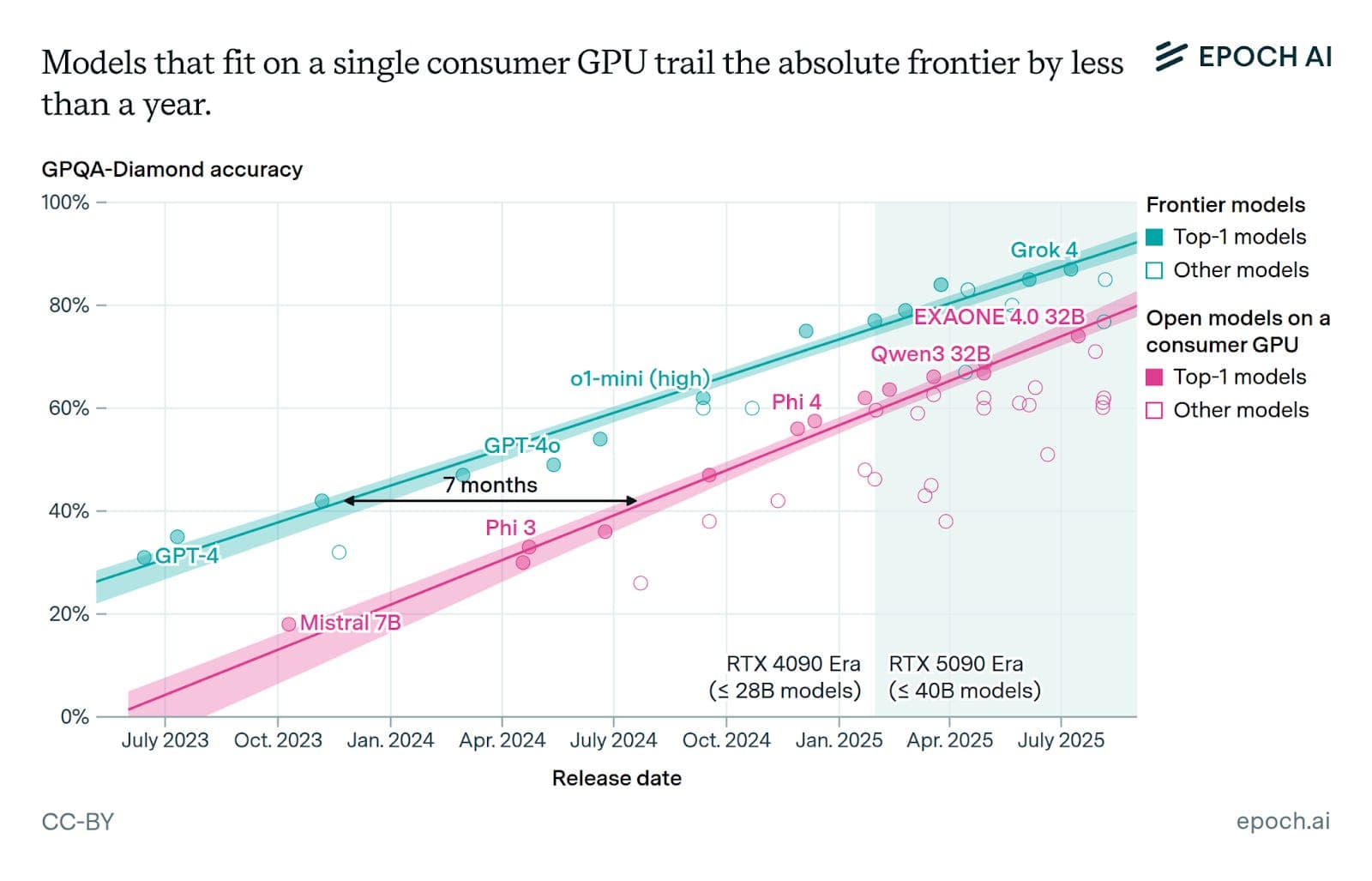
This critique taps directly into the central tension of the 2024-2025 AI landscape: the race between closed, proprietary service platforms and the rapidly maturing open-source ecosystem. As we covered in our analysis of Llama 3.1's release, the performance gap between frontier proprietary models (like GPT-4o or Claude 3.5) and the best open-weight models has narrowed significantly for many tasks, especially when fine-tuned for specific domains like retrieval and summarization.
Pu's argument aligns with a broader movement towards smaller, more efficient models and local inference, a trend underscored by the rise of companies like Replicate and Hugging Face, which facilitate easy deployment of open models. However, it also glosses over significant practical hurdles. Building a reliable, comprehensive, and low-latency web-scale search index is a monumental engineering challenge far beyond simply running a crawler on a desktop. Perplexity's value lies in its real-time indexing of a vast portion of the web, sophisticated query understanding, and result synthesis—a system that requires distributed data centers, not a single Mac Mini.
Furthermore, this follows increased scrutiny on AI pricing models. As we noted in our coverage of Anthropic's new pricing tiers, enterprise customers are beginning to question the long-term cost of embedding AI APIs into their workflows. Pu's post is a radical extension of that questioning, advocating for complete disintermediation.
For practitioners, the actionable insight here is not that you can perfectly clone Perplexity on your desk, but that the core RAG-based Q&A functionality for internal or specific-domain knowledge bases is now firmly within reach of individual developers and small teams. The Mac Mini serves as a symbol of accessible, powerful edge compute. The real cost shift is from recurring API calls to upfront development time and hardware investment—a trade-off that is becoming increasingly viable for many use cases.
Frequently Asked Questions
Can you really build a full Perplexity clone on a Mac Mini?
Not a perfect, web-scale clone. You can build a functional Retrieval-Augmented Generation (RAG) system that answers questions based on a corpus of documents you provide or a limited set of websites you crawl. It would lack Perplexity's breadth, real-time updates for breaking news, and polished UX, but the core architectural principle—retrieve relevant text, then generate an answer—is replicable with open-source tools.
What are the main open-source tools needed for this?
The stack would typically involve: a local LLM (e.g., a quantized Llama 3.1 70B or a smaller, fine-tuned model like Mistral 7B), an embedding model (e.g., BGE or OpenAI's open-source embeddings), a vector database (e.g., Chroma, Qdrant, or LanceDB) for storing and searching indexed content, and a framework to orchestrate the RAG pipeline (LlamaIndex or LangChain). For web crawling, tools like Scrapy or Crawlee would be needed.
What's the biggest challenge in building a local AI search engine?
Scale and freshness. Creating and maintaining a comprehensive, up-to-date index of the open web requires massive, distributed crawling infrastructure and significant compute for continuous re-embedding of new data. A local system is best suited for searching a static, bounded corpus of documents (like internal wikis, research papers, or specific websites) rather than the entire internet.
Is the $2,500 Mac Mini powerful enough for this?
An M2 Pro or M3 Mac Mini with 32GB+ of unified memory is capable of running a 7B-13B parameter LLM at useful speeds and hosting a local vector database for millions of document chunks. For larger 70B models, inference will be slower and may require more advanced quantization. It is a capable platform for a personal or small-team knowledge base assistant, which is the realistic interpretation of Pu's claim.