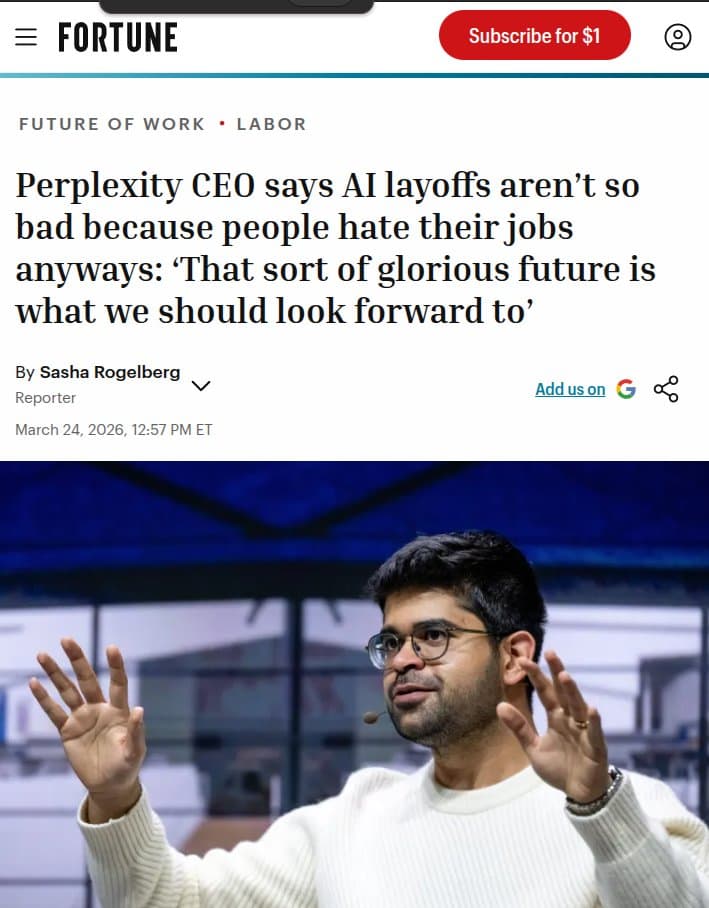
Perplexity AI CEO Aravind Srinivas has presented a contrarian economic thesis: widespread AI-driven layoffs could serve as a catalyst for a surge in small, AI-powered businesses. In an interview with Fortune, Srinivas argued that AI lowers the cost of starting a company to the point where individuals can use large language models (LLMs), automation tools, and AI agents to replace functions that previously required teams of analysts, support staff, marketers, and junior engineers.
The Core Argument: From Job Loss to Entrepreneurship
Srinivas's view reframes potential job displacement not as a pure negative, but as a "temporary shock" that could redirect labor. The central premise is that AI fundamentally changes the math of entrepreneurship. Founders can now leverage AI to:
- Write marketing and product copy
- Handle customer service and support queries
- Conduct competitive analysis and market research
- Build software prototypes and MVPs
- Manage back-office operations (accounting, HR, etc.)
This capability stack, Srinivas suggests, enables the creation of "one-person or very small firms that produce real revenue without the payroll that older companies needed." The implication is that millions of people could be pushed out of "disliked jobs" and into founding their own AI-augmented ventures.
The Counterargument: Economic Friction and Debate
The Fortune report immediately notes the significant friction in this optimistic scenario. Losing a stable paycheck is "painful for most," and the skills required to be a successful founder—product vision, sales, capital allocation—are not universally held. Many workers cannot "instantly become founders."
Furthermore, economists are still divided on the core premise. There is active disagreement on whether AI is genuinely replacing labor at a large scale or merely "giving companies a new excuse for cuts" in a slowing economic environment. The long-term net effect on employment—destruction vs. creation—remains a major open question in macroeconomics.
gentic.news Analysis
Srinivas's argument sits at the intersection of two major trends we've been tracking: the rapid commoditization of AI capabilities via APIs and open-source models, and the shifting venture capital landscape toward lean, capital-efficient startups. This follows a pattern of AI industry leaders, like OpenAI's Sam Altman and Anthropic's Dario Amodei, making broader socioeconomic predictions about AI's impact, though Srinivas's focus on small business formation is a distinct angle.
His thesis aligns with data points we've covered, such as the proliferation of AI agent frameworks (CrewAI, AutoGen) and no-code AI tools that lower technical barriers. However, it arguably underestimates systemic barriers. As we reported in our analysis of the "AI Engineer" trend, while AI lowers the cost of building software, the costs of customer acquisition, regulatory compliance, and distribution remain high and are not solved by LLMs. The success of a one-person AI-powered business likely depends heavily on the founder's existing network and industry expertise, not just their prompt engineering skills.
This also presents a potential contradiction for Perplexity's own business model. While advocating for AI-empowered individuals, Perplexity is itself a venture-backed company aiming to scale and, presumably, employ a significant workforce. The vision of a fragmented economy of micro-businesses contrasts with the concentrated market power of the large AI infrastructure providers (OpenAI, Anthropic, Google, Meta) whose models these businesses would rely on.
Frequently Asked Questions
What did the Perplexity CEO say about AI and layoffs?
Perplexity CEO Aravind Srinivas argued that AI-driven layoffs could have a silver lining by pushing millions of people out of jobs they dislike and into starting their own small, AI-powered businesses. He believes AI drastically lowers startup costs by handling tasks that once required teams of employees, changing the fundamental economics of entrepreneurship.
Is AI actually causing widespread job losses?
Economists currently disagree on this point. While there is evidence of AI automating specific tasks (particularly in clerical and analytical roles), it is not yet clear if this is leading to net job destruction at a large scale. Some analysts argue that AI is primarily augmenting existing jobs or that companies are using "AI" as a justification for layoffs they would have made anyway due to broader economic conditions.
Can one person really start a company using just AI tools?
Technically, yes. AI tools can now handle coding, copywriting, customer service, and market research at a basic level. However, building a sustainable, revenue-generating business requires much more than these operational tasks. It requires product-market fit, sales, marketing, funding, and strategic decision-making—areas where AI is currently an assistant, not a replacement for human judgment and effort. The feasibility depends heavily on the industry and the individual founder's skills.
What is Perplexity AI?
Perplexity AI is a company that provides an AI-powered answer engine and conversational search interface. It competes with traditional search engines by using large language models to provide direct, cited answers to user queries instead of a list of links. CEO Aravind Srinivas is a former research scientist at OpenAI and Google Brain.