In a remarkable fusion of biology and technology, researchers have achieved what sounds like science fiction: training lab-grown brain cells to play the classic video game Doom. This breakthrough, emerging from the intersection of neuroscience and artificial intelligence, represents a significant leap forward in our understanding of biological computation and neural interfaces.
The DishBrain Experiment
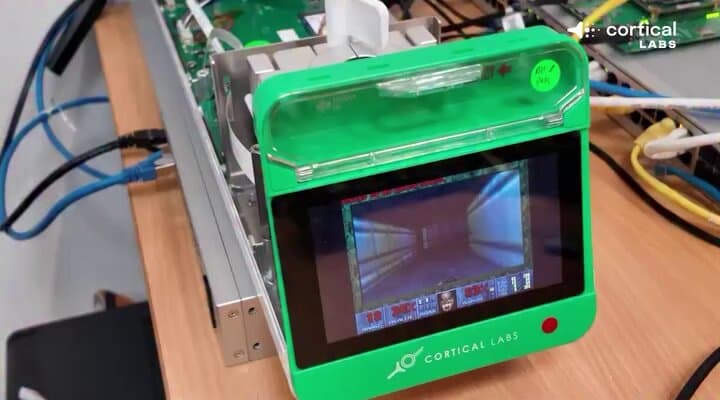
The experiment, conducted by researchers at Cortical Labs and Monash University, involves what they call "DishBrain"—a collection of 800,000 living human and mouse neurons grown in a laboratory dish. These neurons are connected to a computer system via microelectrode arrays that both stimulate the cells and record their electrical activity.
In the Doom experiment, researchers created a simplified version of the game where neurons receive input about their virtual environment and must make decisions to navigate and survive. The neurons aren't "seeing" the game in the traditional sense but rather receiving patterned electrical signals representing the game state and responding with electrical outputs that control movement.
How Biological Neurons Learn Games
The learning process for these in vitro neurons differs fundamentally from traditional machine learning. Rather than programming explicit rules, researchers use a concept called the "free energy principle," which suggests that biological systems naturally seek to minimize uncertainty about their environment.
When neurons make decisions that lead to predictable outcomes (like successfully navigating a corridor), they receive predictable electrical stimulation. When they make poor decisions (like running into a wall), they receive unpredictable stimulation. Over time, the neurons self-organize to seek predictable patterns, effectively learning to play the game through this biological reinforcement mechanism.
Dr. Brett Kagan, Chief Scientific Officer at Cortical Labs, explained: "We've shown we can interact with living biological neurons in such a way that compels them to modify their activity, leading to something that resembles intelligence."
Technical Implementation and Challenges
The system uses high-density microelectrode arrays to create a bidirectional interface between biological and digital systems. Electrodes deliver electrical pulses representing game information while simultaneously recording neural responses. A custom software layer translates between the digital game environment and the biological neural network.
One significant challenge was keeping the neurons alive and healthy during extended experiments—the cells require precise temperature, nutrient, and gas exchange conditions. Another was developing algorithms that could effectively translate between game states and neural stimulation patterns that the biological system could interpret meaningfully.
Implications for Neuroscience and AI
This research has profound implications for both neuroscience and artificial intelligence development:
Understanding Biological Intelligence: The experiment provides a unique window into how networks of neurons process information and adapt. Unlike studying brains in living organisms, this system allows researchers to observe neural computation in a controlled, simplified environment.
Biological Computing: The DishBrain represents a potential new direction in computing—using living neurons as processing units. While still primitive compared to silicon-based computers, biological systems offer advantages in energy efficiency and pattern recognition that could complement traditional computing.
Brain-Computer Interfaces: The technology developed for communicating with dish-grown neurons could inform next-generation brain-computer interfaces, potentially leading to more sophisticated prosthetics or treatments for neurological conditions.
AI Development: By studying how biological neural networks learn and adapt, researchers may develop new AI algorithms that more closely mimic biological intelligence, potentially leading to more efficient and adaptable artificial systems.
Ethical Considerations and Future Directions
As with any breakthrough involving biological systems, this research raises important ethical questions. The neurons used are derived from human stem cells and mouse embryos, prompting discussions about the moral status of such engineered neural systems. Researchers emphasize that these are not conscious beings but rather simplified neural networks without the complexity of a full brain.
Future research directions include scaling up the neural networks, increasing task complexity, and potentially combining biological and artificial neural networks in hybrid systems. The team also plans to explore pharmaceutical testing on these systems, using them as biological sensors to measure drug effects on neural function.
The Bigger Picture: Where This Technology Is Heading
The DishBrain experiment represents more than just a novelty—it's part of a growing field exploring biological computation and neural interfaces. Similar research includes work on organoid intelligence (using brain organoids for computing) and various brain-computer interface projects.
What makes this breakthrough particularly significant is the demonstration that even relatively simple biological neural networks can perform complex information processing tasks when properly interfaced with digital systems. This suggests potential applications ranging from biological sensors to novel computing architectures.
As Dr. Kagan noted: "This is brand new, virgin territory. And we want more people to come on board and collaborate with this, to use the system that we've built to further explore this new area of science."
Source: Research from Cortical Labs and Monash University, building on previous work published in the journal Neuron.