In a significant advancement for natural language processing, researchers have introduced dLLM (Simple Diffusion Language Modeling), a comprehensive framework that promises to standardize and democratize diffusion-based approaches to language generation. This development represents a crucial step toward making diffusion language models more accessible, reproducible, and comparable across research teams and applications.
What Are Diffusion Language Models?
Before diving into dLLM's significance, it's essential to understand the paradigm shift diffusion models represent in language generation. Unlike traditional autoregressive models like GPT that generate text sequentially (left-to-right), diffusion models work by gradually adding noise to data and then learning to reverse this process. This approach has shown remarkable success in image generation (as seen in DALL-E and Stable Diffusion) and is now making inroads into text generation.
Diffusion language models offer several potential advantages over autoregressive approaches:
- Non-sequential generation: They can generate text in parallel rather than token-by-token
- Better coherence: The iterative refinement process may produce more globally coherent text
- Flexible conditioning: They can incorporate various conditioning signals more naturally
- Improved controllability: The denoising process offers multiple opportunities to guide generation
Despite these advantages, diffusion language models have faced adoption barriers due to fragmented implementations and lack of standardization.
The dLLM Framework: Standardizing the Diffusion Revolution
The dLLM framework addresses these challenges through several key innovations:
Unified Training Pipeline
dLLM provides standardized recipes for training diffusion language models from scratch, eliminating the need for researchers to reinvent fundamental components. This includes standardized implementations of noise schedules, loss functions, and training procedures that have been validated across multiple model architectures.
Seamless Model Conversion
Perhaps most significantly, dLLM includes "accessible recipes" for converting existing autoregressive models (like BERT) and other architectures into diffusion language models. This capability dramatically lowers the barrier to entry for researchers and organizations already invested in traditional language models.
Reproducibility and Benchmarking
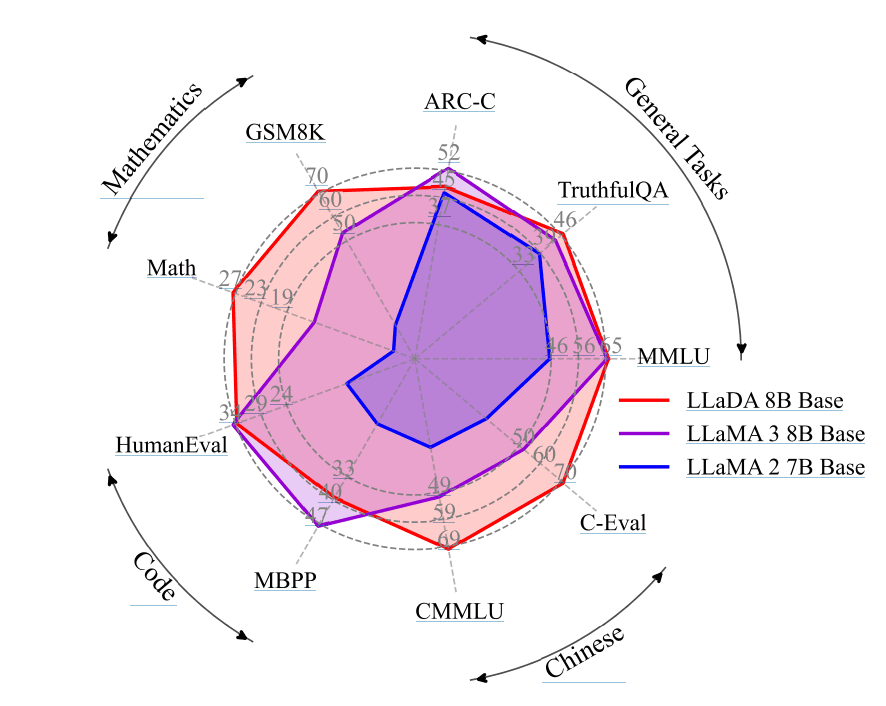
The framework enables researchers to reproduce state-of-the-art diffusion language models like LLaDA and Dream with minimal configuration. This standardization facilitates fair comparisons between different approaches and accelerates progress through shared baselines and evaluation protocols.
Flexible Inference System
dLLM standardizes inference procedures for diffusion language models, including various sampling strategies and guidance techniques. This ensures consistent behavior across different implementations and makes it easier to deploy these models in production environments.
Technical Architecture and Capabilities
While specific architectural details require consulting the original research paper, the dLLM framework appears to implement several key components:
- Noise scheduling system that controls how noise is added and removed during training and inference
- Conditioning mechanisms that allow models to generate text based on various inputs
- Efficient sampling algorithms that balance quality and computational cost
- Evaluation metrics specifically designed for diffusion language models
Practical Applications and Implications
The standardization offered by dLLM opens numerous practical applications:
Research Acceleration
By providing common ground for diffusion language model research, dLLM enables faster iteration and comparison. Researchers can now focus on novel contributions rather than reimplementing baseline components.
Enterprise Adoption
Organizations with existing investments in models like BERT can explore diffusion approaches without starting from scratch. The conversion recipes lower both technical and financial barriers to experimentation.
Creative Applications
Diffusion models' parallel generation capabilities may enable new creative applications where traditional sequential generation proves limiting. This includes poetry generation, code synthesis, and interactive storytelling systems.
Educational Value
The framework serves as an excellent educational resource for students and practitioners seeking to understand diffusion approaches to language modeling.
Challenges and Future Directions
Despite its promise, diffusion language models still face challenges that dLLM helps address but doesn't completely solve:
- Computational requirements: Diffusion models typically require more compute than comparable autoregressive models
- Sampling speed: The iterative denoising process can be slower than single-pass generation
- Evaluation complexity: Assessing diffusion model quality requires different metrics than traditional language models
Future developments likely to build on dLLM include:
- Hybrid approaches combining diffusion and autoregressive techniques
- Specialized architectures optimized for specific domains or tasks
- Efficiency improvements reducing computational requirements
- Multimodal extensions integrating text with other modalities
Conclusion
The dLLM framework represents a significant milestone in the evolution of language generation technologies. By standardizing diffusion language modeling, it accelerates research, lowers adoption barriers, and creates a foundation for future innovations. As the framework gains adoption, we can expect more rapid progress in developing language models that combine the strengths of diffusion approaches with the practical advantages of standardization.
For researchers and practitioners interested in exploring this technology, the dLLM framework offers an accessible entry point into the promising world of diffusion language models. Its ability to convert existing models and reproduce state-of-the-art systems makes it both a practical tool and a catalyst for broader innovation in natural language processing.
Source: HuggingPapers announcement of dLLM framework (https://x.com/HuggingPapers/status/2028384100847964407)