A groundbreaking new architecture called DualPath is revolutionizing how large language models handle the critical but problematic KV-cache during inference, particularly for AI agents that require extended conversations and complex reasoning. The system, detailed in research highlighted by HuggingFace's HuggingPapers, addresses one of the most persistent bottlenecks in modern LLM deployment: the storage and transfer of key-value (KV) cache between different computational stages.
The KV-Cache Conundrum in Modern LLMs
Key-value caching has become essential for efficient transformer inference, allowing models to reuse previously computed attention states rather than recalculating them for each token. This mechanism dramatically reduces computational overhead for sequential text generation, but it comes with significant storage requirements that grow linearly with sequence length.
For AI agents engaged in extended dialogues, document analysis, or complex reasoning tasks, these KV-caches can become massive—often exceeding the memory capacity of individual processing units. The traditional approach of storing KV-cache in the same memory as the model weights creates contention that severely limits throughput, especially in multi-tenant environments where multiple requests compete for resources.
How DualPath Breaks the Bottleneck
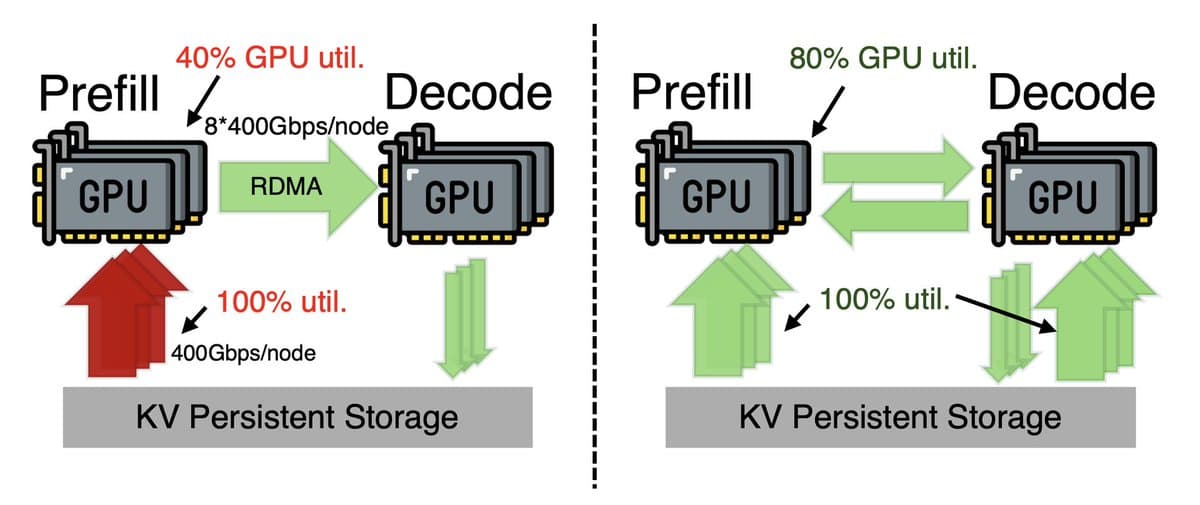
The DualPath architecture introduces a clever solution: separating the loading paths for KV-cache based on the specific needs of different inference stages. The system implements what researchers call "dual-path loading"—first loading the cache to decode engines, then efficiently transferring it to prefill engines via Remote Direct Memory Access (RDMA).
This separation allows each component to access the cache without waiting for the other, eliminating the storage contention that plagues traditional architectures. The RDMA transfer mechanism is particularly crucial, as it enables high-speed, low-latency movement of cache data between different processing units without involving the CPU, dramatically reducing overhead.
Performance Breakthroughs
The results are nothing short of remarkable. According to the research, DualPath achieves:
- 1.87× throughput improvement for offline inference scenarios
- 1.96× throughput improvement for online inference scenarios
These improvements translate to nearly doubling the number of requests that can be processed simultaneously without sacrificing latency or quality. For AI agent applications—where models must maintain context over extended interactions—this breakthrough could enable more complex, longer-running conversations and analyses that were previously impractical due to performance constraints.
Implications for AI Agent Development
The implications of this research extend far beyond raw performance metrics. By solving the KV-cache storage bottleneck, DualPath enables:
- More sophisticated AI agents capable of maintaining context over thousands of tokens without performance degradation
- Improved multi-agent systems where multiple LLM instances can share cache resources efficiently
- Cost-effective deployment of agentic AI at scale, reducing the hardware requirements for equivalent performance
- New architectural possibilities for complex reasoning systems that require extended memory and attention mechanisms
The Technical Innovation Behind DualPath
At its core, DualPath represents a fundamental rethinking of how computational resources are allocated during inference. Traditional systems treat KV-cache as a monolithic resource that must be accessible to all components simultaneously, creating inevitable contention. DualPath instead recognizes that different stages of the inference pipeline have different access patterns and requirements.
The decode stage—responsible for generating tokens sequentially—needs rapid, low-latency access to the entire KV-cache. The prefill stage—which processes the initial prompt—has different requirements. By separating these paths and optimizing the transfer mechanism between them, DualPath achieves near-optimal resource utilization.
The RDMA implementation is particularly noteworthy. RDMA allows one computer to access another's memory without involving either's operating system, CPU, or cache. This zero-copy approach minimizes latency and CPU overhead, making the cache transfers essentially "free" from a computational perspective.
Looking Forward: The Future of Efficient LLM Inference
As LLMs continue to grow in size and complexity, and as AI agents become more sophisticated in their capabilities, innovations like DualPath will become increasingly critical. The research demonstrates that architectural improvements—not just hardware advancements or model optimizations—can deliver order-of-magnitude improvements in efficiency.
The DualPath approach could inspire similar innovations in other areas of LLM infrastructure, potentially leading to a new generation of inference systems designed specifically for the demands of agentic AI. As researchers continue to push the boundaries of what's possible with transformer architectures, solutions to fundamental bottlenecks like KV-cache management will determine how quickly these technologies can be deployed at scale.
Source: Research highlighted by HuggingFace's HuggingPapers on X/Twitter, detailing the DualPath architecture for breaking KV-cache bottlenecks in agentic LLM inference.