
Epoch AI published an explicit five-variable polynomial system generating all primes, a concrete instance of Matiyasevich's theorem. The construction follows Yuri Matiyasevich's 1971 work linking Diophantine equations to recursively enumerable sets.
Key facts
- 5 variables in the explicit polynomial system
- Based on Matiyasevich's 1971 theorem
- Positive values exactly equal all primes
- Ties to Hilbert's tenth problem undecidability
- Published by Epoch AI in 2026
Epoch AI has published an explicit polynomial system in five variables whose positive values are exactly the prime numbers, a concrete realization of a result first proved by Yuri Matiyasevich in 1971. According to Epoch AI The system encodes primality through a Diophantine equation, offering a compact algebraic characterization of primes.
Matiyasevich's theorem, building on work by Martin Davis, Hilary Putnam, and Julia Robinson, showed that every recursively enumerable set is Diophantine — meaning it can be defined by a polynomial equation. This implies there exists a polynomial whose positive values are exactly the primes, but the original proofs were non-constructive or produced unwieldy polynomials. Epoch AI's contribution is an explicit, simplified construction in just five variables, making the abstract result tangible.
Key Takeaways
- Epoch AI published a five-variable polynomial system whose positive values are exactly the primes, a concrete Matiyasevich construction.
- The result ties to Hilbert's tenth problem and signals Epoch's pivot into pure math.
Why five variables matter
The number of variables is not arbitrary. Matiyasevich and his collaborators spent years reducing the variable count in such constructions. A five-variable system sits at the edge of what is practically writable — fewer variables typically require astronomically larger coefficients or degrees. Epoch AI's system balances compactness with explicitness, a trade-off that has been a focus of computational number theory since the 1970s.
The construction also ties into Hilbert's tenth problem, which asked for an algorithm to decide whether any given Diophantine equation has integer solutions. Matiyasevich's theorem proved no such algorithm exists, and the prime-generating polynomial is a direct consequence. Epoch AI's explicit form allows direct computation, though practical prime generation remains computationally intensive — the polynomial's degree and coefficient sizes mean evaluating it for large inputs is infeasible with current hardware.
Computational and theoretical implications
While the polynomial generates all primes in principle, it is not a practical primality test. The degree and coefficient growth make brute-force evaluation impractical beyond small numbers. This mirrors the broader lesson of Diophantine constructions: they prove existence and structure, not efficiency. For engineers, the value is conceptual — a compact algebraic handle on primality that could inform symbolic computation or automated theorem proving.
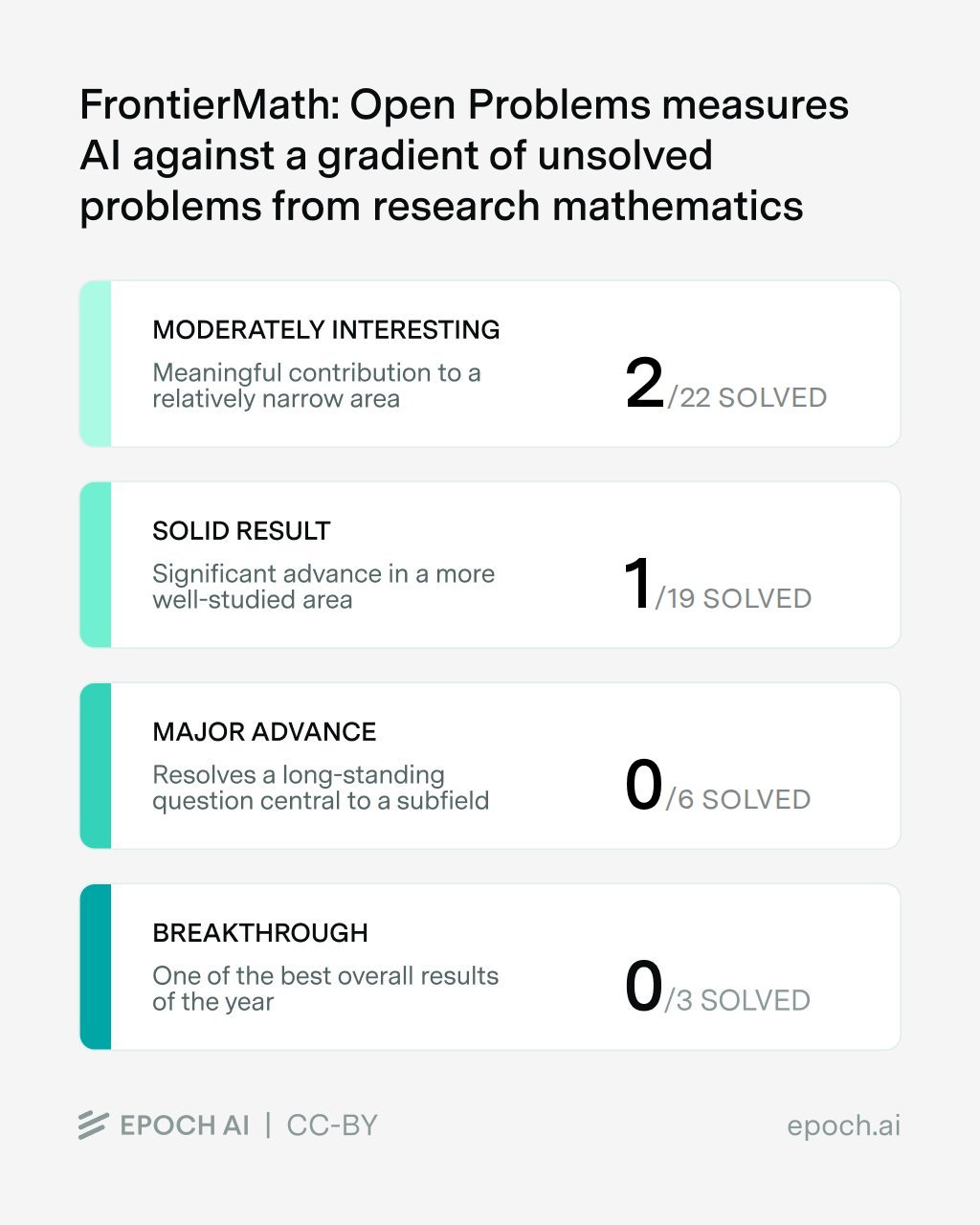
Epoch AI's publication also signals a broader trend: research organizations are increasingly publishing constructive results in number theory, not just surveys. The organization, better known for tracking AI training compute and FrontierMath benchmarks, is expanding into pure mathematics. This follows their July 2026 decision to open FrontierMath's unsolved problems to public scrutiny, a move that positioned them as a serious mathematical institution. [Per Epoch AI's recent history]
What to watch
Watch for whether Epoch AI publishes a follow-up with a lower-degree variant or a constructive algorithm for evaluating the polynomial efficiently. Also monitor their next pure-math release — if they continue beyond FrontierMath, expect more explicit Diophantine constructions or connections to automated theorem proving.
Source: news.google.com