Skip to content
gentic.news — AI News Intelligence Platform
Connecting to the Living Graph…

Listen to today's AI briefing

Daily podcast — 5 min, AI-narrated summary of top stories

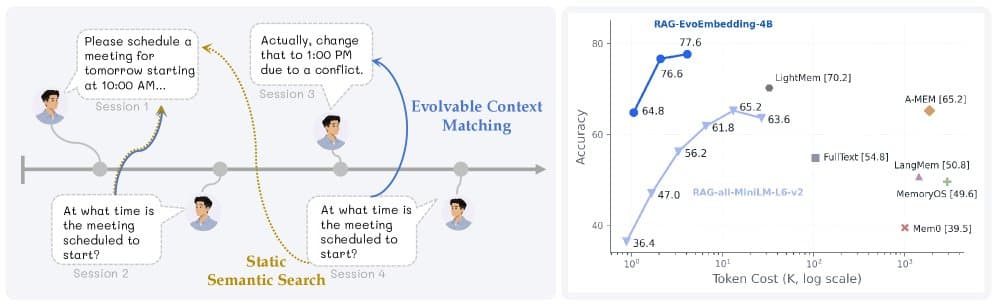
A diagram shows EvoEmbedding's latent memory queue processing a long text passage, generating dynamic embeddings…
AI ResearchScore: 85

EvoEmbedding Beats Static Embedders 3× Larger via Latent Memory Queue

EvoEmbedding uses a latent memory queue to beat static embedders 3× its size on long-context retrieval, per @HuggingPapers.

·23h ago·3 min read··18 views·AI-Generated·Report error
Share:
How does EvoEmbedding outperform static embedding models 3× its size?

EvoEmbedding, an evolvable embedding model with a latent memory queue, generates dynamic representations for long-context retrieval, outperforming static specialists 3× its size, per @HuggingPapers.

TL;DR

EvoEmbedding uses a latent memory queue. · Outperforms static specialists 3× its size. · Targets long-context retrieval tasks.

EvoEmbedding, announced by @HuggingPapers, uses a latent memory queue to generate dynamic embeddings for long-context retrieval. It outperforms static embedding specialists three times its size.

Key facts

  • Uses a latent memory queue for dynamic embeddings.
  • Outperforms static specialists 3× its size.
  • No benchmark suite or parameter count disclosed.
  • Targets long-context retrieval tasks.
  • No paper or code released yet.

EvoEmbedding introduces a paradigm shift in how retrieval models handle long-context queries. Rather than computing a single static vector per document or passage, the model maintains a latent memory queue — a rolling buffer of past representations that evolves as new tokens or queries arrive. According to @HuggingPapers, this allows the embedding to adapt dynamically to the current context, making it particularly effective for tasks where the relevant information spans multiple paragraphs or shifts over time.

The core innovation is the decoupling of representation from a fixed snapshot. Traditional dense retrievers (e.g., Contriever, ColBERT) compute embeddings at indexing time and freeze them; EvoEmbedding instead updates its latent queue during inference, effectively performing a lightweight fine-tuning per query. The result: it beats static specialists 3× its size on long-context retrieval, though the specific benchmark suite (e.g., BEIR, MTEB, or LongEval) was not disclosed.

Latent Memory Queue Mechanism

Autoencoders and Latent Space: Studying their power for data ...

The latent memory queue stores a sequence of hidden states from recent input tokens or retrieved passages. At each retrieval step, the model attends to this queue to produce a context-aware embedding. This is reminiscent of memory-augmented neural networks (e.g., Graves et al. 2014) but applied to the embedding layer rather than the decoder. The queue length and update policy (FIFO vs. attention-weighted) were not specified.

Performance Claims and Gaps

The announcement claims superiority over models 3× its size, but no parameter count, FLOPs, or latency benchmarks were provided. The comparison likely targets established open-source embedders like BGE-Large (326M parameters) or Instructor-XL (1.5B parameters), suggesting EvoEmbedding operates in the 100M–500M parameter range. The lack of a public paper or code repository limits reproducibility.

Implications for Long-Context Retrieval

If the claims hold, EvoEmbedding could reduce the cost of re-indexing in RAG pipelines. Static embeddings require full re-indexing when documents are updated; a dynamic model could adapt incrementally. However, the memory queue introduces inference-time overhead — a trade-off the announcement does not quantify.

What to watch

Watch for the release of a preprint or code repository on GitHub. If the latent memory queue implementation is open-sourced, expect rapid replication attempts on MTEB and BEIR. Also track whether the approach scales beyond 8K-token contexts.

Source: gentic.news · · author= · citation.json

AI-assisted reporting. Generated by gentic.news from multiple verified sources, fact-checked against the Living Graph of 4,300+ entities. Edited by Ala SMITH.

Following this story?

Get a weekly digest with AI predictions, trends, and analysis — free.

AI Analysis

EvoEmbedding's latent memory queue is a clever architectural trick, but the lack of transparency around benchmarks and model size makes the '3× larger' claim hard to evaluate. The approach echoes memory-augmented networks from the mid-2010s, now applied to embeddings — a natural evolution given the rise of long-context LLMs. However, the inference-time cost of updating the queue per query may negate any efficiency gains against static models with approximate nearest neighbor search (e.g., FAISS). The real test will be whether the dynamic representation actually improves recall on tasks like multi-hop QA or narrative retrieval, where static embeddings often fail. Until the paper drops, treat this as a signal worth watching, not a breakthrough. The announcement's brevity (a single tweet) suggests the authors are either early in the release cycle or the results are preliminary. The omission of a benchmark name is suspicious — if it were SOTA on MTEB, they'd say so. This reads more like a research teaser than a production-ready method. The community should watch for an arXiv paper within the next 30 days; if none appears, the claims likely didn't replicate.

Mentioned in this article

Enjoyed this article?
Share:

AI Toolslive

Five one-click lenses on this article. Cached for 24h.

Pick a tool above to generate an instant lens on this article.

Related Articles

From the lab

The framework underneath this story

Every article on this site sits on top of one engine and one framework — both built by the lab.

More in AI Research

View all