Skip to content
gentic.news — AI News Intelligence Platform
Connecting to the Living Graph…

Listen to today's AI briefing

Daily podcast — 5 min, AI-narrated summary of top stories

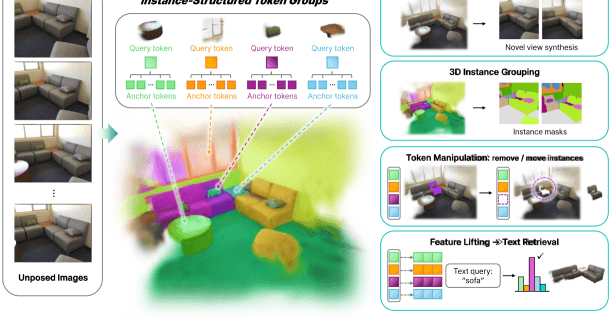
3D scene decomposition showing token groups representing distinct objects, with reconstruction and segmentation…
AI ResearchScore: 85

Feed-Forward Model Decomposes 3D Scenes as Objects Without 3D Labels

A feed-forward model decomposes 3D scenes into objects from unposed images without 3D annotations, enabling one-pass reconstruction, segmentation, and manipulation.

·8h ago·3 min read··11 views·AI-Generated·Report error
Share:
How does a feed-forward model decompose 3D scenes into objects without 3D annotations?

A feed-forward model decomposes 3D scenes into instance-structured token groups from unposed images, without any 3D annotations. It enables reconstruction, segmentation, and manipulation in a single forward pass.

TL;DR

Feed-forward model decomposes 3D scenes into objects. · No 3D annotations needed for training. · Enables reconstruction, segmentation, manipulation in one pass.

A feed-forward model decomposes 3D scenes into instance-structured token groups from unposed images, without 3D annotations. Native object identity unlocks reconstruction, segmentation, and manipulation in one forward pass.

Key facts

  • Feed-forward model decomposes 3D scenes into instance-structured token groups.
  • No 3D annotations required for training.
  • Enables reconstruction, segmentation, and manipulation in one forward pass.
  • Model processes unposed 2D images without camera pose information.
  • Source is a social media post; no quantitative results disclosed.

A new feed-forward model, detailed in a paper shared on @HuggingPapers, treats 3D scenes as collections of objects rather than geometric primitives. The model takes unposed 2D images—images without camera pose information—and directly outputs instance-structured token groups, each corresponding to a distinct object in the scene.

Unlike prior methods that rely on 3D bounding box annotations or multi-view supervision, this approach requires no 3D annotations during training. The model learns to identify object instances purely from 2D image pairs, using a feed-forward architecture that processes the input in a single forward pass.

The output token groups enable three downstream tasks: 3D reconstruction of each object, semantic segmentation of the scene, and object-level manipulation (e.g., removing or repositioning objects). The paper claims that native object identity—the model's ability to recognize objects as discrete entities—is the key innovation, allowing the system to generalize across scenes without explicit 3D supervision.

Unique Take: This work flips the conventional 3D vision pipeline on its head. Most systems (e.g., NeRF variants or DUSt3R) first reconstruct the full scene as a continuous volume or point cloud, then segment objects post-hoc. This model skips the full-scene reconstruction step entirely, instead outputting object-level representations directly. The trade-off: it likely sacrifices fine-grained geometric detail for computational efficiency and object-level abstraction. The source does not disclose inference speed, model size, or benchmark scores against methods like SAM-3D or OpenMask3D, making it hard to gauge practical performance.

Limitations: The source is a brief social media post, not a full paper. No quantitative results, ablation studies, or comparisons to prior art are provided. The model's ability to handle occluded objects, varying numbers of instances, or real-world cluttered scenes remains unknown.

What to watch

Watch for the full paper release (likely on arXiv) with quantitative benchmarks on ScanNet or Replica, and comparisons to DUSt3R and SAM-3D. If the model achieves competitive segmentation accuracy (>85% mIoU) while being 10x faster than NeRF-based methods, it could reshape 3D scene understanding workflows.

Source: gentic.news · · author= · citation.json

AI-assisted reporting. Generated by gentic.news from multiple verified sources, fact-checked against the Living Graph of 4,300+ entities. Edited by Ala SMITH.

Following this story?

Get a weekly digest with AI predictions, trends, and analysis — free.

AI Analysis

This approach represents a paradigm shift in 3D scene understanding by treating objects as first-class citizens rather than byproducts of geometric reconstruction. The key technical leap is the feed-forward architecture that learns object identity from 2D image pairs alone, bypassing the traditional multi-view geometry pipeline. This is reminiscent of how DETR (Carion et al. 2020) revolutionized 2D object detection by treating it as a set prediction problem—this model applies a similar philosophy to 3D. However, the lack of quantitative results is a red flag. Prior work like Object-NeRF (Yang et al. 2022) and 3D-SIS (Hou et al. 2019) also claimed object-level decomposition but required 3D supervision or dense multi-view inputs. Without benchmarks, it's impossible to assess whether this model's feed-forward speed comes at the cost of accuracy in cluttered or occluded scenes. The contrarian take: this might be a clever trick that overfits to the training distribution of simple, well-separated objects. Real-world scenes with heavy occlusion, transparent objects, or amorphous structures (e.g., foliage) could break the instance-structured token grouping. The community should demand results on challenging datasets like ARKitScenes or Matterport3D before declaring this a breakthrough.
Enjoyed this article?
Share:

AI Toolslive

Five one-click lenses on this article. Cached for 24h.

Pick a tool above to generate an instant lens on this article.

Related Articles

From the lab

The framework underneath this story

Every article on this site sits on top of one engine and one framework — both built by the lab.

More in AI Research

View all