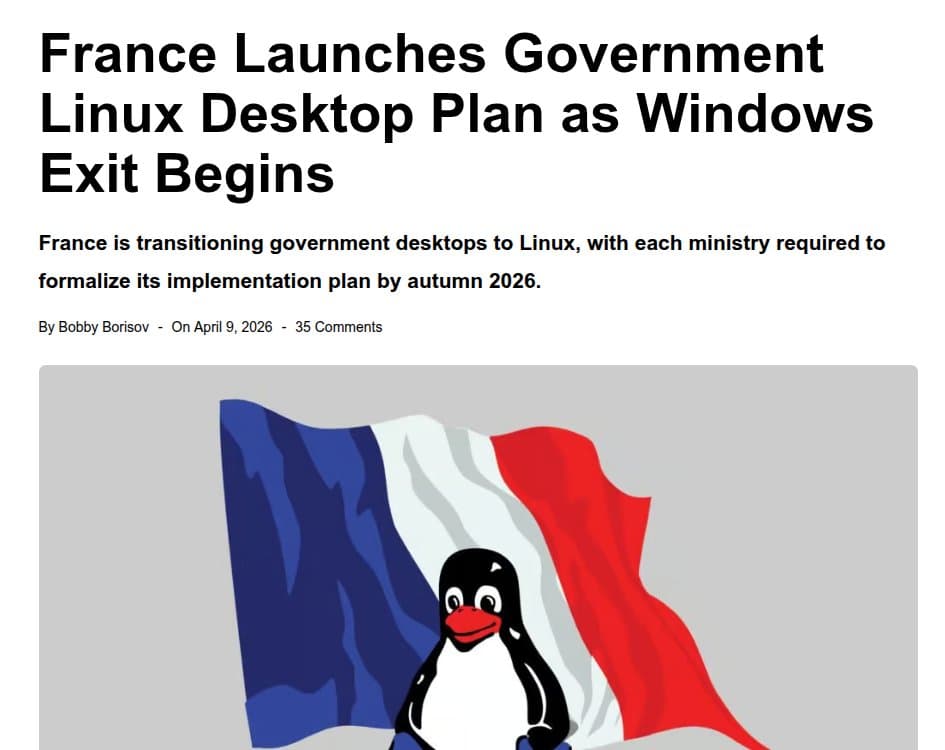
France has taken a decisive step toward technological sovereignty by declaring Linux desktops an official state policy and ordering every government ministry to submit migration plans by autumn 2026. The move explicitly treats dependence on Microsoft Windows as a national sovereignty risk, framing the desktop operating system as critical national infrastructure.
What Happened: A Sovereign Computing Mandate
According to reports from Linuxiac.com and social media commentary from AI researcher Rohan Paul, the French government has issued a directive requiring all ministries to develop concrete plans for transitioning from Windows to Linux-based desktop environments. The deadline for submission is autumn 2026, suggesting a multi-year migration timeline.
The policy represents a significant escalation in Europe's efforts to reduce technological dependence on US companies. French officials are reportedly framing desktop infrastructure as part of national infrastructure, making reliance on foreign-controlled operating systems a security concern.
The Technical Challenge: Rebuilding the Operating Stack
The migration from Windows to Linux presents substantial technical hurdles that go beyond simply installing a new operating system. Windows environments in large organizations typically grow around several interconnected components:
- Active Directory: Microsoft's directory service for user authentication, permissions, and policy management
- Microsoft Office formats: DOCX, XLSX, and PPTX files that may have compatibility issues with open-source alternatives
- Endpoint security agents: Antivirus, EDR (Endpoint Detection and Response), and compliance tools
- Device management systems: Tools like Microsoft Endpoint Manager (formerly SCCM) for deploying updates and managing configurations
- Custom internal applications: Legacy or proprietary software built specifically for Windows environments
Moving to Linux effectively means rebuilding this entire operating stack with open-source or European alternatives. This includes finding replacements for identity management (potentially FreeIPA or OpenLDAP), office productivity suites (LibreOffice or OnlyOffice), and security tooling compatible with Linux endpoints.
European Context: Growing Tech Sovereignty Movement
This French initiative aligns with broader European efforts to establish technological independence. The European Union has been pushing for digital sovereignty through various initiatives, including:
- GAIA-X: A European cloud infrastructure project aiming to reduce dependence on AWS, Azure, and Google Cloud
- Next Generation Internet (NGI): Initiatives to develop more open, trustworthy internet technologies
- Open Source Program Offices (OSPOs): Government adoption of open-source software policies
Lawmakers and government leaders across Europe are reportedly growing more aware of what they perceive as "the looming threat" of over-reliance on U.S. technology, particularly in critical infrastructure sectors.
Implementation Timeline and Challenges
The autumn 2026 deadline for migration plans suggests a phased approach rather than an immediate switch. Government IT departments will need to:
- Inventory existing systems: Catalog all Windows-dependent applications and workflows
- Identify alternatives: Find Linux-compatible replacements for critical software
- Develop migration strategies: Plan user training, data migration, and compatibility testing
- Address legacy systems: Handle applications that cannot be easily ported to Linux
- Establish support structures: Create help desks and documentation for the new environment
The success of this initiative will depend heavily on whether the French government can develop a coherent ecosystem of supported applications and provide adequate training for thousands of government employees accustomed to Windows interfaces.
Potential Impact on European Tech Ecosystem
This policy could stimulate growth in Europe's open-source and enterprise software sectors. Companies offering Linux desktop support, compatibility layers for Windows applications (like Wine or CrossOver), and open-source alternatives to Microsoft's productivity suite may see increased demand.
If successful, France's migration could serve as a blueprint for other European nations considering similar moves toward technological sovereignty. However, failed or problematic implementations could also deter other governments from following suit.
gentic.news Analysis
This French initiative represents one of the most concrete implementations of Europe's digital sovereignty ambitions to date. While previous efforts like GAIA-X focused on cloud infrastructure, targeting the desktop operating system strikes at the most visible layer of user interaction with technology.
The technical challenges cannot be overstated. Windows environments in large organizations represent decades of accumulated dependencies, from legacy line-of-business applications to user familiarity with specific interfaces. The French government will need to balance sovereignty concerns with practical usability—employees who cannot effectively perform their jobs due to an unfamiliar operating system represent a different kind of security risk.
This move aligns with broader trends we've covered at gentic.news, including the European Union's increasing scrutiny of US tech giants and growing investment in open-source alternatives. However, it represents a more aggressive approach than we've seen from other European governments, most of which have focused on cloud sovereignty rather than desktop migration.
The success or failure of this initiative will likely influence similar debates in Germany, the Netherlands, and other European nations considering reduced dependence on US technology. If France can demonstrate a successful migration with minimal productivity disruption, we may see a domino effect across European government IT departments.
Frequently Asked Questions
What specific Linux distribution will the French government use?
The announcement doesn't specify a particular Linux distribution. Government IT departments will likely evaluate several options, potentially including Ubuntu (which has enterprise support), Debian (known for stability), or specialized government distributions like GendBuntu (used by French Gendarmerie). The choice may vary by ministry based on specific needs.
How will this affect French government employees who only know Windows?
Successful migration will require extensive training programs and potentially gradual rollout strategies. Employees may receive training on Linux basics, alternative office software, and new workflows. Some ministries might implement dual-boot systems or virtual desktop environments during the transition period to minimize disruption.
Will this policy apply to all government computers?
The directive appears comprehensive, covering "every ministry," suggesting broad applicability. However, specialized systems with hardware dependencies on Windows drivers or proprietary software may receive exemptions or longer timelines. Critical infrastructure systems with unique requirements will likely be addressed on a case-by-case basis.
How does this relate to France's previous technology sovereignty efforts?
France has previously invested in sovereign cloud initiatives and promoted open-source software in government. This desktop migration represents a natural extension of those policies, applying sovereignty principles to endpoint computing. It builds on existing French expertise in open-source adoption while significantly expanding the scope of what's being targeted for replacement.