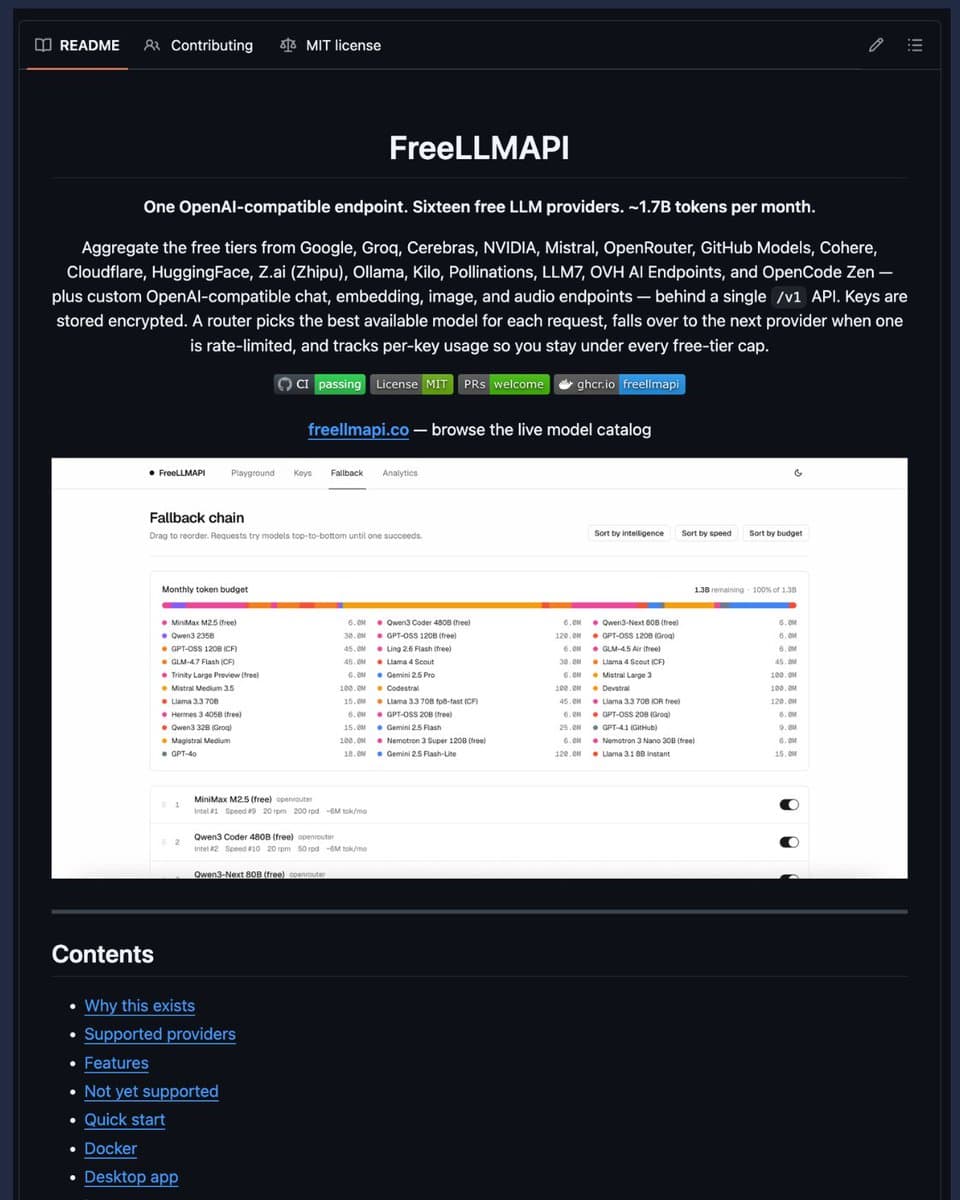
FreeLLMAPI aggregates 11 free LLM providers into one endpoint, offering up to 1.7B tokens per month. The GitHub project automatically routes requests with fallover when providers rate-limit.
Key facts
- 11 free LLM providers aggregated behind one endpoint.
- 1.7 billion tokens per month total claimed capacity.
- Automatic fallover when provider rate limits hit.
- OpenAI-compatible /v1 API with chat, embeddings, images.
- Supports streaming, tool calling, and audio.
FreeLLMAPI, a GitHub repository shared by @hasantoxr, consolidates free tiers from 11 LLM providers — including Google, Groq, Mistral, OpenRouter, GitHub Models, Cohere, Cloudflare, HuggingFace, Z AI, Ollama, and Kimi — behind a single OpenAI-compatible /v1 endpoint. According to @hasantoxr, the project claims these free tiers stack to approximately 1.7 billion tokens per month.
The core innovation is automatic fallover: when one provider exhausts its free quota or hits a rate limit, the router transparently switches to the next available model. This eliminates the manual key rotation and provider monitoring that typically plagues side projects relying on free tiers. Users authenticate with one key and one router, and the system tracks usage per key to stay under each provider's free-tier caps. Keys are stored encrypted.
What the endpoint supports
FreeLLMAPI supports chat completions, embeddings, image generation, audio transcription, tool calling, and streaming — all through the standard OpenAI SDK interface. That means existing codebases using openai Python library or compatible HTTP clients can switch to FreeLLMAPI by changing the base URL and API key.
The project does not disclose the exact token limits per provider, nor does it specify which models are available behind each provider's free tier. The 1.7B figure is an aggregate claim from the repo, not independently verified.
The structural angle
FreeLLMAPI is less a new model and more a meta-infrastructure play: it exploits the fragmentation of free inference offers from competing cloud and AI companies. Each provider offers a free tier as a customer acquisition funnel — Google gives Gemini access, Groq offers LPU-accelerated models, Mistral gives its own models. By aggregating them, FreeLLMAPI turns a dozen funnels into one pipeline, effectively arbitraging the sign-up incentives of competing vendors.
This pattern mirrors early cloud aggregation tools (e.g., Cloudflare's Workers or 1Password's credential management) but applied to inference supply. The practical ceiling is not model quality but provider tolerance — if enough users adopt the router, providers may tighten free caps or require API key verification tied to a single user identity.
Limitations and risks
Free tiers typically impose latency penalties, lower priority queues, and feature restrictions (e.g., no streaming on some providers). The router adds an additional hop, increasing p99 latency. And the 1.7B figure assumes no overlapping rate limits — if multiple users hit the same provider simultaneously, the actual throughput is lower.
The repo does not appear to have been audited for security; storing API keys encrypted locally is only as safe as the deployment environment. No license or contribution guidelines are visible in the source material.
Key Takeaways
- FreeLLMAPI aggregates 11 free LLM providers into one endpoint, offering 1.7B tokens/month with automatic fallover.
- Reduces friction for side projects but faces provider tolerance risks.
What to watch

Watch for provider rate-limit tightening if FreeLLMAPI gains traction. Also monitor the repo's GitHub star count and any forks adding paid tier integration — that would signal the project evolving from side project to production tool.