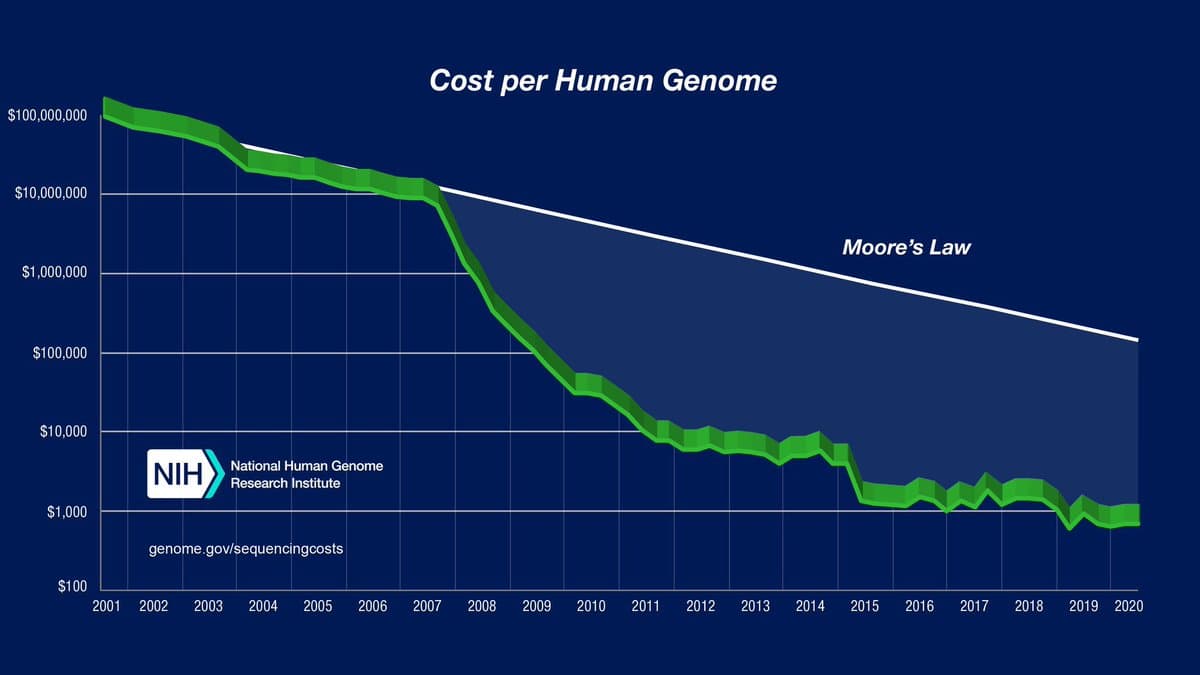
In 2000, sequencing the first human genome was a monumental scientific achievement with an equally monumental price tag: between $500 million and $1 billion. By 2006, that cost had dropped to $20 million—still prohibitive for widespread use. Fast forward to today, and the price has collapsed to a mere $100, according to data shared by Wharton professor and AI researcher Ethan Mollick. This represents a staggering 10 million-fold reduction in just 24 years, transforming genomics from an exclusive research endeavor into an accessible tool for personalized medicine.
The Sequencing Cost Curve: A Timeline of Disruption
The journey from billion-dollar project to hundred-dollar commodity follows one of the most dramatic cost-reduction curves in technological history:
- 2000: Human Genome Project completion ($500M-$1B)
- 2006: Early commercial sequencing ($20M)
- 2015: $1,000 genome milestone reached
- 2022: $600 genome
- 2024: $100 genome
This acceleration has been particularly remarkable in recent years. As Mollick notes, the price dropped from $600 to $100 in just two years—a 6x reduction that would have been unimaginable during the early decades of sequencing technology.
The AI and Automation Revolution in Genomics
While improvements in sequencing hardware (from Sanger sequencing to next-generation platforms) drove initial cost reductions, the recent precipitous drop owes much to artificial intelligence and machine learning. AI algorithms now optimize every stage of the sequencing pipeline:
1. Sample Preparation Automation: Robotic systems guided by computer vision handle delicate biological samples with precision and consistency far exceeding human technicians.
2. Sequencing Optimization: Machine learning models predict optimal run conditions, reduce errors, and maximize throughput of sequencing machines.
3. Data Analysis Acceleration: The most computationally intensive phase—assembling and interpreting billions of DNA fragments—has been transformed by AI. What once required supercomputers and months of analysis now happens in hours on standard hardware.
4. Quality Control: Neural networks identify and correct sequencing errors in real-time, reducing the need for expensive repeat sequencing.
Companies like Illumina, Oxford Nanopore, and newer entrants have increasingly integrated AI throughout their platforms, creating virtuous cycles where more data improves algorithms, which in turn enable cheaper sequencing.
Implications for Medicine and Society
The $100 genome represents more than just a price milestone—it fundamentally changes what's possible in healthcare and research:
Personalized Medicine at Scale: At this price point, genomic sequencing becomes feasible for routine medical care. Doctors could sequence patients' genomes to predict disease risks, select optimal medications, and detect conditions years before symptoms appear.
Population Genomics: Large-scale studies involving millions of participants become economically viable, potentially uncovering genetic factors behind complex diseases that have eluded smaller studies.
Global Health Equity: While still not universally accessible, the $100 genome moves us closer to a world where genetic testing isn't limited to wealthy nations or individuals.
Direct-to-Consumer Expansion: Companies like 23andMe and AncestryDNA may expand from limited genotyping (analyzing specific markers) to full genome sequencing at competitive prices.
The Data Economics of Cheap Sequencing
The plummeting cost creates new economic dynamics. As sequencing becomes cheaper than storing the resulting data, we're entering an era where the value shifts from generating genomic data to interpreting it. The bottleneck is no longer obtaining genetic information but making sense of it—a challenge perfectly suited to AI.
This creates opportunities for:
- Interpretation platforms that explain what genomic variants mean for individual health
- Preventive health services based on genetic risk profiles
- Drug discovery leveraging massive genomic datasets to identify new targets
Ethical Considerations and Challenges
With great data comes great responsibility. The $100 genome raises urgent questions:
Privacy and Security: How do we protect extremely sensitive genetic information from misuse?
Genetic Discrimination: Will employers or insurers use genomic data against individuals?
Interpretation Gaps: Having a genome sequence is meaningless without understanding what it signifies—and our knowledge of human genetics remains incomplete.
Psychological Impact: How do individuals handle knowing their genetic predispositions to serious diseases?
Equity: Will the benefits of cheap sequencing accrue primarily to those already privileged in healthcare systems?
The Future: Where Do We Go From $100?
Industry observers suggest the cost decline may continue, potentially reaching $10 genomes within a few years. At that point, sequencing could become as routine as a blood test. The convergence of cheap sequencing with other technologies creates particularly exciting possibilities:
Single-Cell Sequencing at Scale: Currently expensive but crucial for understanding cellular diversity in tissues.
Long-Read Sequencing Improvements: Better resolution of complex genomic regions.
Integration with Epigenetics: Combining DNA sequence with information about how genes are regulated.
Real-Time Sequencing: Portable devices for field use in agriculture, ecology, and outbreak detection.
Conclusion: A New Era of Biological Understanding
The journey from $1 billion to $100 for a human genome sequence represents one of the most dramatic examples of technological democratization in history. What was once an international consortium project involving hundreds of scientists is now approaching commodity status.
As Mollick's data visualization makes clear, this isn't just incremental improvement—it's exponential transformation. The implications extend far beyond medicine to agriculture, biotechnology, anthropology, and our fundamental understanding of what makes us human.
The true significance of the $100 genome may not be the price itself, but what it enables: a future where our genetic makeup informs our healthcare from birth, where diseases are intercepted before they manifest, and where biological data becomes as integral to our digital lives as social media or search history.
Source: Ethan Mollick (@emollick) on Twitter/X, May 16, 2024