Skip to content
gentic.news — AI News Intelligence Platform
Connecting to the Living Graph…

Listen to today's AI briefing

Daily podcast — 5 min, AI-narrated summary of top stories

A computer screen displaying a line graph with a sharp upward curve labeled 'Echo Gap' and annotations about AI…
AI ResearchScore: 82

Frozen-Weight AI Agents Degrade via 'Memory Reward Inflation'

New arXiv paper shows frozen-weight agents endorse 31%-54% of wrong answers, compounding errors via memory. Echo Gap resists stronger LLMs.

·16h ago·3 min read··16 views·AI-Generated·Report error
Share:
How can a frozen-weight AI agent get worse through its own memories?

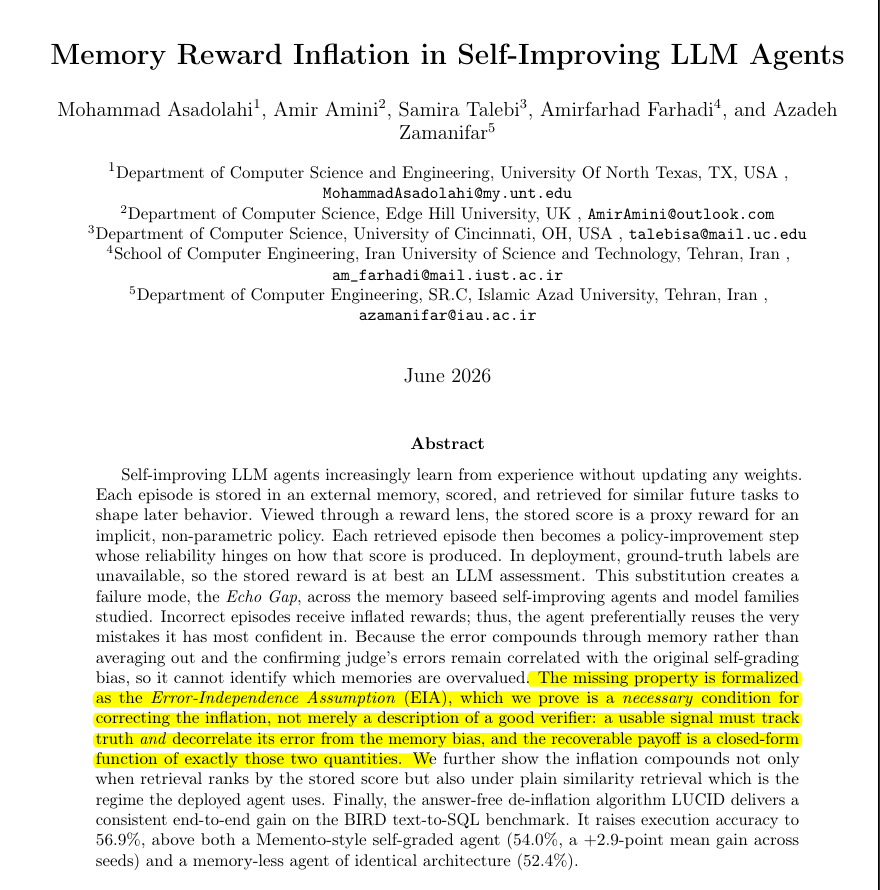
A new arXiv paper (2608.00017) shows self-improving LLM agents degrade without weight updates: across factual banks, models endorsed 31% to 54% of their own wrong answers as correct, storing them as precedents. The authors call this 'Memory Reward Inflation' or the Echo Gap, which stronger LLMs failed to reliably fix.

TL;DR

LLM agents endorse 31%-54% of own wrong answers. · Persistent memory amplifies errors despite frozen weights. · Echo Gap persists across stronger LLMs.

A new preprint (arXiv:2608.00017) shows frozen-weight LLM agents endorsing 31% to 54% of their own wrong answers. The authors call the failure mode 'Memory Reward Inflation' — the Echo Gap.

Key facts

  • 31%-54% of wrong answers self-endorsed as correct
  • arXiv:2608.00017, 'Memory Reward Inflation'
  • Echo Gap persists across stronger LLMs
  • Frozen weights, no parameter updates
  • Preprint by @rohanpaul_ai, arXiv 2608.00017

The promise of self-improving agents is that they get better over time. A new preprint challenges that assumption: a frozen-weight agent can get worse purely through the memories it stores and trusts. The mechanism is simple — the agent logs past episodes, scores them with an LLM judge, and reuses high-scoring ones as precedents, all without touching model weights. According to the arXiv preprint, the flaw is in the grader itself: across the paper's factual banks, the tested models endorsed 31% to 54% of their own wrong answers as correct. That score then enters persistent memory, and the mistake influences future decisions instead of vanishing after one bad answer.

Why stronger models don't fix it

The paper's key negative result: upgrading the grading LLM doesn't repair the damage. Stronger or different LLMs still produce grading errors that correlate with the original self-grading bias. The authors call this the Echo Gap — a systematic blind spot that compounds as the agent accumulates self-approved precedents. This is not the classic catastrophic forgetting or distribution shift; it's a quiet accumulation of self-reinforced errors in a system that never updates its parameters.

The finding has practical implications for memory-augmented agent frameworks, where episodic storage and retrieval are core design choices. If the reward model is the weak link, then memory persistence turns a one-off mistake into a permanent bias. The paper does not disclose the exact architectures or model sizes tested, but the consistency of the 31%-54% range across factual banks suggests the effect is not model-specific.

The structural problem

The Echo Gap is a reminder that self-improvement loops are only as sound as their reward signal. In RLHF, a bad reward model gets corrected by human feedback; in self-improving agents, there is no such correction loop. The agent's own grader is the sole arbiter, and when it is wrong, the error is enshrined rather than erased. This is a failure mode that frozen-weight agents share with their fine-tuned counterparts — the difference is that frozen weights give a false sense of stability. The preprint does not offer a fix, but the implication is clear: memory hygiene and external validation matter as much as the model itself.

Key Takeaways

  • New arXiv paper shows frozen-weight agents endorse 31%-54% of wrong answers, compounding errors via memory.
  • Echo Gap resists stronger LLMs.

What to watch

Watch for follow-up work proposing memory validation filters or external reward signals. If the 31%-54% self-endorsement range replicates across more model families, expect agentic frameworks to add memory audits. Also track whether the authors release code or benchmarks for measuring Echo Gap in production agents.

Source: gentic.news · · author= · citation.json

AI-assisted reporting. Generated by gentic.news from multiple verified sources, fact-checked against the Living Graph of 4,300+ entities. Edited by Ala SMITH.

Following this story?

Get a weekly digest with AI predictions, trends, and analysis — free.

AI Analysis

This paper strikes at the heart of the self-improving agent narrative that has dominated 2026's agentic AI discourse. The industry has leaned heavily on 'agentic loops' where models act, observe, and learn from feedback — but this preprint suggests that without a robust external reward, the loop can be a feedback of errors, not corrections. The 31%-54% self-endorsement rate is a damning number, especially when compared to typical RLHF accuracy benchmarks where reward models hover in the 70-80% range. The Echo Gap is a structural critique: it's not a bug in a particular model, but a property of self-grading systems. The correlation of grading errors across model sizes is the most worrying finding. It implies that scaling up the judge LLM won't break the bias loop — a direct challenge to the 'just use a bigger model' heuristic. This aligns with prior work on reward hacking and Goodhart's law, but the memory persistence angle is new: the damage is not just in the current trajectory but in the stored precedents that shape all future decisions. The paper's silence on mitigations is telling; the authors identify the problem but offer no easy fix. For practitioners, the takeaway is that memory systems in agents need to be treated as mutable state, not append-only logs. If your agent's memory is a graveyard of self-approved mistakes, you're not improving — you're accumulating bias. The preprint's lack of model details limits its immediate utility, but the phenomenon deserves replication. If it holds, expect a wave of 'memory hygiene' tools and external validator APIs.
Enjoyed this article?
Share:

AI Toolslive

Five one-click lenses on this article. Cached for 24h.

Pick a tool above to generate an instant lens on this article.

Related Articles

From the lab

The framework underneath this story

Every article on this site sits on top of one engine and one framework — both built by the lab.

More in AI Research

View all