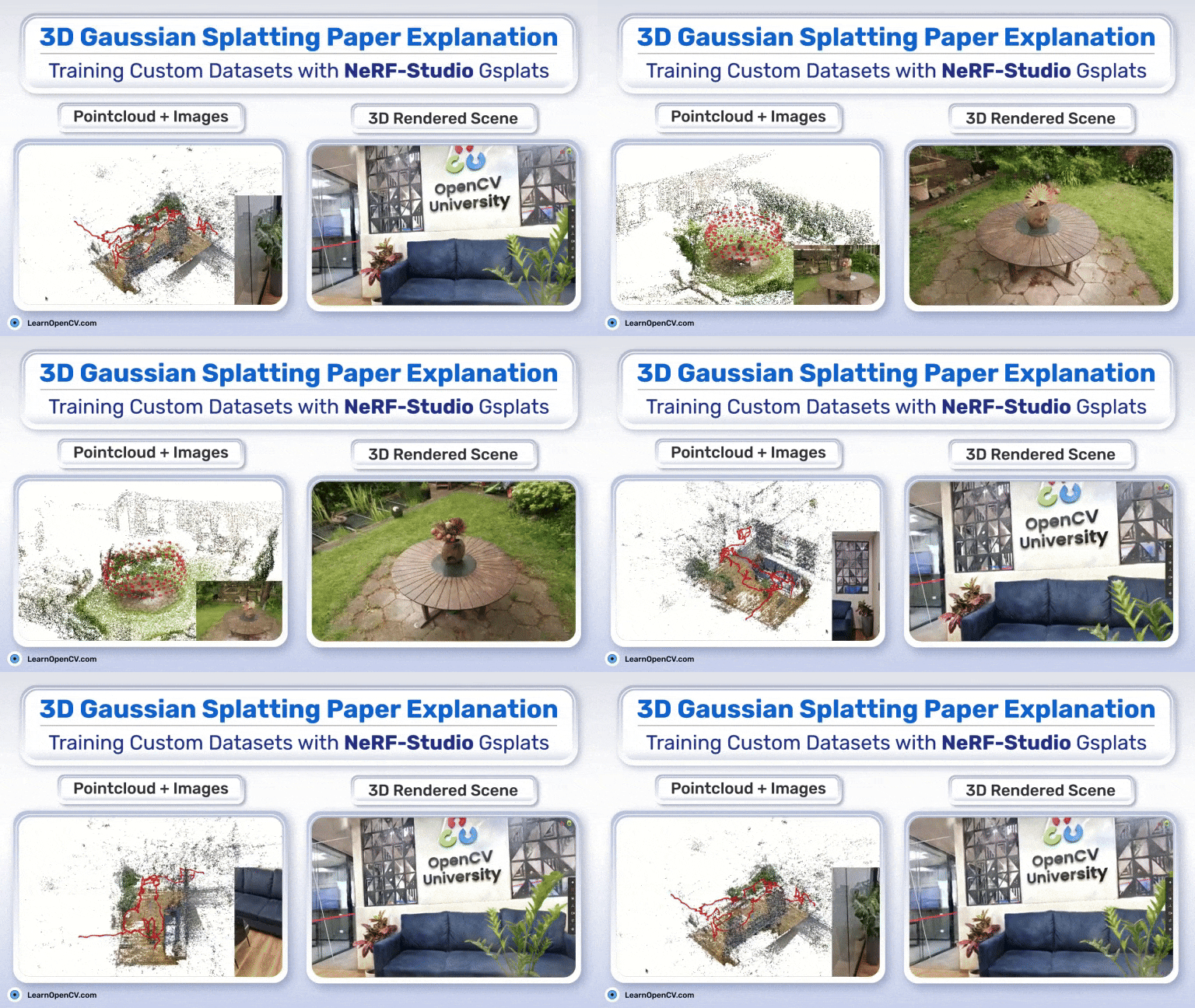
InfiniSplat, a feed-forward single-image 3D Gaussian Splatting framework, targets large-baseline novel view synthesis and was accepted to SIGGRAPH Asia 2026. The work addresses a persistent gap in single-image NVS, where wide camera baselines often break geometry and appearance predictions.
Key facts
- Accepted to SIGGRAPH Asia 2026
- Feed-forward single-image 3DGS
- Targets large-baseline novel view synthesis
- No quantitative results disclosed in source
- Paper link not yet provided in tweet
InfiniSplat, introduced via @HuggingPapers, is a feed-forward framework that predicts 3D Gaussian Splatting (3DGS) representations from a single image. The method is designed for large-baseline novel view synthesis, a setting where the target viewpoint differs substantially from the input — a regime that has historically been difficult for single-image models.
Why large-baseline matters
Most single-image NVS methods, such as those built on neural radiance fields or early 3DGS, assume small viewpoint changes. Large baselines introduce occlusions, disocclusion, and severe perspective distortion. InfiniSplat aims to handle these by predicting a full 3D Gaussian scene representation directly, rather than relying on depth-based warping or multi-view geometry. The acceptance at SIGGRAPH Asia 2026 signals peer validation, though the source tweet provides no architectural details, training data, or quantitative benchmark results — the paper itself has not yet been linked in the thread.
The 3DGS advantage
3D Gaussian Splatting, popularized by Kerbl et al. 2023, models scenes as collections of anisotropic Gaussians with explicit position, covariance, opacity, and color. Unlike NeRF's implicit volumetric rendering, 3DGS supports fast rasterization and differentiable rendering, making it a natural fit for feed-forward prediction. InfiniSplat's feed-forward design means it can generate novel views without per-scene optimization — a key differentiator from optimization-based 3DGS that requires minutes per scene.
What's missing
The tweet lacks specifics: no architecture diagram, no training dataset (e.g., RealEstate10K or DTU), no comparison against baselines like PixelNeRF or Splatter Image, and no metrics such as PSNR or SSIM. This is typical of a teaser announcement, but it limits the ability to assess the claim's strength. The community will need the full paper to verify whether InfiniSplat actually outperforms existing single-image methods on large-baseline benchmarks.
Key Takeaways
- InfiniSplat, a feed-forward single-image 3DGS framework for large-baseline NVS, was accepted to SIGGRAPH Asia 2026.
- Details are sparse, but the approach targets a known weakness in single-image view synthesis.
What to watch

Watch for the full InfiniSplat paper release, expected ahead of SIGGRAPH Asia 2026. Look for quantitative comparisons on large-baseline benchmarks like RealEstate10K, and whether the method generalizes to unseen scenes without fine-tuning. Also track if the authors release code or pretrained models, which would accelerate adoption.