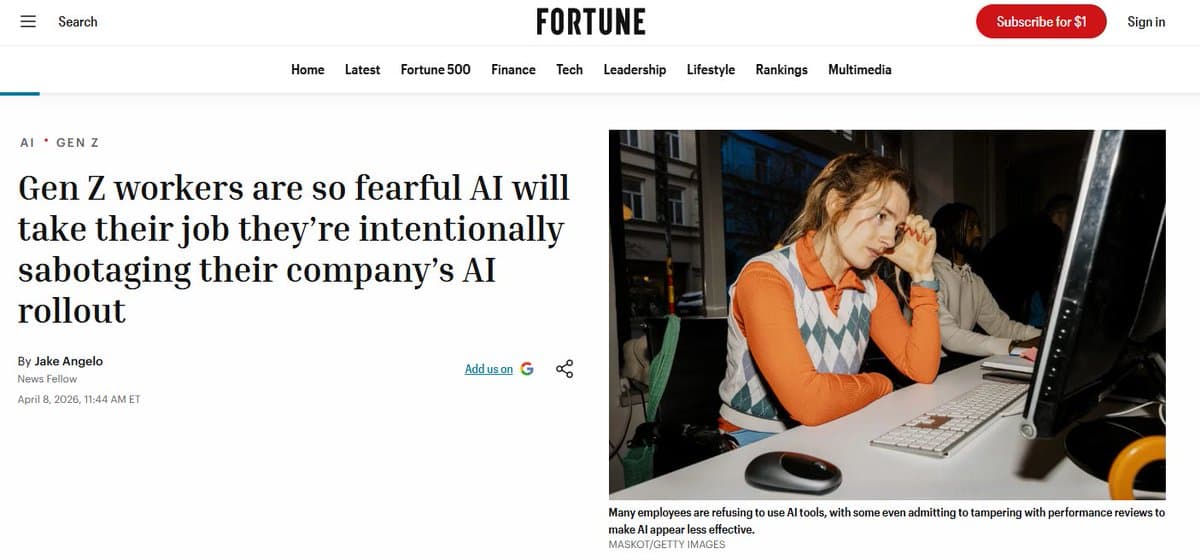
A concerning workplace dynamic is emerging as artificial intelligence becomes embedded in corporate workflows. According to a report highlighted by industry observers, Gen Z workers—driven by a palpable fear of job displacement—are actively sabotaging company AI rollouts. This resistance creates a paradoxical outcome: by hindering adoption, these employees may be making themselves more vulnerable to replacement, while colleagues who master the new tools are rewarded with promotions and greater job security.
The core tension stems from the rapid, often opaque, integration of AI agents and co-pilots into roles spanning coding, marketing, design, and administrative work. For a generation that entered the workforce during the peak of AI hype and layoff headlines, the technology represents an existential threat rather than a productivity lever.
Key Takeaways
- A new report details Gen Z workers actively undermining corporate AI adoption due to job security fears.
- This resistance paradoxically increases their replacement risk as AI-proficient 'power users' advance.
What's Happening: Resistance as a Survival Tactic
The sabotage is not typically overt system hacking. Instead, it manifests in subtler, hard-to-track forms:
- Data Starvation: Deliberately providing AI training pipelines with low-quality, incorrect, or biased data to cripple model performance.
- Workflow Obstruction: Refusing to follow new AI-augmented SOPs, or creating manual workarounds that negate efficiency gains.
- Cultural Poisoning: Spreading skepticism and fear among peers, slowing organization-wide buy-in and adoption rates.
- Silent Non-Cooperation: Simply not using the provided AI tools, then arguing the technology "doesn't work" for their tasks.
This behavior is a rational, if misguided, response to a perceived threat. The logic is simple: if the AI fails to deliver value, the company will halt its rollout and preserve traditional jobs. However, this calculus ignores a fundamental corporate reality.
The Irony: Sabotage Accelerates Replacement Risk
The report notes that while resisters stall local adoption, they cannot stop the macro-trend. Companies view AI integration as a strategic imperative for competitiveness. When a team or individual is seen as incompatible with this future, they become a candidate for restructuring.
Meanwhile, "AI power users"—often from the same generational cohort or adjacent Millennials—who lean into the technology see immediate benefits. They automate tedious portions of their work, produce higher volumes of output, and develop hybrid human-AI skills that are currently in short supply. Management rewards this behavior with visibility, promotion, and increased responsibility. In effect, the saboteurs are clearing the field for their more adaptable peers to advance.
This creates a self-fulfilling prophecy: fear of replacement leads to actions that make replacement more likely. The saboteur proves the point that a resistant employee is less valuable than a compliant AI system or an AI-augmented colleague.
The Core Problem: A Lack of "Proper Adaptation"
The source tweet argues this turmoil underscores the critical need to properly adapt AI to the working world and to build a "new post-laboratory economy." The current rollout pattern is often the problem:
- Top-Down Decree: Leadership mandates AI adoption for cost-saving or efficiency goals, directly invoking labor cost reduction.
- Poor Change Management: IT or a vendor installs a tool with minimal training, no clear employee-upskilling pathway, and vague guardrails.
- Zero-Sum Framing: The narrative becomes "AI vs. Jobs," not "AI & Humans for New Outcomes."
In this environment, sabotage is a form of grassroots pushback against a process that feels hostile to worker interests.
What This Means in Practice
For companies, this is a massive change management failure. Successful AI integration requires:
- Transparent Reskilling Guarantees: Clear, funded pathways for employees to transition into AI-supervisory or hybrid roles.
- Co-Development: Involving employees in selecting and tailoring AI tools to their real workflows.
- Measuring Augmentation, Not Just Replacement: Tying AI success metrics to team output quality and innovation, not just headcount reduction.
For workers, particularly Gen Z, the strategic imperative shifts. The highest job security lies in becoming the irreplaceable integrator—the human who knows how to guide, prompt, edit, and ethically deploy the AI. Fighting the tool itself is a losing battle; mastering its leverage is the surviving, and thriving, move.
gentic.news Analysis
This report is not an isolated data point but a symptom of the painful, uncoordinated transition into the AI-augmented workplace. It connects directly to trends we've been tracking: the rise of AI Anxiety as a measurable psychological phenomenon and the strategic corporate push for Agentic Workflows that automate entire job functions, not just tasks.
Historically, technological shifts (industrial automation, software digitization) followed a similar pattern of worker resistance, but the speed and cognitive nature of AI acceleration have compressed the timeline from decades to quarters. This aligns with our previous coverage on McKinsey's 2025 Q4 report, which predicted that up to 30% of current work hours could be automated by 2030, with clerical and entry-level knowledge work being the most exposed. Gen Z workers are on the front line of this exposure.
The emergence of "AI power users" as a new professional class also tracks with the proliferation of AI upskilling platforms like Coursera and Udacity, which have seen enterprise subscriptions spike by over 200% year-over-year. Companies are implicitly creating a two-tier system: those who are funded and encouraged to upskill, and those who are left to fear the outcome. The sabotage described is, in part, a reaction to this perceived inequity in adaptation resources.
Ultimately, this dynamic represents a critical failure in the AI Adoption Lifecycle. The "laboratory" phase of AI—focused purely on technical capability—has collided with the complex social and economic realities of the "working world." Building a stable "post-laboratory economy" will require structural thinking about job redesign, wage models, and continuous education, moving far beyond simply deploying another SaaS tool. Without this, employee resistance will remain a significant drag on the trillion-dollar productivity gains AI promises.
Frequently Asked Questions
Why are Gen Z workers specifically sabotaging AI?
Gen Z is the first generation to enter the professional workforce simultaneously with the widespread commercialization of generative AI. They have less job security, less established seniority, and are often in the entry-level roles most susceptible to automation. Their sabotage is a defensive tactic against a technology perceived as an immediate threat to their livelihood.
What does being an "AI power user" mean?
An AI power user is an employee who goes beyond basic prompting to deeply integrate AI tools into their daily workflow. They understand the strengths and limitations of models, use advanced techniques like chain-of-thought prompting or custom GPTs, and automate multi-step processes. They often achieve significantly higher output and quality, making them highly valuable during transitional periods.
Is sabotaging company AI illegal or a fireable offense?
Yes, in most cases. Deliberately undermining company systems, providing false data to corrupt processes, or willfully refusing to follow implemented work procedures can constitute gross misconduct or violation of IT policies, leading to immediate termination. It is a high-risk strategy with severe professional consequences.
How can companies roll out AI without triggering this resistance?
Successful rollouts focus on augmentation over replacement. Key steps include: co-designing tools with employee input, providing comprehensive upskilling and reskilling programs with guaranteed role transitions, clearly communicating that AI is a tool to elevate work rather than eliminate workers, and rewarding employees for successful AI integration and innovation.