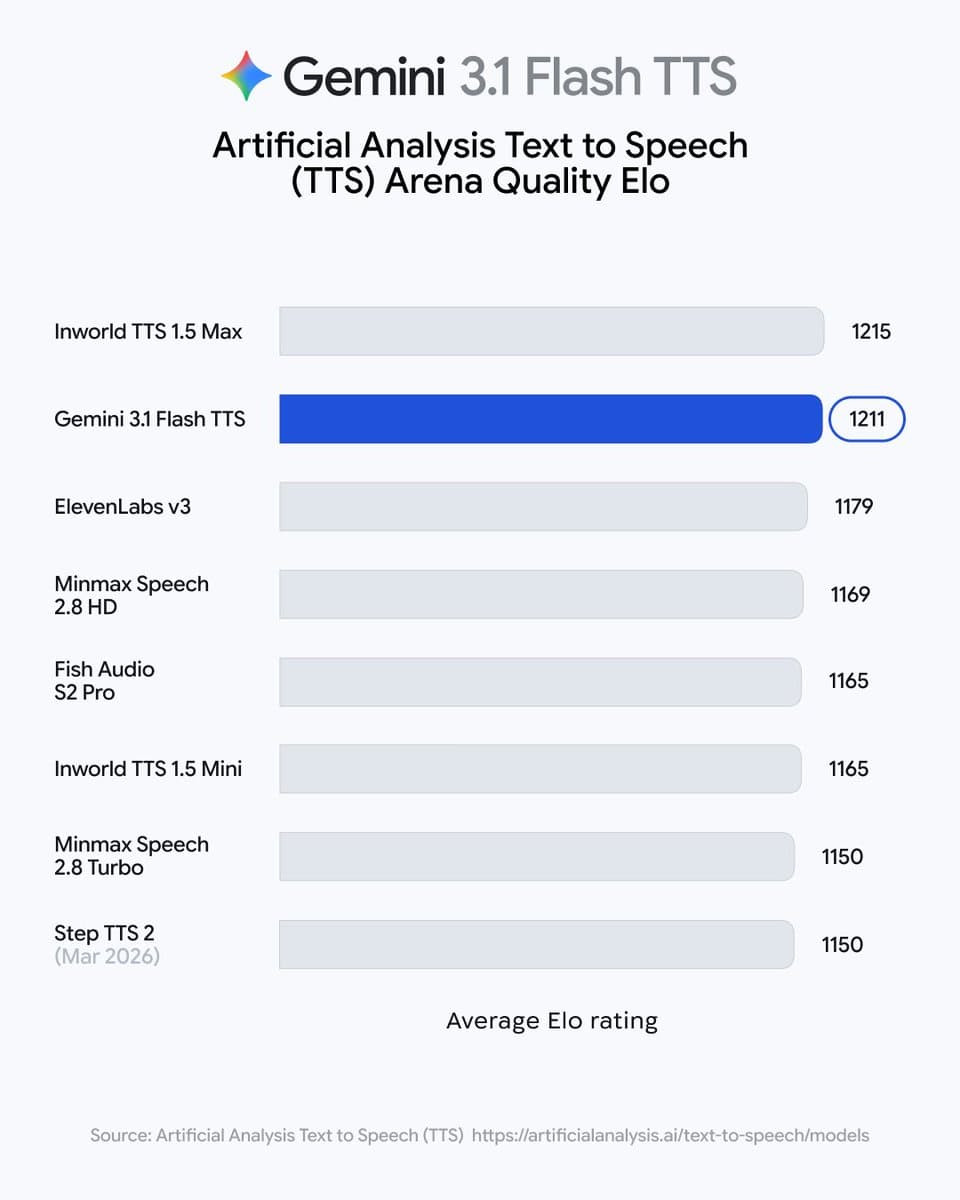
Google has released Gemini 3.1 Flash TTS, a new text-to-speech model within its Gemini API suite. The model introduces highly controllable speech synthesis via simple text prompts, more natural-sounding voices, and support for over 70 languages.
Key Takeaways
- Google has launched Gemini 3.1 Flash TTS, a text-to-speech model featuring prompt-based voice control and support for over 70 languages.
- This release expands Google's multimodal AI offerings directly to developers.
What's New
The core advancement is the prompt-based control system. Instead of relying solely on traditional SSML (Speech Synthesis Markup Language) tags or pre-defined voice profiles, developers can now use natural language instructions within the text prompt to modify speech characteristics.
For example, a prompt could be:
"Read this in a cheerful, excited tone, speaking at a fast pace: 'Welcome to the conference!'
The model interprets these descriptive cues to adjust prosody, emotion, and pacing dynamically. This represents a shift from parameter-based control to intent-based control, lowering the technical barrier for creating nuanced synthetic speech.
Technical Details
Gemini 3.1 Flash TTS is available immediately via the Google AI Studio and the Gemini API. It's positioned as a fast, cost-effective model within the Gemini 3.1 family, which also includes the larger Gemini 3.1 Pro model for general reasoning.
Key specifications from the launch include:
- Model Family: Gemini 3.1 (Flash variant)
- Primary Feature: Prompt-controlled speech synthesis
- Language Support: 70+ languages and variants
- Availability: Google AI Studio & Gemini API
- Pricing: Follows standard Gemini API TTS pricing tiers based on characters processed.
The release follows Google's pattern of deploying specialized, efficient "Flash" models for specific tasks, complementing their larger, more capable counterparts.
How It Compares
The prompt-based control directly challenges the established workflow of competitors like Amazon Polly and Microsoft Azure Neural TTS, which primarily use SSML for fine-grained control. OpenAI's voice models in ChatGPT also offer expressive voices but lack this explicit prompt-driven control layer.
Control Method Natural language prompts within text SSML markup or preset voice styles Ease of Use High (descriptive commands) Lower (requires SSML knowledge) Flexibility Dynamic interpretation of intent Precise but rigid parameter settingThis approach could simplify audio content creation for applications like audiobooks, dynamic voiceovers, and interactive agents where emotional tone needs to shift contextually.
What to Watch
Initial access is through the API. Real-world performance and the true granularity of control achievable through prompts versus dedicated SSML will be key benchmarks to watch. Developers will need to test the consistency of the model's interpretation of subjective terms like "cheerful," "authoritative," or "slow."
Google has not yet released detailed audio samples or a systematic evaluation against established TTS benchmarks like MOS (Mean Opinion Score) for this specific model. Its performance in low-resource languages among the 70+ supported will also be a critical test of its utility.
gentic.news Analysis
This launch is a strategic move by Google to capture developer mindshare in the rapidly evolving TTS space. It follows the company's February 2024 rebranding of Bard to Gemini and the subsequent release of the Gemini 1.5 models with their million-token context window. The TTS release continues the pattern of expanding the Gemini portfolio from a pure chat interface into a suite of multimodal tools.
The prompt-based control mechanism is particularly significant. It aligns with a broader industry trend of moving from complex configuration to natural language instruction as the primary interface for AI systems. We observed a similar shift with image generation models like Midjourney and DALL-E 3, where prompt engineering became central. Google is now applying that paradigm to speech synthesis.
This release also directly competes with ElevenLabs, a startup that has dominated the high-quality, controllable TTS narrative with its own prompt-based features and voice cloning. Google's entry with a similarly capable model, backed by its massive infrastructure and existing Gemini ecosystem, poses a substantial threat to standalone TTS providers. It leverages Google's existing strengths in machine translation and multilingual models to offer wide language support out of the gate.
For practitioners, the key takeaway is the lowering of the integration barrier for advanced TTS. If the prompt control works robustly, it could eliminate the need for teams to maintain complex SSML generation logic, making sophisticated audio a standard feature in more applications.
Frequently Asked Questions
What is Gemini 3.1 Flash TTS?
Gemini 3.1 Flash TTS is a new text-to-speech model released by Google as part of its Gemini AI family. Its standout feature is the ability to control speech characteristics—like tone, emotion, and speed—using simple natural language instructions written directly into the text prompt.
How do I access Gemini 3.1 Flash TTS?
The model is available now through Google AI Studio (the web-based developer tool) and the Gemini API. Developers can use it by sending text prompts to the API endpoint designated for the TTS model, following Google's published documentation.
How does prompt-based TTS control differ from using SSML?
Traditional Speech Synthesis Markup Language (SSML) is a precise, XML-like code that requires specific tags and values (e.g., <prosody rate="fast">). Gemini's prompt-based control uses descriptive language (e.g., "say this excitedly and quickly"), which is more intuitive but may offer less deterministic, pixel-perfect control compared to SSML.
What are the main use cases for this model?
Primary use cases include generating dynamic voiceovers for videos and presentations, creating more expressive dialogue for chatbots and virtual assistants, producing audiobooks with character-appropriate narration, and building accessible content in multiple languages with nuanced vocal expression.