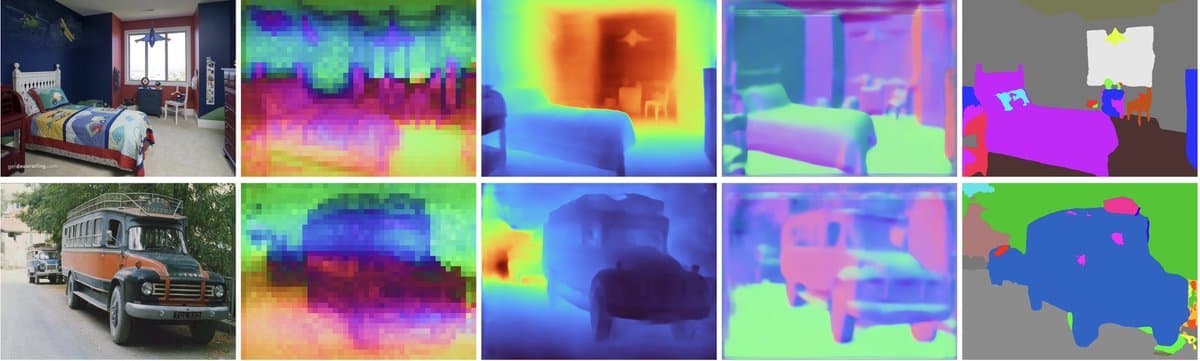
Google has released a new family of vision encoder models, TIPSv2-B/14, on the Hugging Face Hub. The models are designed for multi-task dense prediction, capable of performing depth estimation, surface normal prediction, and semantic segmentation from a single shared backbone.
Key Takeaways
- Google has released the TIPSv2-B/14 vision encoder model on Hugging Face.
- It performs three dense prediction tasks—depth estimation, surface normal prediction, and semantic segmentation—from a single backbone.
What's New

This release provides a pre-trained vision transformer (ViT) backbone, specifically a ViT-Base/14 architecture, outfitted with DPT (Dense Prediction Transformer) heads. The core innovation is its multi-task capability: a single encoder, trained on Google's proprietary TIPSv2 dataset, can generate three distinct types of dense, pixel-wise predictions:
- Depth Estimation: Predicting the distance of each pixel from the camera.
- Surface Normals: Predicting the 3D orientation (normal vector) of surfaces in the scene.
- Semantic Segmentation: Classifying each pixel into a predefined set of object categories.
This is a departure from the common practice of training separate, specialized models for each task. By using a shared encoder, the model learns a more general and robust visual representation.
Technical Details
The model card on Hugging Face indicates the architecture is built on the Vision Transformer (ViT) framework. The "B/14" denotes a Base-sized model with 14x14 patch size. The DPT heads are a well-established architecture for upsampling the transformer's token-based representations back into full-resolution, pixel-dense output maps.
Key Specifications (from model architecture):
- Backbone: ViT-Base (ViT-B/14)
- Heads: DPT (Dense Prediction Transformer) heads, one per task.
- Training Data: TIPSv2 dataset (Google-internal, details not fully public).
- Outputs: Three parallel dense prediction maps per input image.
- Framework: Available via Hugging Face
transformerslibrary.
How It Compares
Multi-task dense prediction models aim to improve efficiency and representation learning. Here’s how TIPSv2-B/14 fits into the landscape:
TIPSv2-B/14 Google Depth, Normals, Segmentation ViT-B/14 + DPT Heads Single encoder for three geometric/scene tasks DPT (Original) Intel Labs Depth, Segmentation ViT + DPT Heads Pioneered the DPT head architecture. Omnidata Carnegie Mellon Depth, Normals, Segmentation CNN-based Large-scale multi-task model on diverse 2D/3D data. Mask2Former Meta Panoptic/Instance Segmentation Transformer State-of-the-art segmentation-specific architecture.Google's release is notable for providing a ready-to-use, multi-task vision transformer. Its performance relative to state-of-the-art single-task models (like MiDaS for depth or Segment Anything for segmentation) is not benchmarked in the initial release, which is typical for an engineering-focused model drop.
What to Watch
The primary value of this release is practical utility and research facilitation. Developers and researchers can now download a single model to bootstrap projects requiring multiple scene understanding outputs without managing three separate model pipelines.
Limitations & Caveats:
- No Published Benchmarks: The Hugging Face release does not include quantitative results on standard benchmarks (e.g., NYU Depth V2, ADE20K). Performance is unknown relative to the field.
- Dataset Opacity: The TIPSv2 dataset is not publicly available. Its composition, size, and labeling methodology are unclear, making reproduction difficult.
- Task Scope: The model handles three specific tasks. It does not include other common vision tasks like object detection, image captioning, or optical flow.
In practice, this model is best suited for prototyping, as a strong baseline, or as a feature extractor where combined depth, normal, and segmentation signals are useful.
gentic.news Analysis
This release is a classic example of Google's applied research-to-engineering pipeline. It follows the pattern of taking an established research concept—multi-task learning with transformer backbones—and productizing it as a clean, usable artifact. The choice to release on Hugging Face, rather than just through an arXiv paper, signals a focus on developer adoption and ecosystem integration. It lowers the barrier to entry for using advanced multi-task vision models.
Technically, the combination of a ViT backbone with DPT heads is not novel; Intel Labs' original DPT work demonstrated this. The contribution here is the training recipe and dataset (TIPSv2). Google is effectively open-sourcing the weights of a model trained on its internal data, which is often more valuable to the community than the architecture alone. This move can be seen as a strategic effort to standardize the ecosystem around certain model families and data approaches, similar to how the release of BERT and T5 shaped NLP.
For practitioners, the key question is whether this multi-task model's performance on any single task is competitive with cutting-edge, specialized models. Given the lack of benchmarks, it's prudent to treat this as a powerful and convenient tool for multi-task applications, but not necessarily as a new state-of-the-art for depth or segmentation in isolation. Its real impact will be measured by its adoption in robotics, AR/VR, and autonomous system pipelines where fused scene geometry is critical.
Frequently Asked Questions
What is the TIPSv2 dataset?
The TIPSv2 dataset is a Google-internal dataset used to train this multi-task vision model. While its exact contents are not public, the name suggests it is a successor to an earlier TIPS dataset and is likely a large-scale collection of images annotated for depth, surface normals, and semantic segmentation. These annotations are expensive to produce, making the pre-trained weights derived from them valuable.
How do I run the TIPSv2 model from Hugging Face?
You can load and run the model using the Hugging Face transformers library. The typical workflow involves loading the AutoModel class with the specific model ID (e.g., google/tips-v2-b-14), preprocessing an image with the appropriate AutoImageProcessor, and running a forward pass. The model will output a dictionary or tuple containing the three prediction heads.
Is this model better than using three separate models?
It depends on your priority. A single multi-task model is more compute- and memory-efficient at inference time, as you run one encoder instead of three. It can also benefit from positive transfer between tasks during training. However, three separately tuned, state-of-the-art single-task models will likely achieve higher accuracy on their respective tasks if you have the resources to run them all. TIPSv2 offers a compelling trade-off: good performance across multiple tasks with the efficiency of a single model.
What are surface normals used for?
Surface normals are a fundamental representation of 3D shape. Each pixel's normal vector describes the orientation of the surface at that point. They are crucial for computer graphics tasks like relighting, shading, and 3D reconstruction, and in robotics for grasp planning and scene understanding. By predicting normals from a 2D image, this model infers 3D geometry without needing a depth sensor.