The release of Google's TITANS architecture in late 2024 marks what many researchers are calling a "theoretical inflection point" in artificial intelligence. Rather than another incremental improvement in existing paradigms, TITANS represents a fundamental rethinking of how neural networks learn, remember, and forget—drawing directly from six decades of cognitive neuroscience research to transcend the computational limits that have constrained transformer-based systems.
The Memory Crisis in Modern AI
At the heart of contemporary AI's limitations lies what researchers term "The Quadratic Wall." The transformer architecture, despite revolutionizing natural language processing and numerous other domains, contains an inherent mathematical constraint: its self-attention mechanism computes pairwise interactions between all tokens in a sequence, resulting in O(n²) complexity in both computation and memory. This isn't merely an engineering challenge to be optimized—it represents a theoretical ceiling that no amount of parameter scaling can overcome.
For context, this limitation becomes particularly problematic as AI systems attempt to handle longer sequences and more complex reasoning tasks. While techniques like sparse attention and sliding windows have provided temporary workarounds, they fundamentally compromise the architecture's ability to maintain coherent, long-range dependencies—the very capability that defines sophisticated reasoning.
Neuroscience as a Roadmap, Not Just Inspiration
What makes TITANS particularly significant is its systematic implementation of validated neuroscientific principles rather than superficial biological analogies. The architecture implements mechanisms that mirror how biological memory systems operate, including:
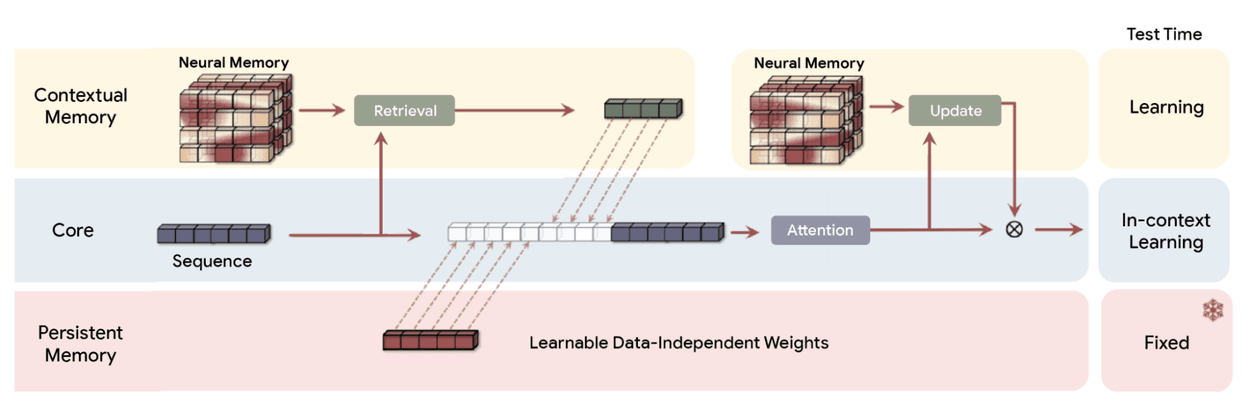
- Test-time learning capabilities that allow the system to adapt during inference, not just during training
- Selective forgetting mechanisms that prioritize important information while discarding irrelevant details
- Hierarchical memory organization that mirrors the brain's distinction between working memory and long-term storage
These features represent more than just technical improvements—they suggest a fundamental shift in how we conceptualize artificial intelligence. Rather than treating memory as a passive storage system, TITANS implements memory as an active, dynamic process that shapes and is shaped by ongoing computation.
Mathematical Foundations and Computational Implications
The mathematical structures underlying TITANS enable what researchers describe as "true adaptive memory"—systems that can learn from single experiences, integrate new information without catastrophic forgetting, and selectively retrieve relevant knowledge based on context. This stands in stark contrast to current systems that require massive datasets and extensive retraining for even minor adaptations.
From a computational perspective, TITANS addresses the quadratic scaling problem through what the research team calls "structured sparsity"—not random or heuristic sparsity, but mathematically principled sparsity that preserves the most important computational pathways while eliminating redundant ones. This approach maintains the expressive power of full attention while dramatically reducing computational requirements.
Broader Implications for AI Development
The implications of this breakthrough extend far beyond technical specifications. TITANS suggests that the most promising path toward more capable AI systems may lie not in scaling existing architectures, but in fundamentally rethinking their computational foundations based on biological principles.
For Google specifically, this development comes at a critical juncture. Following recent controversies, including a Stanford study revealing that Google had been training models on user chat data by default with inadequate opt-out mechanisms, the company faces increasing scrutiny of its AI practices. TITANS represents not just a technical achievement but potentially a strategic repositioning—demonstrating fundamental research leadership at a time when competitive pressures from OpenAI and other rivals continue to intensify.
The Path Forward: From Architecture to Intelligence
Perhaps the most profound question raised by TITANS concerns what the architecture reveals about "the gap between current architectures and genuine intelligence." The research suggests that adaptive memory—the ability to learn, remember, and forget in contextually appropriate ways—may represent a crucial missing component in current AI systems.
As AI development moves forward, TITANS points toward several important directions:
- Hybrid architectures that combine the strengths of transformers with neuroscience-inspired memory systems
- More efficient training paradigms that require less data and compute resources
- Systems capable of continual learning without catastrophic forgetting
- More transparent and interpretable AI through biologically plausible mechanisms
Conclusion: A Paradigm Shift in Progress
Google's TITANS architecture represents more than just another technical paper or research prototype. It signals a potential paradigm shift in how we approach artificial intelligence—from brute-force scaling of existing architectures to principled design based on validated scientific understanding of biological intelligence.
While the full implications will take years to unfold, TITANS already challenges fundamental assumptions about what's possible in AI development. By bridging the gap between neuroscience and machine learning, it offers a roadmap toward systems that don't just process information more efficiently, but learn, remember, and adapt in ways that begin to approach genuine intelligence.
As the AI community digests this development, one thing seems clear: the era of transformer dominance may be giving way to a more diverse ecosystem of architectures, with neuroscience-inspired approaches playing an increasingly central role in pushing beyond current limitations toward more capable, efficient, and intelligent systems.