Google's Virgo fabric uses a flat two-layer topology to synchronize 100K+ accelerators, treating tail latency as a hardware problem.
Google's Virgo Fabric: A Flatter, Faster Network for 100,000-Accelerator AI Clusters
Hyperscalers are rewriting the rules of data center networking for AI, and Google's new Virgo fabric is the latest signal. Announced as part of the AI Hypercomputer architecture, Virgo is built to connect clusters of tens of thousands of accelerators—scaling to over 100,000—with a topology that prioritizes consistent, low-latency performance over traditional peak throughput.
The design directly addresses a fundamental tension in AI infrastructure: training and inference workloads are synchronized, requiring continuous, high-volume east-west data exchange between accelerators. A single slow node can stall an entire job. Google's answer is a flatter, two-layer fabric that reduces hop counts, minimizes queuing delays, and treats tail latency as a system-level reliability risk rather than a networking side effect.
Key Numbers
- Scale: Designed for clusters of 100,000+ accelerators
- Topology: Two-layer fabric (vs. traditional three-tier Clos architectures)
- Focus: High bisection bandwidth, minimized tail latency, workload isolation
- Resilience: Multiple independent switching planes with deep telemetry for congestion detection and automatic rerouting
What's New: A Campus-as-a-Computer Philosophy
Traditional data center networks use multi-tier Clos architectures with oversubscription to balance cost and utilization. For AI workloads, that model breaks down. Sustained east-west traffic keeps links busy and exposes contention points. Google's Virgo fabric replaces the three-tier design with a two-layer topology, reducing the number of hops between any two nodes.
This flattening has direct performance implications. "Flattening reduces hop count and creates more direct, predictable paths between accelerators," said Sameh Boujelbene, vice president at Dell'Oro Group, in the source report. "Which is critical for synchronized workloads."
The design treats tail latency—the worst-case delay for a single packet—as a critical hardware reliability issue. "Google is treating that variability as a system-level risk rather than a networking side effect," said Ron Westfall, vice president and analyst at HyperFrame Research. He framed the approach as "reimagining the data center as a Campus-as-a-Computer."
Technical Details: Fewer Layers, Less Variance
The Virgo fabric is built around multiple independent switching planes. This provides redundancy and allows the network to isolate AI training traffic from other workloads, keeping large clusters synchronized. Deep telemetry monitors for congestion or failures and can reroute traffic without interrupting running workloads.
At the scale of 100,000 accelerators, localized failures are expected. The design goal is to prevent those disruptions from propagating across the cluster. Westfall noted that flattening alone isn't sufficient at larger scales—systems also depend on traffic distribution and optical interconnects to prevent congestion from concentrating as networks simplify.
How It Compares
Google's Virgo fabric enters a competitive landscape where every hyperscaler is rethinking networking for AI. Microsoft has invested in custom networking hardware and topologies for its Azure AI clusters. Amazon Web Services (AWS) uses its Elastic Fabric Adapter (EFA) and custom networking for AI training. Meta has developed its own AI-optimized network designs for its large-scale research clusters.
Google's approach with Virgo is notable for its explicit focus on tail latency as a hardware reliability problem. Rather than treating network performance as an average metric, the design aims to minimize variability—the worst-case delay that can stall a synchronized training step. This aligns with the broader industry recognition that AI networking must be deterministic, not just fast.
What to Watch
While the design principles are clear, Google has not released detailed performance benchmarks for Virgo. The claim of scaling to 100,000+ accelerators is ambitious; maintaining low latency and high bisection bandwidth at that scale will require careful implementation. The reliance on optical interconnects and traffic distribution mechanisms will be critical to making the flattening approach work.
Another open question is how Virgo integrates with Google's TPUv8 accelerators. As we reported on April 29, 2026, "TPUv8 demand highlighted as key driver for Google Cloud growth during earnings." The Virgo fabric is explicitly part of the AI Hypercomputer architecture, which includes TPUs, GPUs, and the software stack to orchestrate them. The combination of TPUv8 and Virgo could give Google a significant advantage in training large models efficiently.
gentic.news Analysis
Google's Virgo fabric is a direct response to the networking bottleneck that has become the critical path for scaling AI training. The insight is straightforward: at 100,000 accelerators, the network is no longer a passive transport layer—it is an active participant in every training step. Treating tail latency as a hardware reliability issue is a conceptual shift that aligns with how AI practitioners already think about distributed training. In practice, this means Google is designing networks with the same rigor as compute accelerators.
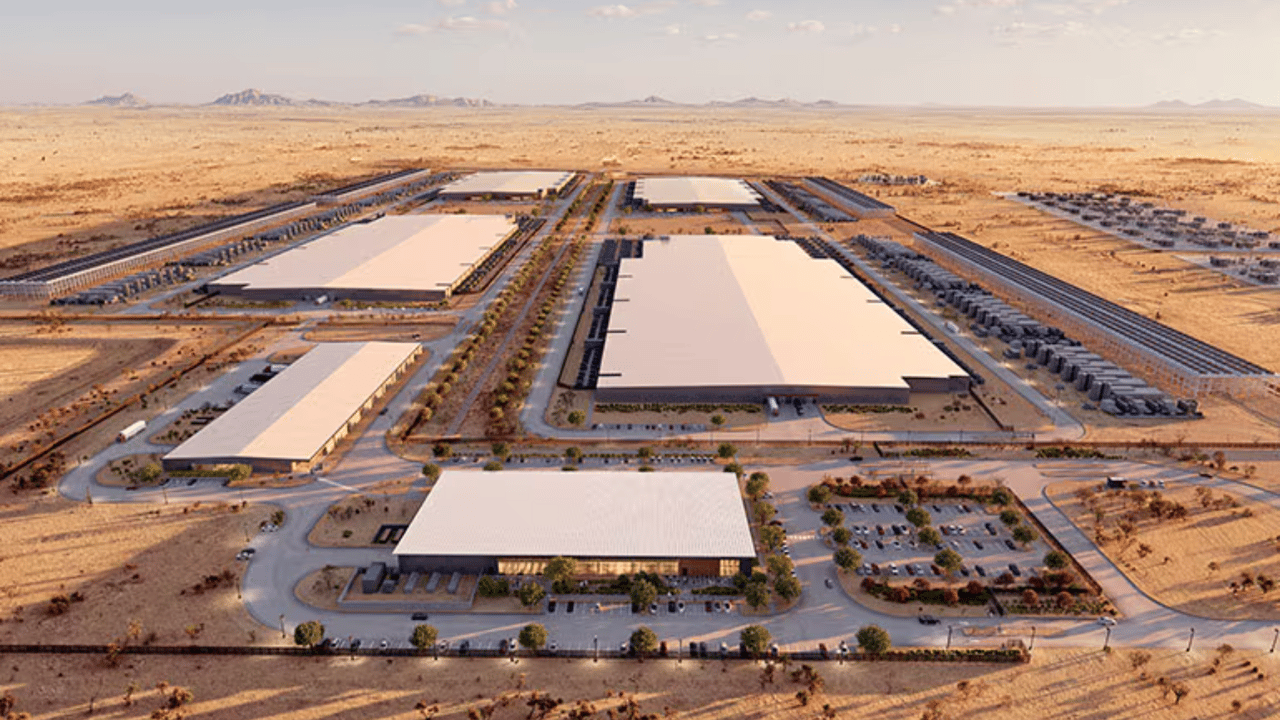
This move follows a pattern we've observed across Google's infrastructure investments. On April 28, 2026, we covered Google breaking ground on a $15 billion data center in India and a $5 billion Texas data center for Anthropic. These are not just capacity builds—they are designed to support the kind of AI-optimized networking that Virgo represents. The Texas facility, in particular, is notable for its scale and its role in supporting Anthropic's training workloads, which will likely benefit from Google's networking expertise.
The timing is also significant. Google recently signed a Pentagon AI deal for classified work, reversing its 2018 stance on military AI contracts. For defense and enterprise customers, the reliability guarantees built into Virgo—multiple switching planes, deep telemetry, automatic failure rerouting—are directly relevant. A fabric that treats network failures as expected and handles them transparently is a prerequisite for mission-critical AI deployments.
Competitively, this puts pressure on other hyperscalers to match the latency guarantees that Virgo promises. If Google can deliver consistent performance at 100,000-accelerator scale, it raises the bar for what enterprises expect from cloud AI infrastructure. The next phase of the AI infrastructure race will be won not just on compute density, but on network determinism.
Frequently Asked Questions
What is Google's Virgo fabric?
Virgo is a data center network fabric designed by Google for large-scale AI clusters. It uses a flatter, two-layer topology to reduce latency and increase bandwidth, supporting up to 100,000 accelerators in a single cluster.
How does Virgo differ from traditional data center networks?
Traditional data center networks use multi-tier Clos architectures with oversubscription. Virgo replaces this with a two-layer design that reduces hop counts and minimizes queuing delays, making it better suited for synchronized AI training workloads that require consistent, low-latency communication.
Why is tail latency important for AI training?
AI training workloads are synchronized—every accelerator in a cluster must complete its computation before the next step can begin. A single slow packet (tail latency) can stall the entire job. Virgo treats tail latency as a hardware reliability issue, designing the network to minimize variability.
Will Virgo be available to Google Cloud customers?
Yes, Virgo is part of Google's AI Hypercomputer architecture, which is offered through Google Cloud. Customers using TPUv8 or GPU clusters on Google Cloud will likely have access to Virgo-based networking for their training workloads.