In a significant development for the AI agent ecosystem, an anonymous developer has open-sourced Headroom, a context optimization layer that promises to dramatically improve the efficiency and cost-effectiveness of AI applications. Positioned as a drop-in solution requiring zero code changes, Headroom addresses one of the most persistent challenges in deploying large language models: context window management.
The Context Problem in Modern AI
As AI agents become increasingly sophisticated, they frequently need to process massive amounts of information—search results, log files, conversation histories, and tool outputs—that can quickly exceed the context limits of even the most capable LLMs. This limitation forces developers to implement complex workarounds, often sacrificing either performance or functionality.
Traditional approaches to context management have included manual summarization, selective inclusion of information, or simply truncating inputs. Each method comes with trade-offs: manual approaches require significant engineering effort, while automated truncation risks losing critical information. Headroom aims to solve this problem systematically through intelligent compression.
How Headroom Works: Three Core Components
Headroom operates as a proxy layer between applications and LLM providers, implementing three key technologies:
1. SmartCrusher: Intelligent Context Compression
The most revolutionary component, SmartCrusher, analyzes tool outputs and other context to identify and preserve what matters while compressing or eliminating noise. According to benchmarks, it achieves 70-90% compression on structured data like search results and log files while maintaining errors, anomalies, and relevant items.
This selective compression is particularly valuable for agent workflows where tools might return extensive data. For example, when processing 1,000 search results (approximately 45,000 tokens), SmartCrusher reduces this to just 4,500 tokens with only 2 milliseconds of overhead.
2. CacheAligner: Stabilizing Prefixes for Better Caching
CacheAligner addresses a subtle but significant performance issue: LLM providers often implement caching based on input prefixes, but variations in how prompts are constructed can prevent this caching from activating. By standardizing prefixes, CacheAligner enables provider caching to work effectively, potentially delivering up to 10x performance improvements.
3. RollingWindow: Managing Context Limits Intelligently
RollingWindow manages the inevitable scenario where context exceeds model limits. Unlike simple truncation, this component ensures that tool calls aren't broken and responses aren't orphaned when context windows roll over, maintaining the integrity of agent interactions.
Implementation Simplicity
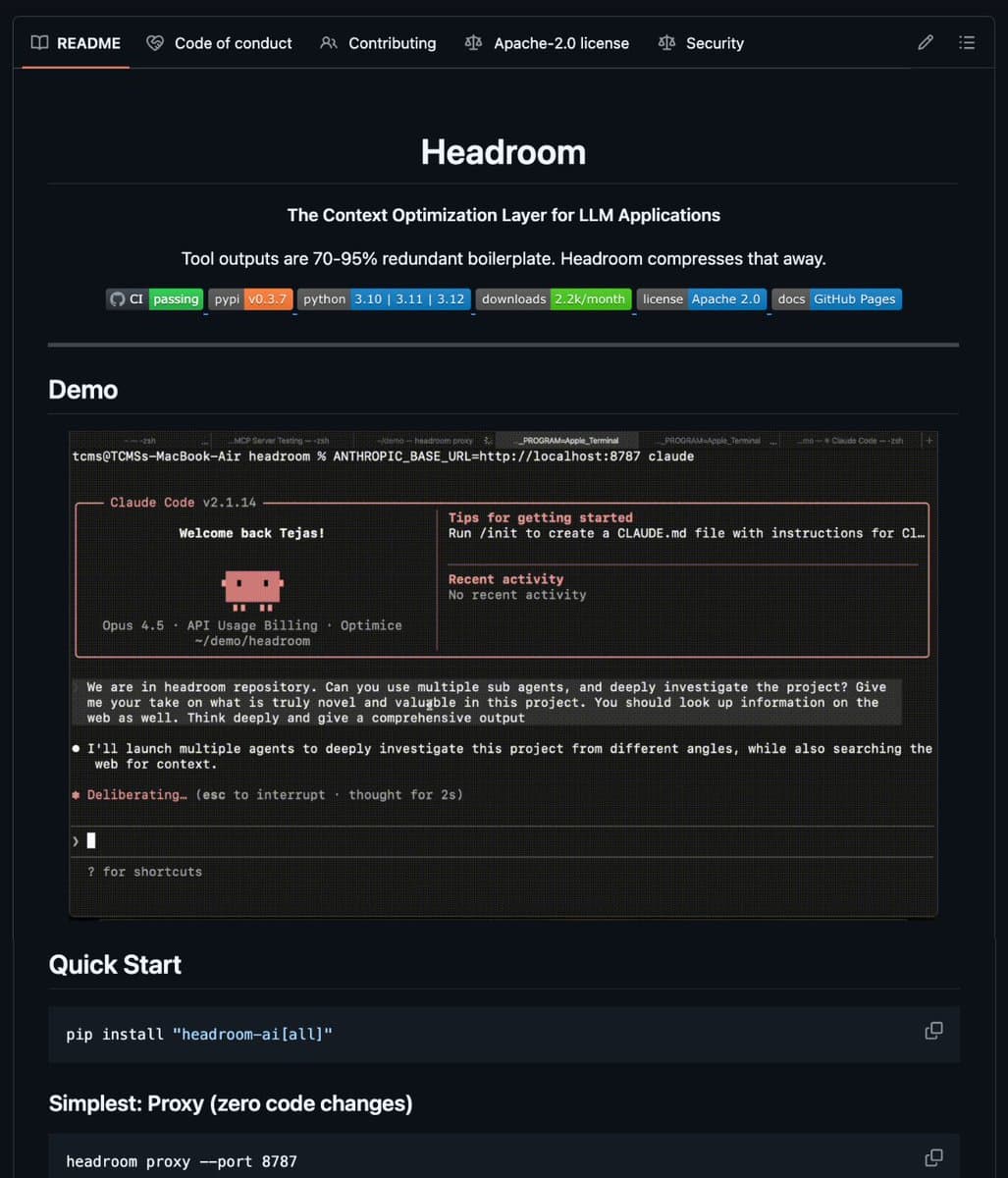
Perhaps Headroom's most compelling feature is its implementation simplicity. Developers can integrate it by simply changing their API endpoint:
ANTHROPIC_BASE_URL=http://localhost:8787 claude
This zero-code approach means existing Claude Code sessions and agent loops can benefit from automatic compression without any modifications to application logic. The system works with major LLM providers including Claude, OpenAI, Gemini, Mistral, Cohere, and any LiteLLM-compatible service.
Real-World Performance Metrics
The published benchmarks demonstrate substantial efficiency gains:
- 1,000 search results: 45,000 tokens → 4,500 tokens (90% savings, ~2ms overhead)
- 500 log entries: 22,000 tokens → 3,300 tokens (85% savings)
- 50-turn conversation: 80,000 tokens → 32,000 tokens (60% savings)
These numbers suggest potentially dramatic cost reductions for applications that process large volumes of data through LLMs, where token costs can quickly become prohibitive.
Open Source Philosophy and Licensing
Headroom has been released under the Apache 2.0 license, making it freely available for both commercial and non-commercial use. This open-source approach could accelerate adoption and community contributions, potentially leading to rapid improvements and adaptations for specific use cases.
The decision to open-source such a potentially valuable technology reflects a growing trend in the AI community toward democratizing access to foundational infrastructure, similar to how frameworks like LangChain and LlamaIndex have lowered barriers to agent development.
Implications for the AI Ecosystem
Headroom's emergence comes at a critical moment in AI development. As agents become more capable and autonomous, their hunger for context grows correspondingly. Solutions that can intelligently manage this context without sacrificing functionality could determine which applications scale successfully.
For enterprise applications, the cost implications alone are significant. A 90% reduction in token usage for data-intensive operations could make previously marginal applications economically viable. For research and development teams, the ability to process more information within context limits could accelerate experimentation and iteration cycles.
Technical Considerations and Limitations
While Headroom's benchmarks are impressive, several questions remain unanswered in the initial announcement. The compression algorithms' behavior with different data types, potential edge cases in information preservation, and long-term maintenance plans will determine its suitability for production environments.
The system's effectiveness likely depends on the structure and predictability of the data being processed. Highly unstructured or novel data formats might present challenges for the compression algorithms. Additionally, the overhead measurements (2ms in the search results example) will need verification across different hardware configurations and network conditions.
The Future of Context Optimization
Headroom represents a new category of AI infrastructure: specialized middleware that optimizes interactions between applications and foundation models. As the AI stack matures, we can expect more such focused solutions addressing specific bottlenecks in the development and deployment pipeline.
Future developments might include:
- Adaptive compression strategies that learn from application patterns
- Integration with vector databases and other retrieval systems
- Specialized optimizations for particular domains (legal, medical, technical)
- Collaborative filtering approaches that leverage anonymized usage data
Getting Started with Headroom
Developers interested in experimenting with Headroom can find the repository through the link in the original announcement. Given its proxy architecture and simple setup, initial experimentation requires minimal investment. The Apache 2.0 license allows for both evaluation and production use without licensing concerns.
As with any new infrastructure component, thorough testing in staging environments is recommended before deployment to production systems, particularly for applications where information integrity is critical.
Source: Original announcement by @hasantoxr on X/Twitter