In a significant advancement for artificial intelligence research, scientists have developed a groundbreaking framework for multi-level meta-reinforcement learning with skill-based curriculum learning, addressing one of the most persistent challenges in sequential decision making. The research, detailed in arXiv:2603.08773, presents an efficient method for systematically inferring and leveraging hierarchical structure in complex problems where sub-tasks must be assembled to accomplish sophisticated goals.
The Hierarchical Compression Breakthrough
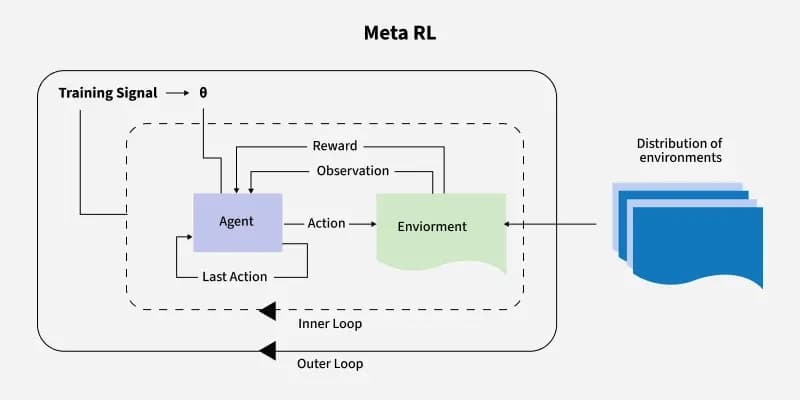
At the core of this innovation is a multi-level procedure that repeatedly compresses Markov decision processes (MDPs) – the mathematical framework used to model decision-making in reinforcement learning. The method treats parametric families of policies at one level as single actions in compressed MDPs at higher levels, while preserving the semantic meanings and structure of the original problem.
This hierarchical compression mimics natural logic for addressing complex MDPs, creating higher-level MDPs that are themselves independent with reduced stochasticity. As noted in the research, "Higher-level MDPs are themselves independent MDPs with less stochasticity, and may be solved using existing algorithms." This coarsening of spatial or temporal scales at higher levels makes finding long-term optimal policies dramatically more efficient.
Decoupling Complexity and Reducing Search Space
The multi-level representation delivered by this procedure achieves several critical advantages. First, it decouples sub-tasks from each other, allowing for more focused learning. Second, it "greatly reduces unnecessary stochasticity and the policy search space, leading to fewer iterations and computations when solving the MDPs." This reduction in computational complexity represents a major breakthrough for scaling reinforcement learning to more complex real-world problems.
Skill Factorization and Transfer Learning
A second fundamental aspect of this work involves the factorization of policies into embeddings (problem-specific components) and skills (including higher-order functions). This separation creates unprecedented transfer opportunities for skills across different problems and different hierarchical levels. Skills learned in one context can be adapted and reused in entirely different domains, accelerating learning and reducing the need for extensive retraining.
Curriculum Learning Integration
The entire process is framed within curriculum learning, where a teacher organizes the student agent's learning process to gradually increase task difficulty while promoting transfer across MDPs and levels. This structured approach to skill acquisition mirrors how humans learn complex tasks – starting with fundamental skills and progressively combining them into more sophisticated capabilities.
The researchers demonstrate that "the consistency of this framework and its benefits can be guaranteed under mild assumptions," providing theoretical grounding for the practical applications demonstrated in their experiments.
Practical Applications and Demonstrations
The paper includes demonstrations of abstraction, transferability, and curriculum learning in various examples, most notably MazeBase+, a more complex variant of the MazeBase environment. These experiments showcase how the framework enables AI agents to master intricate navigation and problem-solving tasks that would be computationally prohibitive with traditional reinforcement learning approaches.
Implications for AI Development
This research represents a significant step toward more human-like learning in artificial intelligence systems. By enabling hierarchical decomposition of complex problems and facilitating skill transfer across domains, the framework addresses fundamental limitations in current reinforcement learning approaches. The ability to systematically infer hierarchical structure from complex tasks could accelerate progress in robotics, autonomous systems, and other domains requiring sophisticated sequential decision-making.
Future Directions and Industry Impact
While the research is currently in preprint form on arXiv (an open-access repository of electronic preprints), its implications are substantial for both academic research and industrial applications. Companies like Meta, which has invested heavily in AI research and development, could potentially leverage such hierarchical approaches to improve their AI systems' capabilities in complex environments.
The framework's emphasis on curriculum learning and skill transfer aligns with broader trends in AI toward more efficient learning paradigms that require less data and computation while achieving greater generalization capabilities.
Source: arXiv:2603.08773, "Multi-level meta-reinforcement learning with skill-based curriculum" (Submitted March 9, 2026)