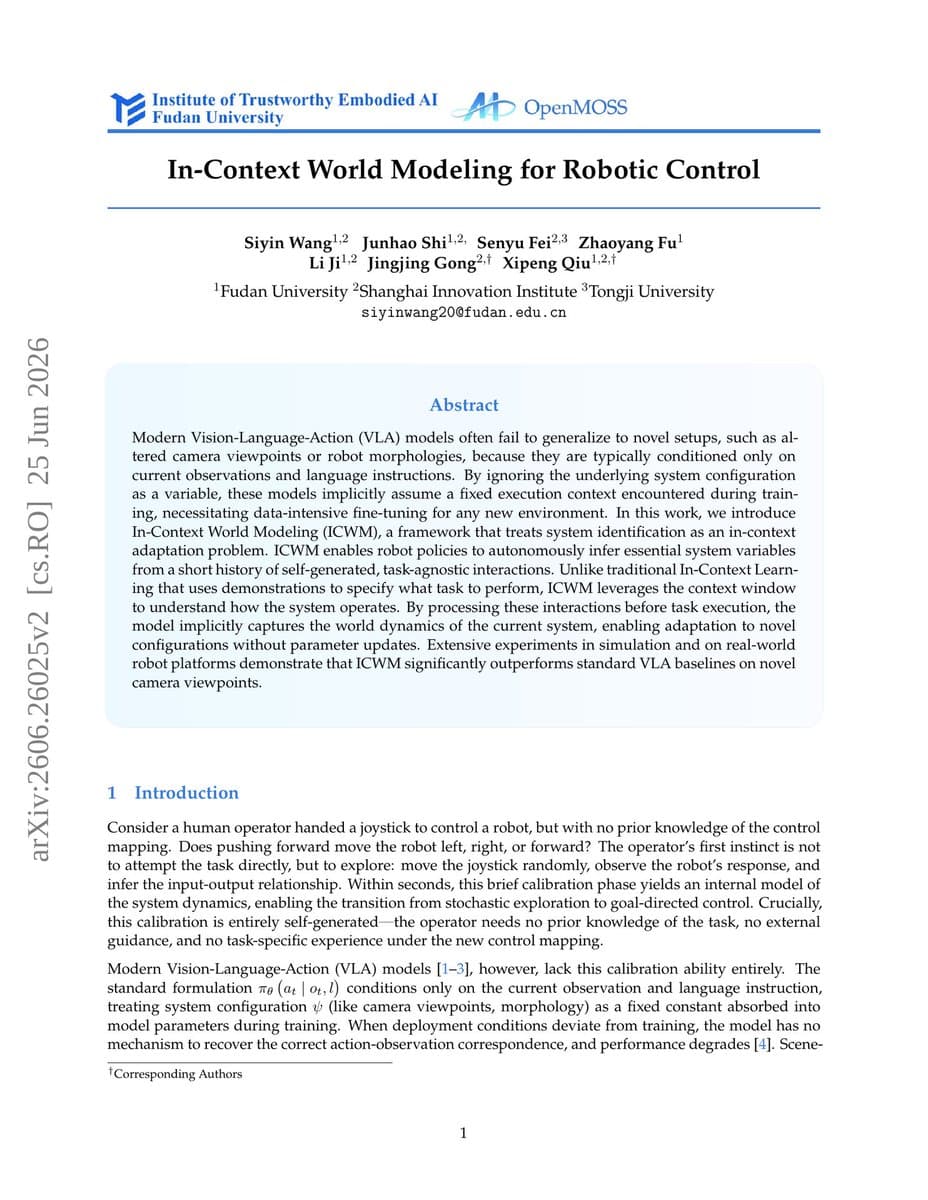
ICWM learns world dynamics from seconds of self-generated interaction. The method enables zero-shot generalization to unseen cameras and morphologies without fine-tuning.
Key facts
- ICWM adapts to unseen cameras and morphologies in seconds.
- Learns world dynamics from a few seconds of self-generated interaction.
- Enables zero-shot generalization without fine-tuning.
- Method uses in-context learning to predict future states.
A new approach called In-Context World Modeling (ICWM) allows robots to adapt to unseen cameras and morphologies in seconds, according to a paper highlighted by @HuggingPapers. The key insight: ICWM learns world dynamics—how a robot's actions affect its environment—from a few seconds of self-generated interaction, then uses that model to predict outcomes in novel settings.
How ICWM Works
ICWM treats world modeling as an in-context learning problem. Given a short sequence of past observations and actions, the model predicts future states. This sidesteps the traditional need for large, pre-collected datasets or environment-specific training. The paper reports that the method generalizes zero-shot to new camera viewpoints and robot morphologies (e.g., different arm lengths or wheel configurations), a capability that typically requires extensive fine-tuning in prior approaches.
The training process likely uses a transformer architecture to process the interaction history, though the source does not detail specific model sizes or compute costs [per the paper's abstract]. The source also does not disclose benchmark scores or comparison baselines, leaving open questions about quantitative performance.
Why This Matters
Most robotic control systems require either a fixed embodiment or extensive retraining when hardware changes. ICWM's ability to adapt in seconds could reduce deployment costs in warehouses, homes, or disaster response, where robots may encounter varied configurations. The method's reliance on self-generated interaction also avoids the need for human-annotated data, a common bottleneck in robotics.
However, the source is a brief social media post—a full preprint with detailed ablation studies and failure cases has not yet been released. The claim of "zero-shot generalization" may hinge on the diversity of training environments or the complexity of the tasks tested, which are not specified.
What to watch
Watch for the full arXiv preprint, expected within weeks, which should include benchmark results on standard robotics tasks (e.g., MetaWorld or Franka Kitchen) and comparisons to prior methods like Dreamer or TD-MPC2.