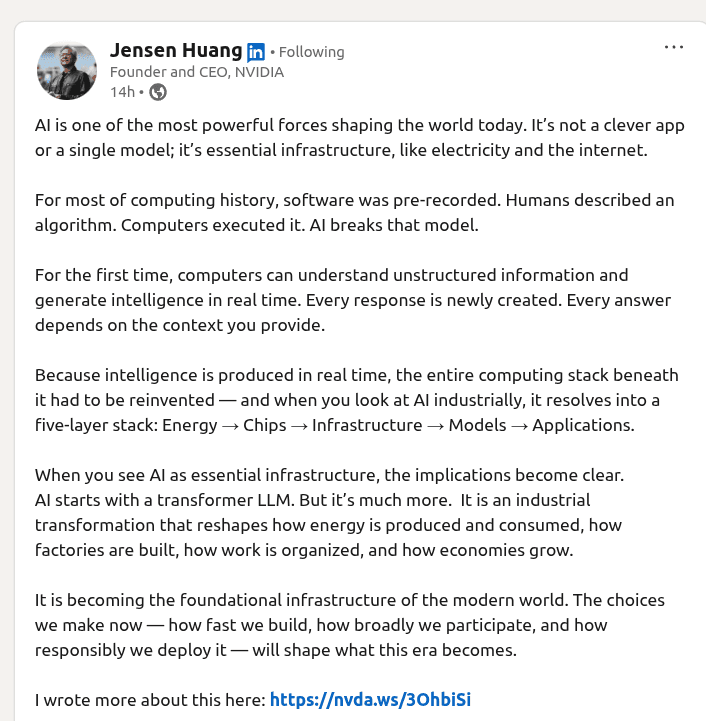
Nvidia CEO Jensen Huang has published a groundbreaking framework that reimagines artificial intelligence not merely as software or algorithms, but as comprehensive industrial infrastructure. In a detailed LinkedIn post and accompanying blog, Huang introduces what he calls the "5-layer cake" of AI, positioning the technology alongside electricity and the internet as fundamental infrastructure for the modern world.
The Five-Layer Framework
Huang's framework presents AI as a vertically integrated stack with five distinct layers, each dependent on the layers beneath it:
1. Energy - "The absolute bottom layer of this system is energy because creating artificial intelligence requires burning electricity constantly." Huang emphasizes that AI's computational demands make energy the foundational resource, much like electricity powers industrial systems.
2. Chips - "Sitting right above the power supply are the chips which act as the engines that actually turn that electricity into massive mathematical calculations." This layer represents the specialized hardware that converts energy into computational power.
3. Infrastructure - "You then need massive physical infrastructure like land, heavy cooling pipes, and complex networking cables to connect 10,000s of these chips together." Huang highlights the physical requirements of large-scale AI deployment, from data centers to cooling systems.
4. Models - "This giant hardware base runs the software models that can actually understand things like human language, complex biology, and basic physics." This layer encompasses the AI algorithms and neural networks that process information.
5. Applications - "The very top layer consists of the actual user applications like self-driving cars or medical software where businesses finally make money from all this setup." This represents the consumer and enterprise-facing products built on the underlying AI infrastructure.
The Infrastructure Mindset
Huang's central thesis is that "intelligence is produced in real time," requiring the entire computing stack beneath it to be reinvented. He argues that "when you look at AI industrially, it resolves into a five-layer stack" that mirrors how we understand other essential infrastructure like power grids or telecommunications networks.
This perspective represents a significant shift from viewing AI primarily as software or algorithms. By framing AI as infrastructure, Huang emphasizes its systemic nature and the interdependence of its components. "Every successful program at the top puts a heavy load on every single layer beneath it all the way down to the original power plant," he notes, highlighting how applications create cascading demands throughout the stack.
Implications for Industry and Policy
The infrastructure framework has profound implications for how companies, investors, and governments approach AI development:
Investment Priorities - Understanding AI as infrastructure suggests that investments should flow not just to application developers, but throughout the stack, particularly to energy and hardware layers that enable everything above them.
Strategic Planning - Companies building AI applications must consider their dependencies on lower layers, from chip availability to energy costs and sustainability.
Policy Considerations - Governments need to approach AI policy holistically, addressing everything from energy infrastructure to chip manufacturing to data center regulations.
Competitive Dynamics - The framework reveals potential bottlenecks and strategic advantages at different layers, with companies like Nvidia positioned at the critical chip layer.
The Energy Imperative
Huang's emphasis on energy as the foundational layer reflects growing awareness of AI's substantial power requirements. As AI models grow larger and more complex, their energy consumption has become a critical concern for both economic and environmental reasons. This layer includes not just electricity generation, but also distribution, efficiency, and sustainability considerations.
From Theory to Practice
While Huang's framework is conceptual, it reflects Nvidia's strategic positioning across multiple layers of the AI stack. The company dominates the chip layer with its GPUs, provides infrastructure solutions through its data center offerings, supports model development through its software platforms, and enables applications through its ecosystem partnerships.
The "5-layer cake" model provides a useful mental model for understanding the AI industry's structure and dependencies. It helps explain why certain companies have strategic advantages, why certain bottlenecks occur, and where future innovations might have the greatest impact.
As AI continues to transform industries and societies, Huang's infrastructure perspective offers a valuable framework for thinking about its development, deployment, and governance. By recognizing AI as essential infrastructure rather than just another technology, we can better prepare for its integration into our economic and social systems.