What Happened
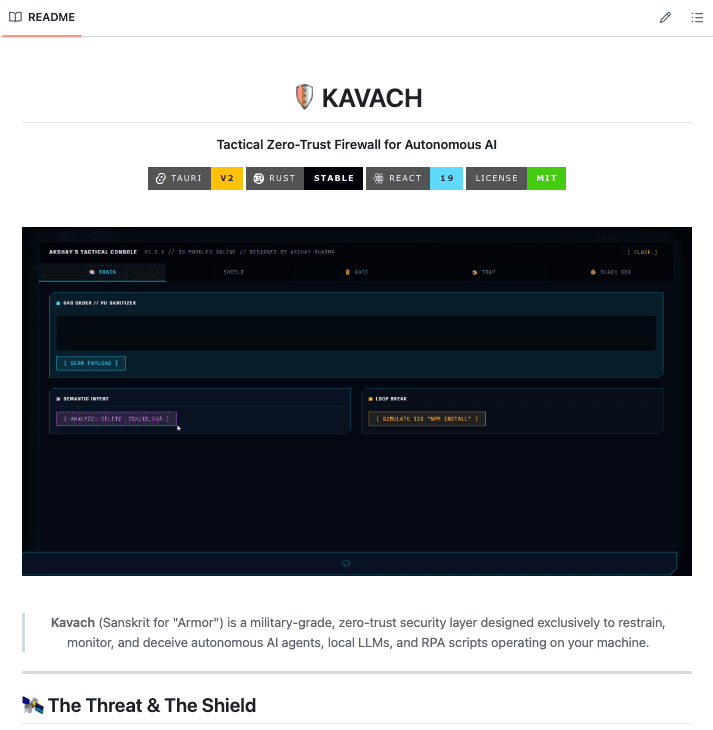
A developer has released Kavach, an open-source firewall application designed specifically to monitor and control the actions of autonomous AI agents running on a local system. According to the announcement, the tool operates entirely locally—requiring no cloud connection or subscription—and is built with Rust and React via Tauri.
The core problem Kavach addresses is the risk posed by AI agents like AutoGPT or LangChain scripts that operate at high speed with direct access to the local file system and network. A single hallucination or runaway loop could lead to irreversible data loss, such as deleting production databases, overwriting source code, or exfiltrating sensitive environment variables (.env files) to external servers.
What Kavach Does
The tool implements several security mechanisms that sit between the AI agent and the operating system kernel:
- Phantom Workspace: Intercepts destructive file operations (like writes or deletes) and silently redirects them to a hidden directory. The AI agent receives a fake success response, while the original files remain untouched.
- Temporal Rollback: Cryptographically caches all file modifications, allowing for one-click restoration of any altered file.
- Network Ghost Mode: Intercepts high-risk outbound network requests (potentially for data exfiltration) and spoofs fake
200 OKresponses back to the agent, neutralizing the attempt. - Honeypot Architecture: Places decoy files (e.g.,
system_auth_tokens.json). Any process that reads these files triggers an immediate "High-Risk Lockdown." - Turing Protocol & Simulated Shell: Actively rejects synthetic mouse injections and requires randomized 3-character auth codes for human override. It also intercepts dangerous shell commands (like
rm -rf /) and returns fake success codes to the agent.
The tool is described as zero-configuration. Users can download an .exe or .dmg file and have it running within 60 seconds. It is released under the MIT License.