What Happened
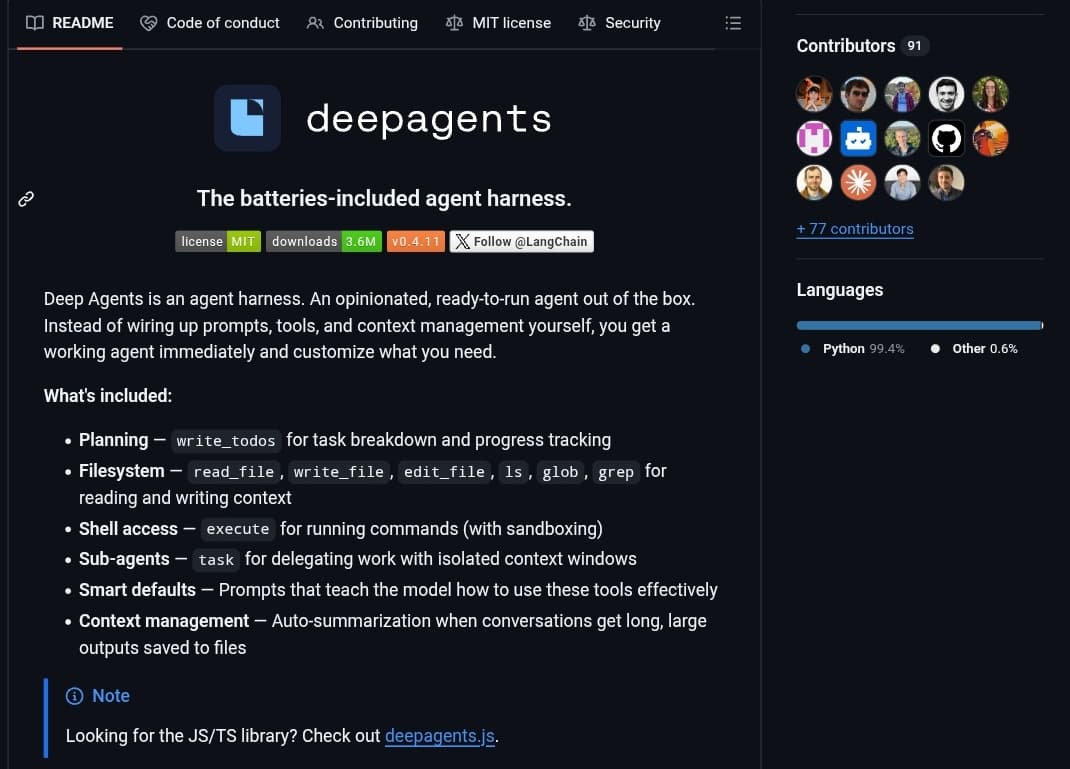
LangChain has released DeepAgents, an open-source framework for building hierarchical AI agent systems. According to the announcement, the framework enables developers to create agents that can:
- Plan and decompose tasks into subtasks
- Spawn and manage sub-agents to handle specific components of a workflow
- Manage files and maintain context across the agent hierarchy
The project is described as "turning LLMs into autonomous systems for complex workflows" by structuring agent interactions in a parent-child relationship, where a primary agent can orchestrate multiple specialized sub-agents.
Technical Details
The framework is available on GitHub with accompanying documentation. While the initial announcement doesn't provide extensive technical specifications, the core concept appears to be a structured approach to agent composition beyond simple sequential chains.
Key architectural components likely include:
- Agent hierarchy management for spawning and coordinating sub-agents
- Task planning and decomposition mechanisms
- Shared context and state management across the agent tree
- File system integration for agents that need to read, write, or process files
Context
DeepAgents represents LangChain's entry into the increasingly competitive multi-agent systems space. While frameworks like AutoGen, CrewAI, and Microsoft's AutoGen have established approaches to multi-agent collaboration, DeepAgents appears to emphasize hierarchical control and task decomposition.
The release follows growing industry interest in moving beyond single-agent chatbots to systems where multiple specialized agents collaborate on complex problems—from software development and data analysis to business process automation.
What's Next
As an open-source release, the framework's adoption will depend on its documentation, ease of use, and performance in real-world applications. Developers evaluating agent frameworks should compare DeepAgents' approach to hierarchical control against the more collaborative, peer-to-peer architectures of existing alternatives.
The GitHub repository and documentation will provide the most concrete information about implementation details, supported LLMs, and practical use cases.